


Albuquerque opens new $25M quantum lab in innovation district
Corban Tillemann-Dick demonstrated the Maybell dilution refrigerator that stood on display at Tuesday’s ribbon-cutting. He showed how the machine works and why quantum computing cannot proceed without the quiet it holds.
“The reason you need a refrigerator like this for quantum computing is that when you are directly manipulating quantum states, you need the environment to be incredibly quiet,” Tillemann-Dick said. “So the vibration of atoms themselves, the formation of quasi-particles, all of the noise of the universe that we live in, will disrupt these fragile quantum states.”
A quantum computer processes information using quantum states rather than the simple on-or-off bits of an ordinary machine. Its basic unit is the qubit, a fragile quantum bit that can exist in a combination of states known as superposition until it is measured. When a physical qubit is not sufficiently isolated from its surroundings, it suffers decoherence, which introduces noise and error into the calculation. Heat and the ordinary vibration of matter break that isolation, so the processors that manipulate those states demand extreme cold. The refrigerator reaches about 460 degrees below zero, roughly 500 times colder than deep space.
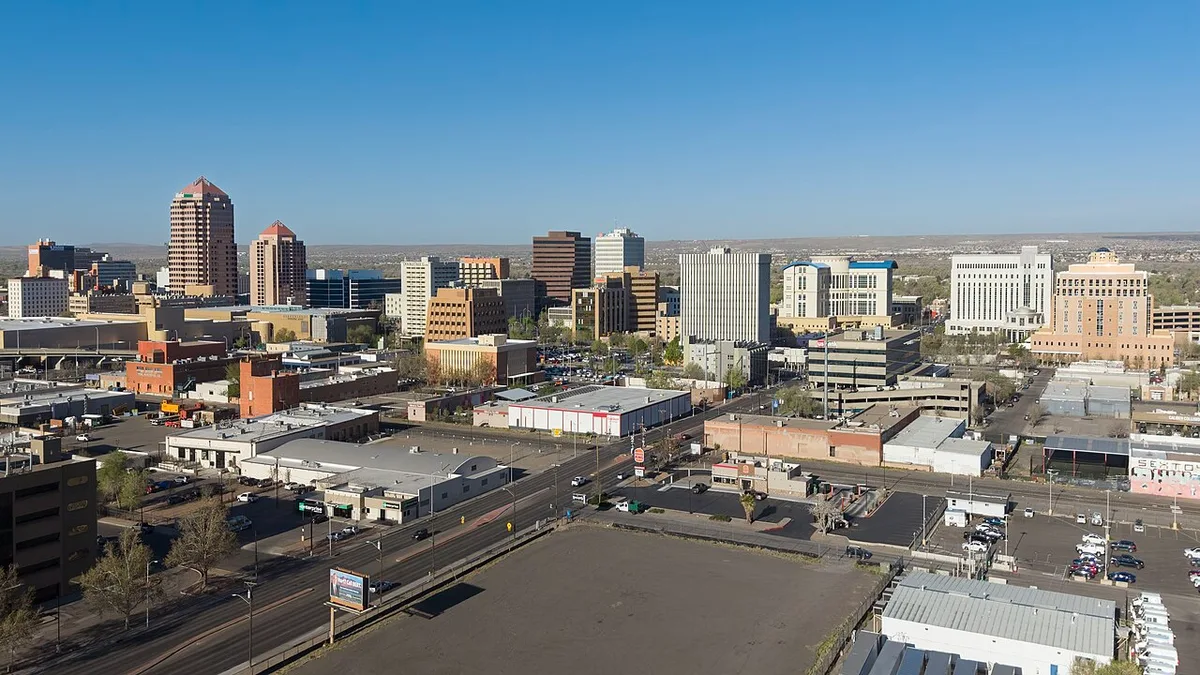
The Roadrunner Quantum Lab is a 35,000-square-foot facility in Downtown Albuquerque’s Innovation District. The state put $25 million into the lab. Roadrunner Venture Studios, a venture studio that invests in early-stage technology companies, runs the shared space. Adam Hammer, co-founder and CEO of the firm that operates the lab, put the opening in plain terms.
“People think that this country can’t build big and important things anymore,” Hammer said. “Well, what we’re opening today, the Roadrunner Quantum Lab powered by the state of New Mexico, is proof of a different model.”
Rep. Meredith Dixon helped secure the state money. At the ribbon-cutting she told the crowd that “building a strong future requires robust investment in the industries and the workforce of tomorrow.” The lab sits inside a broader $450 million total state investment in quantum over the past two years. That same push backed the University of New Mexico’s Quantum New Mexico Institute and ABQ-Net, the first open-access quantum network in the country.
“When we fought for this funding in the 2025 session, this is exactly what we pictured: A facility that gives quantum companies the infrastructure and partnerships they need to reach their full potential,” Dixon said.
Governor Michelle Lujan Grisham and Economic Development Secretary Rob Black framed the opening as high-paying jobs, infrastructure, and a room where startups can turn research into companies. Black said the lab gives quantum startups access to the infrastructure, equipment and connections they need to turn breakthrough research into companies, products and high-skill jobs.

Nearly a dozen initial tenants now share the floor: Diraq, IonQ, Sandia National Laboratories, Los Alamos National Laboratory, Quantum Machines, QBoltz, Mesa Quantum, Elevate Quantum, QuEra Computing, Conductor Quantum, Photon Queue, Manzano Systems and Noblespace. Sandia and Los Alamos will jointly run an on-site Quantum Demonstration Facility so companies can build and test with lab scientists through cooperative research agreements. Jen Gaudioso co-directs quantum work at Sandia that feeds that arrangement. Scott Millard is expanding IonQ into the same space. QuEra Computing added a separate $4 million open-access facility and testbed partnership.
At Tuesday’s ribbon-cutting, Diraq announced plans to establish its research and development laboratory inside the facility. Andrew Dzurak, the company’s founder and CEO, tied the move directly to the lab’s commercial purpose.
“Roadrunner Quantum Lab is focused on bringing quantum computing to market, and their commitment to commercialization closely mirrors our own,” Dzurak said. “We’re building quantum computing processors based on silicon because that’s the most economical and scalable way to reach the many millions of qubits that our customers will require.”
Diraq was founded in 2022 as a spin-out from UNSW Sydney. It has raised over $140 million. The company already runs U.S. operations in Palo Alto, Chicago and Los Angeles, plus research and engineering centers in Australia. Its processors use silicon spin qubits, which control the spin of electrons in semiconductor devices and can be fabricated on the same CMOS production lines that make ordinary computer chips. The state is backing the Albuquerque expansion with matching support tied to Diraq’s place in Stage B of DARPA’s Quantum Benchmarking Initiative, the federal program whose goal is utility-scale quantum computing by 2033.
Diraq has signed a memorandum of understanding to establish its research and development laboratory at the Roadrunner Quantum Lab. The laboratory is expected to open by year’s end. Diraq’s space will include a dilution refrigerator made by Maybell Quantum Industries, a Denver company founded in 2021. The Maybell cryogenic equipment supports device characterization and other research and development activities. A dedicated measurement engineering team will be established in Albuquerque, adding specialized capability in quantum device testing and characterization. Further growth is planned as operations scale.
David Kistin, director of the Roadrunner Quantum Lab, welcomed Diraq and the measurement-engineering team coming with it. “We’re excited to welcome Diraq to the Roadrunner Quantum Lab as the company expands its U.S. research and development capabilities,” Kistin said. He added that the team will bring another technical dimension to the work across the facility.
“Diraq’s decision to build here is more proof that New Mexico has the talent, the labs and the infrastructure quantum companies need to go from research to real-world scale,” said Nora Meyers Sackett, director of the New Mexico Technology and Innovation Office.
Diraq’s roadmap targets 150,000 physical qubits per chip by 2029 and over 2 million by 2031, aimed at the DARPA Quantum Benchmarking Initiative’s utility-scale goal by 2033.
“It will usher in an era where infectious disease, cancer and climate change will be things of the past because of problems that will be solved in systems like this,” Tillemann-Dick said.