NASA Orbiter Discovers Moon’s Largest Newly Formed Crater
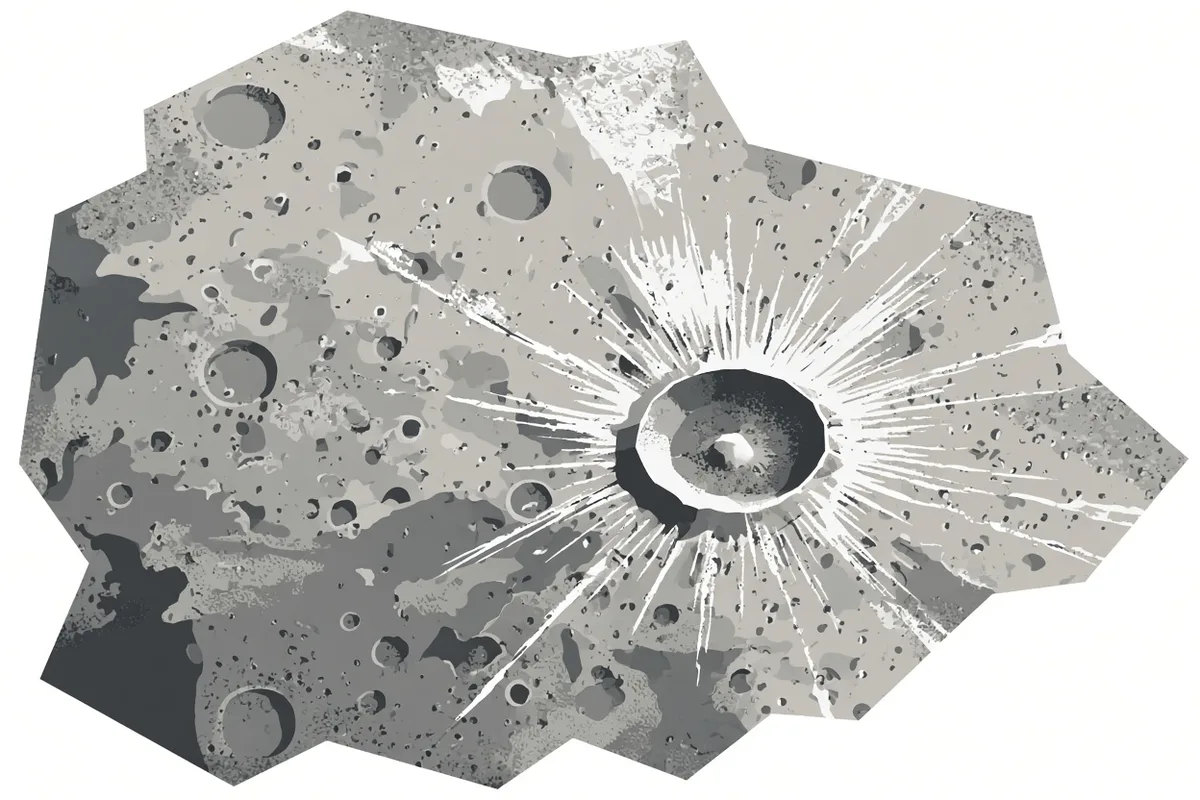
Robert Wagner was midway through a routine data-quality check on October 24, 2025, when an unusually bright patch with a dark halo caught his eye on a giant Moon map. The map had been built from Lunar Reconnaissance Orbiter Camera data: hundreds of Wide-Angle Camera frames taken years apart, combined by software that leaves unchanged terrain gray and throws any difference into bright or dark relief. Wagner, an image-processing specialist from Intuitive Machines who works with the LROC system, saw in the haloed spot the signature of surface material that had been shaken up.
“I just stopped, dropped everything, and started looking into what that spot was,” Wagner said.
He set the newer LROC images against older ones of the same stretch of ground. The bright patch and its dark ring had not been there in the earlier record. The comparison showed a fresh impact debris pattern—rock and dust flung outward from a crater that had formed sometime after the prior imaging pass.

“It was by far the most obvious impact debris pattern I’ve ever seen in one of these images,” Wagner said.
The crater formed between April 11 and May 22, 2024, on the Moon’s eastern near side, near the boundary between the highlands and mare basalt. The impactor was an asteroid or comet fragment roughly the size of a three- to six-story building. It was named McGetchin for Thomas McGetchin, a lunar scientist who became director of the Lunar and Planetary Institute in 1977 and co-authored a 1973 ejecta distribution model.
McGetchin is 222 meters (728 feet) across and about 43 meters (141 feet) deep. The measured diameter ranges from 213 to 231 meters. The walls have a median slope of 24 degrees and reach 41 degrees in places. A continuous ejecta blanket—rock fragments and granular material excavated during the impact—extends a median of about 146 meters (479 feet) beyond the rim. Researchers identified the approximate edge of that deposit by changes in surface reflectance and by the preservation of older craters.
“This event constitutes a statistically rare, effectively once-in-a-lifetime observation,” researchers wrote in Science Advances. “McGetchin crater is exceptional because it is the largest newly formed impact crater that has been identified to date,” Tyler Powell said. Impact-production models put a collision of this magnitude at about once every 132 years—or once a century or more.
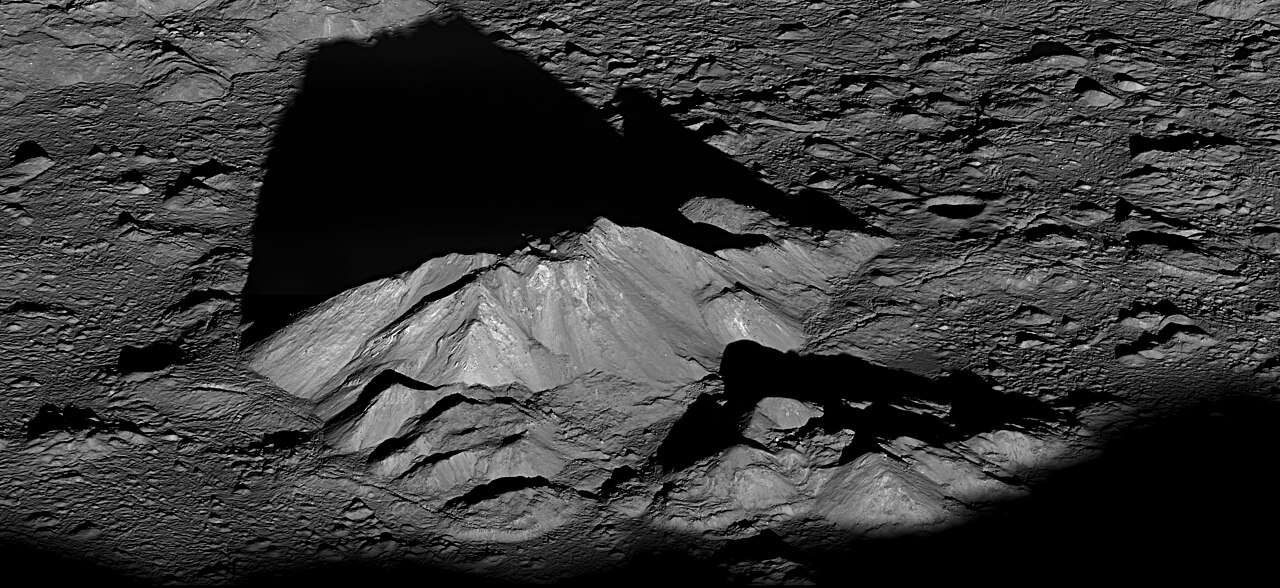
The Diviner team made follow-up observations between November 15, 2025, and February 18, 2026, and confirmed a thermal cold spot around the site. Narrow-Angle Camera frames, including one taken on December 5, 2025, at roughly 0.9 meters per pixel and another on March 3, 2026, resolved the fresh bowl and the ejecta immediately around the rim. On March 3, 2026, the Narrow-Angle Camera made a side-looking frame aimed east across an area about 2.4 kilometers (1.5 miles) wide that shows the fresh bowl and the ejecta field laid out around the rim.
Hundreds of Wide-Angle Camera frames from before and after the collision, corrected for viewing geometry and illumination, mapped a bright disturbance zone extending about 15 kilometers from the crater and a broader, discontinuous region of reduced reflectance stretching more than 100 kilometers, with localized changes reaching roughly 140 kilometers. In the farthest stretches the reflectance shifts were as subtle as about 1 percent. The distant patterns indicated changes in the texture of the uppermost regolith rather than a continuous cover of thick ejecta.
Two companion papers in Science Advances on September 16, 2026, laid out the findings. Mark Robinson of Intuitive Machines led the crater study; a Diviner-instrument team that included Tyler Powell and David Paige of UCLA examined the thermal anomalies. The Lunar Reconnaissance Orbiter has held its polar mapping orbit since 2009. More than seventeen years of pole-to-pole passes built the before-and-after archive; the cameras and Diviner work from roughly sixty miles up.

The thermal and optical records together showed a surface process that reaches well past the rim. The impact had fluffed the regolith—the loose rocky soil that blankets the Moon—into a less dense layer, one that held heat less well through the lunar night. That same disturbance altered the texture of the topmost grains far from the continuous ejecta, shifting how the ground reflected sunlight even where the change was slight.
“We’re now thinking of impacts as a way to garden the regolith — churning the sediments and putting stuff above that’s usually below the surface,” David Paige said.
Tyler Powell, lead author of one of the studies, put the rarity in plain terms. “A crater of this size is expected to form on the moon only once per century, so we're extremely lucky it formed during the lifetime of the LRO mission and that we are able to observe the region both before and after impact,” he said.
“Observations from the surface would be really valuable because they would allow us to correlate what we see and map from orbit with small-scale changes to surface texture, the distribution of ejected material, and other properties that can only be studied in detail from the surface,” Powell said.