Meta Unveils VR Headset, Camera-Free Smart Glasses
Mark Zuckerberg took the stage at Meta Connect 2026 in Menlo Park on September 23 and began unveiling the company’s new device lineup. The dual reveal held the room’s focus from the first minutes: virtual reality spectacles built to sit on the face like eyewear, and a pair of camera-free smart glasses.
The VR spectacles arrived as Meta’s latest wearable form, a departure from the bulk of earlier headsets. Beside them stood the Ray-Ban Meta Audio glasses, designed without cameras and centered on sound alone. One pointed toward full virtual environments worn lightly. The other offered only audio. Together they marked the clearest statement of Meta’s direction in face-worn hardware, with the VR glasses still months from shelves and the camera-free pair moving sooner toward preorder.
The Meta VR Glasses weighed about 3.5 ounces, roughly 100 grams. They are five times lighter than the Meta Quest 3. Priced at $1,299.99 and due to ship in spring 2027, the magnesium-alloy frames held only the displays, lenses, cameras and sensors. All compute, battery and storage sat in a separate puck that clipped to a pocket and linked to the glasses by optical cable. Inside the puck was the Snapdragon Reality Elite chip, delivering 48 TOPS of on-device AI. The puck ran up to three hours of continuous high-resolution playback, supported 45-watt fast charging, and weighed about 10.5 ounces, according to Road to VR.
Connor Jewiss owns an Apple Vision Pro and a Meta Quest 3. Weight had been the barrier that made him quit films before the end and leave both headsets on the shelf. Pressure on his forehead always arrived around an hour and a half into a movie on the Vision Pro, so he took it off. The decision of whether it was even worth putting one on stopped him most evenings. At 3.5 ounces the new glasses sat in the range of bulky sunglasses.
The displays inside were 5K micro-OLED panels delivering 2412 by 2288 pixels to each eye at 37 pixels per degree. Pixels per degree simply counts how much detail lands in every segment the eye can see, which is why text stays crisp instead of blurring into softness. The field of view ran 70 degrees horizontal by 66 vertical. On the Quest 3 that window opens to roughly 110 by 96. Dolby Vision and Dolby Atmos were built in. The glasses became the first VR device ever certified IMAX Enhanced.

Navigation worked through eye tracking and hand gestures alone. More than 75 games launched playable by gesture, and the entire Quest catalog carried over without change. Touch Plus controllers and Bluetooth gamepads such as an Xbox controller remained available, sold separately at extra cost. Disney+ brought titles such as The Avengers and Black Panther directly to the glasses. Meta worked to add Amazon Prime Video, YouTube and other streamers. Microsoft brought Xbox Cloud Gaming so titles could stream without local hardware. Hologram Calling built a photorealistic rendering of the user for video calls from one photo taken in the Meta AI app.
A virtual reality headset is a head-mounted device that uses stereoscopic near-eye displays and positional tracking to match a virtual camera to the wearer’s eyes. Facebook acquired Oculus in 2014. The standalone Quest line that followed, including the Quest 3, kept the experience self-contained. Bulk had remained the long form-factor problem. The split design placed only displays, lenses, cameras and sensors in the magnesium frames while the puck held the Snapdragon Reality Elite, battery and storage, letting the lighter glasses carry the full software catalog and the new calling feature without the old weight.
A WIRED reporter sat through a brief hands-on demo of the VR Glasses at Meta Connect and found the narrower field of view left the picture feeling less immersive than a sealed headset. The open sides kept the edges of the virtual image visible, and the room stayed in peripheral sight unless light blockers were added.
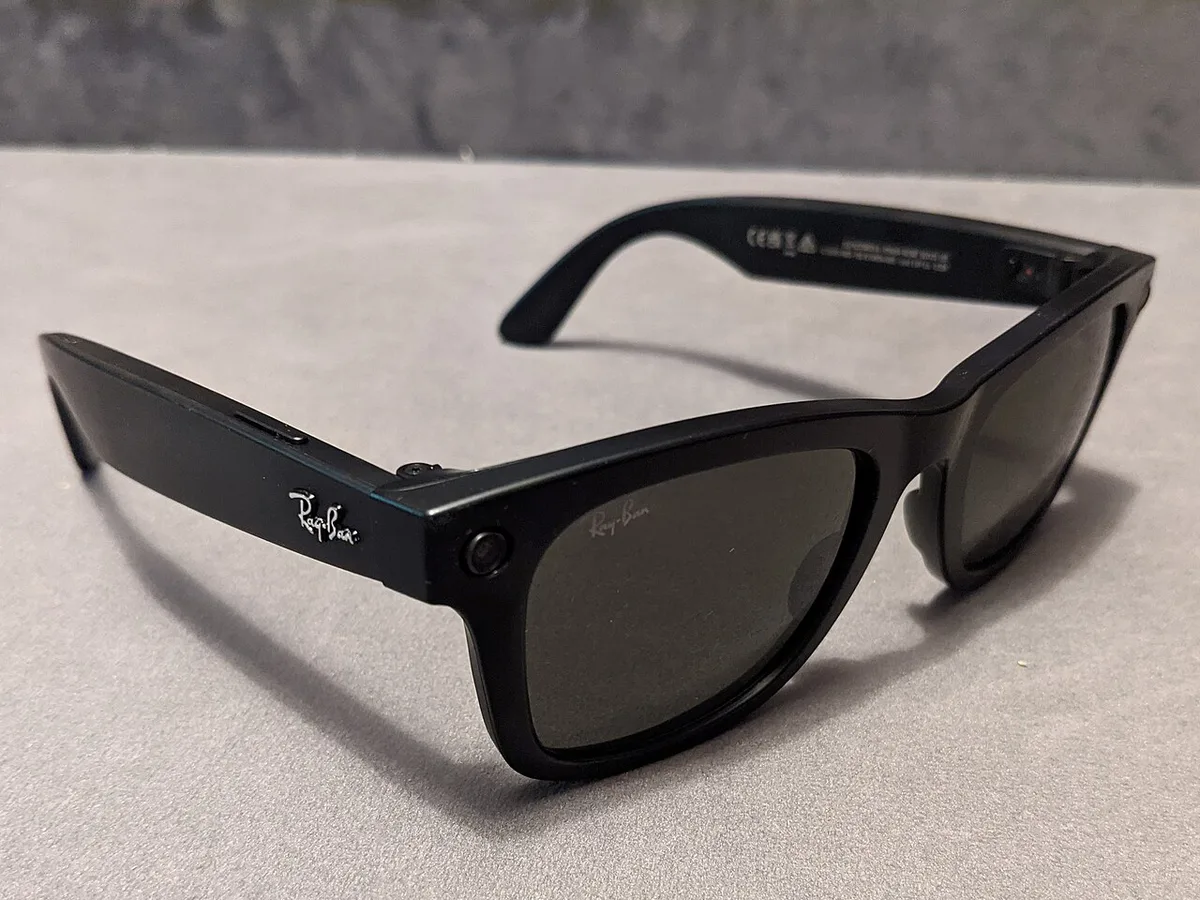
The Ray-Ban Meta Audio glasses weighed 43 grams. They carried no cameras at all. Priced from $349, they delivered up to 12 hours of battery life on a charge and 48 hours with the case. EssilorLuxottica designed them in Clubmaster and Burbank styles across 23 color and lens combinations. Preorders opened October 13, with some reports placing first shipments as early as October 10. Mark Zuckerberg said it directly: “Once you get used to high quality audio, it's just a thing that you want all the time, right?” The frames stayed slim because they held only the speakers and the link to Meta’s Muse assistant for music, calls, translation and conversation. No photo or video hardware sat in the arms.
By the second quarter of 2026 Meta already held 68.7 percent of global smart-glasses shipments. The Audio pair moved toward preorder while the heavier virtual-reality spectacles remained months from any shelf. Daniel Howley noted Meta’s stock dropping before the bell the morning after the announcement.