




Focus without distraction is the real professional edge
Knowledge workers, writers, and managers whose days vanish into email get a structural case for reclaiming attention.
IJR · Oct 10, 2026 · 13 min read
In 60 seconds
- Automation and globalization favor people who master hard skills fast and produce elite output—both depend on distraction-free concentration.
- Open offices, instant messaging, and constant availability make deep work rare by rewarding the easiest visible busyness.
- Willpower fails against distraction; fixed rituals, schedules, and locations make starting deep work automatic.
- Idle phone use leaves attention residue and weakens later focus; deliberate boredom and productive meditation reverse the atrophy.
- Adopt digital tools only when gains on your few core goals outweigh attention costs—not because they offer any benefit.
- Schedule every work hour and cap shallow logistics so low-value tasks stop expanding to fill the day.
The big idea
Newport’s wager is that distraction-free concentration is growing rarer exactly as it grows more valuable, so those who protect it gain a compounding edge in skill and output. Four reinforcing rules—ritualizing focus, embracing boredom, selecting tools like a craftsperson, and draining shallow work—treat attention as finite and actively defended rather than passively spent.
The book in brief
Newport starts from the modern knowledge economy: automation and cheaper global labor hollow out routinized work, leaving advantage with people who work well with intelligent machines, become best in their field, or hold capital. For most knowledge workers the first two paths both rest on quickly mastering hard things and producing at elite quality and speed—which he defines as deep work, distraction-free concentration that stretches cognitive limits. He sets this against shallow work, logistical busywork that can be done distracted and creates little new value.
He then diagnoses why deep work is scarce. Organizations follow a principle of least resistance: without clear metrics for deep output, people default to immediate email replies and frequent meetings that look busy. Open floor plans and instant messaging normalize interruption. Because deep work’s absence causes no immediate visible harm, nothing self-corrects, and individuals cannot count on their environments to protect focus.
The deep work hypothesis follows: as the skill grows rarer and more valuable, those who cultivate it thrive. Newport notes the claim applies unevenly—jobs built on constant responsiveness have less room—and that willpower alone fails because it depletes. The rest of the book turns to four rules that replace moment-by-moment self-control with structure.
Rule One builds rituals and scheduling philosophies so starting deep work becomes automatic, then extends into hub-and-spoke collaboration design and executive-style tracking of deep hours. Rule Two treats concentration as a muscle weakened by constant low-level stimulation and rebuilt by tolerating boredom and practicing focused idle thought. Rule Three rejects the any-benefit standard for digital tools in favor of a craftsman’s weighing of costs against a few core goals. Rule Four forces shallow work into the open by scheduling every hour and making oneself harder to reach.
The arc lands on one claim: unmanaged attention defaults to the shallow and easy; only deliberate structure reclaims it for harder work. The advice fits autonomous knowledge roles better than interruption-centered jobs, but the diagnosis of attention as the scarce resource holds across them.
Context
Cal Newport’s 2016 book argues that distraction-free concentration had become both rare and professionally decisive for knowledge workers whose days dissolve into connectivity.
The key ideas

1
Deep work creates elite output
Automation and globalization leave three kinds of thrivers—and for knowledge workers, two of those paths both require distraction-free concentration that masters hard things fast and produces at elite quality and speed.
Deep work
Distraction-free concentration that masters hard skills and produces elite output
Shallow work
Logistical tasks like email done while distracted that create little new value
Newport opens with the modern economy’s filter. Machines and cheaper labor abroad hollow out work that can be routinized, leaving those who work well with intelligent machines, those who are the best in their field, and those with capital. For most knowledge workers the first two routes depend on quickly mastering hard things and producing elite output in both quality and speed.
He names the underlying capacity deep work: professional activity done in distraction-free concentration that pushes cognitive limits. Shallow work is the opposite—logistical tasks like email that tolerate distraction and create little new value. Organizations drift toward valuing visible busyness over this harder output, so the ability to actually do deep work becomes a competitive edge almost by default.
The book ties the demand to deliberate practice. Genuine skill improvement, on the account of psychologist Anders Ericsson’s research, needs focused attention on a specific stretch goal with immediate feedback, not passive repetition. Newport extends that requirement to programmers, consultants, and writers alike.
In practice: The book points to Anders Ericsson’s deliberate-practice research as the template: focused attention on a stretch goal with immediate feedback, not passive repetition.
2
Defaults erase deep focus
Without metrics for deep output, organizations follow the principle of least resistance and reward the easiest visible busyness even though nothing forces that outcome.
Claimed benefit
Open plans and instant messaging sold as collaboration and serendipity
Actual effect
Fragmented attention and structurally difficult concentration
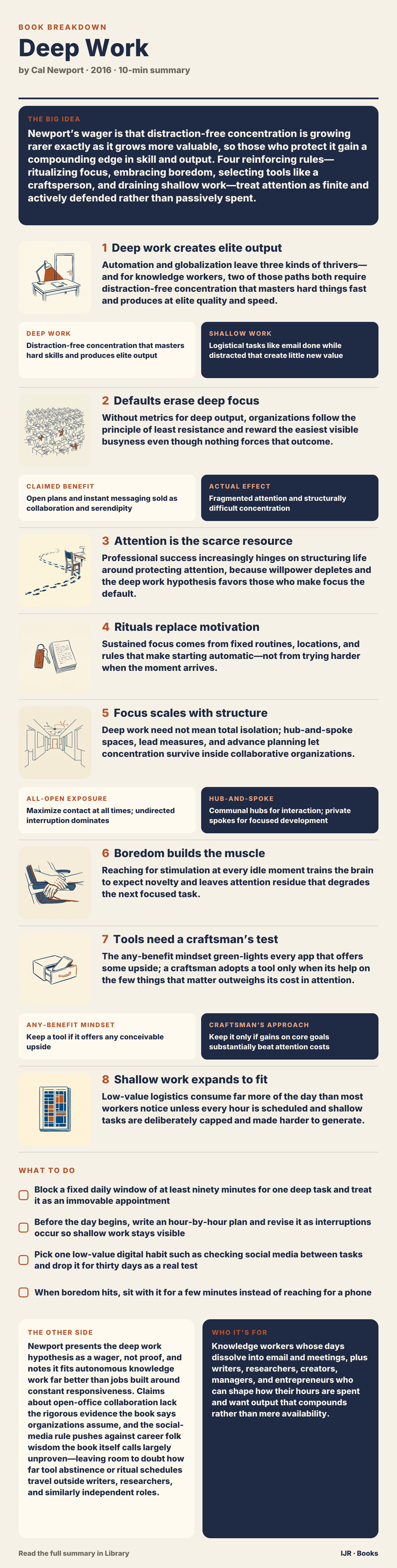
Having argued deep work is valuable, Newport asks why so few workplaces cultivate it. His answer is emergent, not conspiratorial: the principle of least resistance. Absent clear metrics for deep work’s value, people default to behaviors easiest in the moment because they produce visible busyness even when they don’t produce valuable output.
Open floor plans illustrate the drift. The book cites companies like Facebook’s headquarters designed by Frank Gehry, justified by collaboration and serendipity claims that lack rigorous evidence and actively undermine concentration. Instant messaging tools normalize near-instant response and fragment attention across the day.
Deep work’s value is hard to measure directly and its absence causes no immediate visible harm, so organizations underinvest in protecting it. Shallow work’s costs are similarly invisible, so nothing self-corrects. An individual therefore cannot expect the environment to support focus; default incentives point away from it.
In practice: The book describes Facebook’s open headquarters designed by Frank Gehry as a collaboration-justified layout that undermines the concentration deep work needs.

3
Attention is the scarce resource
Professional success increasingly hinges on structuring life around protecting attention, because willpower depletes and the deep work hypothesis favors those who make focus the default.
Newport frames the deep work hypothesis as a wager: the ability to perform deep work is becoming rarer at exactly the moment it becomes more valuable, so the few who cultivate it will thrive. He treats it as a hypothesis, not a proven law, and notes it applies unevenly—a customer-service role or any job built on real-time responsiveness has less room than writing, research, or programming.
Willpower alone will not carry the day. Drawing on psychologist Roy Baumeister’s work on ego depletion, Newport argues that resisting distraction moment by moment exhausts a limited resource. Relying on fresh self-control each time a ping arrives sets the worker up to fail.
The alternative is rituals and routines that remove repeated decisions. A novelist writing at the same desk at the same hour lets the environment trigger focus instead of requiring a new act of discipline. That shift sets up the four rules that follow.
In practice: The book compares the needed routines to a novelist who writes at the same desk at the same hour so the setting itself cues focus.
4
Rituals replace motivation
Sustained focus comes from fixed routines, locations, and rules that make starting automatic—not from trying harder when the moment arrives.
Rule One rejects spontaneous motivation. Newport lays out scheduling philosophies. The monastic approach, linked to writer Neal Stephenson, minimizes ordinary communication to protect huge unbroken blocks. The bimodal approach, used by psychiatrist Carl Jung, alternates intense isolated retreats with periods of normal engagement. The rhythmic approach blocks the same hours every day—such as writing from 5 to 7:30 a.m. before other obligations—and is the one Newport favors because it lowers activation energy. The journalistic approach, associated with Walter Isaacson, switches into deep work whenever a spare slot appears, though the book cautions it needs experience beginners lack.
Beyond the calendar, ritual matters: fixed locations, specific starting behaviors, and rules about what is allowed in the session so the brain stops renegotiating terms every time. Grand gestures raise the stakes. The book cites J.K. Rowling checking into a hotel to finish the last Harry Potter novel, arguing that unusual effort or expense signals importance and locks in commitment.
Structure substitutes for willpower. Every minute spent deciding whether to focus is already a minute of focus lost.
In practice: The book describes J.K. Rowling checking into a hotel to finish the final Harry Potter novel as a grand gesture that raised commitment through unusual expense and effort.
5
Focus scales with structure
Deep work need not mean total isolation; hub-and-spoke spaces, lead measures, and advance planning let concentration survive inside collaborative organizations.
All-open exposure
Maximize contact at all times; undirected interruption dominates
Hub-and-spoke
Communal hubs for interaction; private spokes for focused development
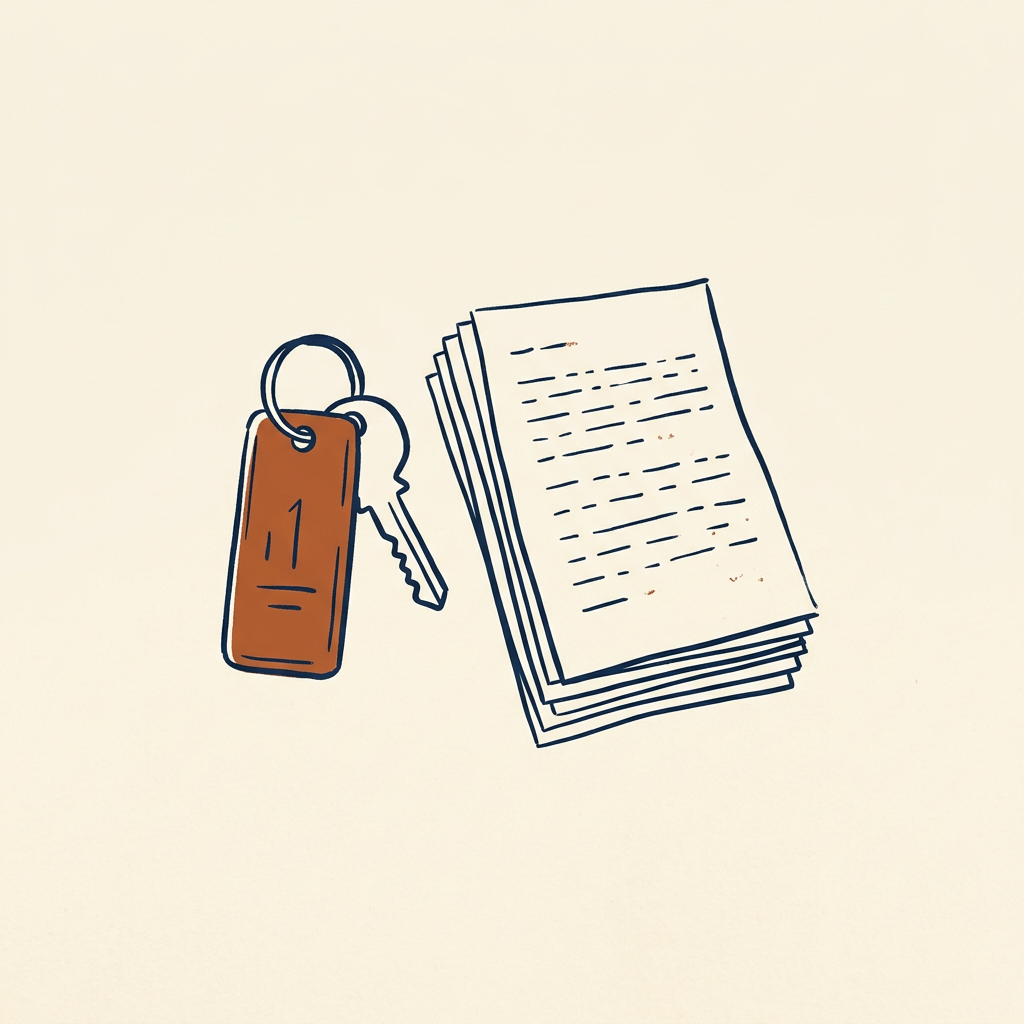
Newport answers the charge that deep work is antisocial. He describes a hub-and-spoke model: communal spaces support interaction while private spokes hold focused work. Bell Labs’ historic design is the book’s example—long hallways that encouraged chance encounters paired with private offices where researchers could develop the ideas those encounters sparked. Collaboration and deep work are not opposites; the mistake is treating constant exposure as the path to value when undirected interruption mostly yields shallow exchange.
He also introduces executive habits: manage your own deep-work capacity like a business. Identify the most important goals, track a lead measure such as hours of deep work logged, keep a visible scoreboard, and hold a regular self check-in. Making time to plan the day’s hours in advance beats reacting to whatever arrives.
A periodic retreat or walk for high-level reflection tests whether daily activity still serves deeper goals. Without that zoom-out, shallow busyness can continue indefinitely while the worker believes progress is happening.
In practice: The book points to Bell Labs’ long hallways for chance encounters paired with private offices where researchers could actually develop the sparked ideas.

6
Boredom builds the muscle
Reaching for stimulation at every idle moment trains the brain to expect novelty and leaves attention residue that degrades the next focused task.
Rule Two targets a habit Newport treats as corrosive: grabbing a phone at the first hint of boredom, whether in line or between tasks. Constant switching, on this account, trains the brain toward novelty and makes distraction harder to resist even during work meant to be deep.
He links the damage to research on attention residue by organizational psychologist Sophie Leroy: switching tasks leaves a lingering trace of attention on the first task and degrades performance on the second. Idle-moment phone use is not neutral; the book claims it actively weakens deep work attempted later the same day.
The prescription is scheduled, not endless, breaks from focus. Productive meditation uses a walk or commute to think through one specific professional problem instead of defaulting to a podcast or screen. Structured concentration practice—such as memorizing a deck of cards, following memory champions studied in Joshua Foer’s Moonwalking with Einstein—builds general capacity. Concentration is treated as a muscle that atrophies under constant interruption and strengthens under deliberate resistance.
In practice: The book recommends productive meditation: using a commute or walk to work one professional problem rather than filling the idle stretch with a phone.

7
Tools need a craftsman’s test
The any-benefit mindset green-lights every app that offers some upside; a craftsman adopts a tool only when its help on the few things that matter outweighs its cost in attention.
Any-benefit mindset
Keep a tool if it offers any conceivable upside
Craftsman’s approach
Keep it only if gains on core goals substantially beat attention costs
Rule Three attacks how people choose digital tools. Newport names the common standard the any-benefit mindset: if a tool offers any conceivable advantage, however small, people feel justified keeping it, without weighing that advantage against fragmented attention.
He proposes a craftsman’s approach instead. Identify the few things that matter most in professional and personal life, then adopt a tool only if its positive impact on those things substantially outweighs its negatives. The book offers a diagnostic: one person interviewed quit social media for thirty days and found no one noticed and nothing important was harmed—evidence, on this account, that the ongoing value had been overstated.
The rule is flagged as the most controversial because much career advice treats a strong social media presence as essential for visibility. Newport pushes back that this is largely unproven folk wisdom for most professions. The same logic extends to leisure: unplanned downtime fills with the easiest screen stimulation and fails to restore mental resources work depletes.
In practice: The book describes a thirty-day social-media quit in which no one noticed the absence and no real harm followed, used as a test of whether the tool’s value was overstated.

8
Shallow work expands to fit
Low-value logistics consume far more of the day than most workers notice unless every hour is scheduled and shallow tasks are deliberately capped and made harder to generate.
Rule Four turns to shallow work itself: necessary administrative tasks that are low in cognitive demand and low in new value. Newport argues most knowledge workers dramatically underestimate how much of the day these tasks claim because they feel productive in the moment.
His main tactic is scheduling every hour of the working day in advance, then revising as the day unfolds. The schedule makes shallow time visible and forces conscious tradeoffs instead of passive drift. A rough gauge he suggests: ask how many years of specialized training a task would need; the answer helps sort deep from shallow.
Becoming harder to reach cuts the volume at the source—for instance by requiring email senders to include a clear proposal rather than open-ended requests. Some roles are built around responsiveness, and for those the aspiration must stay modest. The core claim echoes Parkinson’s Law: shallow work expands to fill the time available unless a fixed quota forces the discipline.
In practice: The book suggests making email senders do more work up front, such as requiring a clear proposal instead of open-ended asks, to reduce shallow obligations.
Key terms
- Deep work Professional activity done in distraction-free concentration that pushes cognitive limits and creates new value
- Shallow work Logistical tasks that can be done while distracted and produce little new value
- Principle of least resistance Defaulting to the easiest visible busyness when deep work’s value lacks clear metrics
- Deep work hypothesis The wager that deep work is growing rarer and more valuable, so those who cultivate it will thrive
- Attention residue The lingering trace of a prior task that degrades performance after you switch
- Any-benefit mindset Adopting a tool because it offers some upside, without weighing attention costs
- Craftsman’s approach Adopting a tool only when its help on your few core goals outweighs its harms
- Productive meditation Using idle time like a walk to think through one specific professional problem
- Grand gesture Unusual effort or expense that signals a work session’s importance and locks commitment
- Hub-and-spoke Communal spaces for interaction paired with private spaces for focused work
What to do
- Block a fixed daily window of at least ninety minutes for one deep task and treat it as an immovable appointment
- Before the day begins, write an hour-by-hour plan and revise it as interruptions occur so shallow work stays visible
- Pick one low-value digital habit such as checking social media between tasks and drop it for thirty days as a real test
- When boredom hits, sit with it for a few minutes instead of reaching for a phone
Questions to think with
- How many hours of true distraction-free work does your current week actually contain?
- Which of your regular tools would survive a craftsman’s test against your few most important goals?
- Where does your workplace’s principle of least resistance show up in meetings, messaging, or floor plans?
- What fixed ritual—time, place, starting act—would make your next deep session automatic?
- If shallow work expanded to fill every gap, what hard cap would force the tradeoff you need?
The other side
Newport presents the deep work hypothesis as a wager, not proof, and notes it fits autonomous knowledge work far better than jobs built around constant responsiveness. Claims about open-office collaboration lack the rigorous evidence the book says organizations assume, and the social-media rule pushes against career folk wisdom the book itself calls largely unproven—leaving room to doubt how far tool abstinence or ritual schedules travel outside writers, researchers, and similarly independent roles.
Who it's for
Knowledge workers whose days dissolve into email and meetings, plus writers, researchers, creators, managers, and entrepreneurs who can shape how their hours are spent and want output that compounds rather than mere availability.