


You cannot do everything, so failing to choose is a choice
McKeown contends that chronic overcommitment spreads effort across trivial pursuits, and only a clear yes should survive so the vital few get real work.
IJR · Oct 11, 2026 · 11 min read
In 60 seconds
- Trying to do and have it all is not neutral; it actively causes mediocrity in everything you touch.
- Choice is a muscle that atrophies into learned helplessness when every request is treated as a command.
- Every yes is an implicit no; essentialists name the trade-off instead of asking how to do both.
- Sunk costs and merely good options lock people in; judge every commitment as if it arrived fresh today.
- Cut to a clear yes, build buffer before you need it, start essential work with small visible wins, and turn the whole discipline into routine.
The big idea
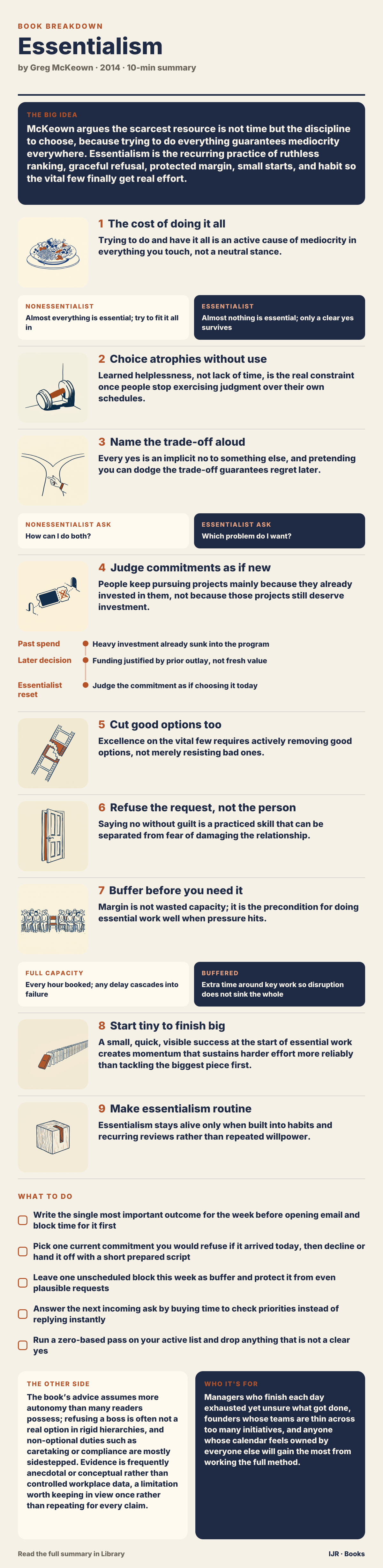
McKeown argues the scarcest resource is not time but the discipline to choose, because trying to do everything guarantees mediocrity everywhere. Essentialism is the recurring practice of ruthless ranking, graceful refusal, protected margin, small starts, and habit so the vital few finally get real effort.
The book in brief
McKeown starts from a chronic problem: people and organizations say yes too often and end up busy without progress. Success itself multiplies options and demands, so the more capable someone becomes the more they are pulled into diffusion. Nonessentialism treats almost everything as essential; essentialism holds that almost nothing is.
He next explains the hidden mechanism. Years of reflexive yeses produce a learned helplessness in which choice feels unavailable even when it is. Trade-offs must be made explicit—ask which problem you want, not how to do both—or circumstance forces a worse split later. The same blur sinks companies that chase low cost and premium quality at once.
Sunk-cost thinking then keeps failing projects and stale roles alive because of what was already spent. The counter-move is zero-based review: would you choose this today knowing what you know. Excellence also requires cutting genuinely good options, not merely bad ones, because finite attention means every extra good commitment dilutes the vital few. If it is not a clear yes, it is a no.
Saying no is a separate interpersonal skill from deciding no; scripts, bought time, and separating the request from the person make the cut real. With space opened, deliberate buffers absorb the ordinary overruns that the planning fallacy predicts. Essential projects then start with a small, quick, visible win so momentum itself becomes a resource. The capstone is turning the entire chain into weekly ritual and habit so the discipline survives stress instead of collapsing when it matters most.
Context
Published in 2014, the book gave a name and a method to widespread anxiety about busyness without progress. It resonated with executives and knowledge workers drowning in obligations.
The key ideas

1
The cost of doing it all
Trying to do and have it all is an active cause of mediocrity in everything you touch, not a neutral stance.
Nonessentialist
Almost everything is essential; try to fit it all in
Essentialist
Almost nothing is essential; only a clear yes survives
McKeown treats a claim that sounds obvious as rarely acted on: you cannot do everything, so failing to choose is itself a choice and usually a bad one. Nonessentialism is the default mode in which every opportunity looks equally urgent and every request seems to deserve a yes.
Success compounds the trap. The more capable you become, the more options and demands arrive, pulling you toward diffusion rather than depth. Praise for versatility becomes a pile of extra projects and ends in adequate work across many fronts instead of exceptional work on a few.
The essentialist reframes the daily question from how to fit something in to whether it is the single most important thing to do right now. This is not a speed trick. It is a stricter filter for what deserves attention at all: if the answer is not a clear yes, it is a no.
In practice: A bright employee praised for versatility is handed more projects as a reward and ends up adequate at many things rather than exceptional at a few.

2
Choice atrophies without use
Learned helplessness, not lack of time, is the real constraint once people stop exercising judgment over their own schedules.
McKeown draws on the idea of learned helplessness associated with Seligman's dogs that stopped trying to escape shocks after repeated failure. After years of reflexive yeses, saying no starts to feel impossible even when it remains entirely available.
Choice behaves like a muscle. The more unexamined obligation lets others decide, the weaker deliberate choosing becomes. In many workplaces every meeting invite or task request is treated as a command rather than a request, so acceptance is no longer recognized as a decision.
The remedy is not one dramatic refusal but repeated small acts of discretion. Feeling you have no choice is itself the problem to address, separate from whatever external pressures exist.
In practice: Employees treat every meeting invite as a command rather than a request they can still decline.

3
Name the trade-off aloud
Every yes is an implicit no to something else, and pretending you can dodge the trade-off guarantees regret later.
Nonessentialist ask
How can I do both?
Essentialist ask
Which problem do I want?
Once choice is recognized as available, McKeown insists trade-offs must be made explicit. Nonessentialists ask how to do both; essentialists ask which problem they want to solve.
Trying to symbolically cover a major client pitch and a family commitment on the same evening—by multitasking or brief appearances—usually satisfies neither side and exhausts the person in the middle. Clarity comes from accepting the loss up front and choosing deliberately instead of letting circumstance force a worse split.
Organizations face the identical trap. Firms that try to be the low-cost provider and the premium-quality leader at the same time blur their identity and lose to competitors who pick one lane. When two demands collide, name the trade-off out loud.
In practice: An executive attempts both a client pitch and a family commitment the same evening and satisfies neither.

4
Judge commitments as if new
People keep pursuing projects mainly because they already invested in them, not because those projects still deserve investment.
- Past spendHeavy investment already sunk into the program
- Later decisionFunding justified by prior outlay, not fresh value
- Essentialist resetJudge the commitment as if choosing it today
McKeown examines why individuals and organizations persist with failing initiatives by tying the pattern to the sunk-cost fallacy: resources keep flowing because of what was already spent rather than what remains to be gained.
The Concorde supersonic jet program is his classic case—continued government funding partly justified by money already spent instead of a fresh commercial assessment. The same logic keeps a manager’s underperforming project alive to avoid admitting waste, or keeps someone in a job past its usefulness because leaving feels like erasing years of effort.
The essentialist habit evaluates every ongoing commitment as if encountering it today. Ask whether you would choose it now, knowing what you know, independent of past outlay. Periodic zero-based reviews—nothing carried forward automatically—make honest trade-offs possible again.
In practice: Concorde funding continued partly because money had already been spent rather than because a fresh look showed commercial viability.

5
Cut good options too
Excellence on the vital few requires actively removing good options, not merely resisting bad ones.
McKeown shifts from mindset to method. The harder discipline is declining genuinely attractive opportunities, because those are the ones that quietly crowd out the essential few.
He compares the work to a film editor’s craft: the skill is not adding footage but cutting scenes that are fine on their own yet do not serve the whole. Attention, energy, and resources are finite, so every extra good commitment dilutes what the highest priorities receive.
A practical filter follows: if something is not a clear, resounding yes, treat it as a no. Removing the merely good is exactly what creates the slack required to do the essential well.
In practice: An executive team ranked a long list of individually defensible initiatives, cut to the top three, and got better results than advancing every item thinly.

6
Refuse the request, not the person
Saying no without guilt is a practiced skill that can be separated from fear of damaging the relationship.
McKeown treats the mechanics of refusal as distinct from the decision to refuse. Many people accept the logic of trade-offs then freeze when a real request arrives, because they conflate declining the ask with rejecting the asker.
He offers simple social moves: separate the decision from the relationship out loud, buy time instead of answering instantly, and deliver a graceful no that acknowledges the need without committing your calendar. A default reply of checking the calendar and getting back creates space to weigh the request against existing priorities rather than caving under momentary pressure.
People also overestimate the social cost; the feared offense rarely arrives at the scale imagined. Without this interpersonal technique the earlier logic stays theoretical.
In practice: An employee answers with ‘let me check my calendar and get back to you’ instead of agreeing on the spot, then weighs the ask against real priorities.

7
Buffer before you need it
Margin is not wasted capacity; it is the precondition for doing essential work well when pressure hits.
Full capacity
Every hour booked; any delay cascades into failure
Buffered
Extra time around key work so disruption does not sink the whole
McKeown shows that nonessentialists run at full capacity by design—every hour scheduled, no room for the unexpected—so any disruption becomes a crisis.
Projects routinely take longer than estimated, a pattern linked to the planning fallacy. Essentialists plan for that reality by leaving extra time around important tasks and meetings. Some executives deliberately block unstructured calendar space to think and to absorb unplanned demands instead of filling every slot.
Slack only appears after the merely good has already been cut. Without protected margin even a well-chosen set of priorities is executed poorly, because ordinary friction has nowhere to go.
In practice: Executives leave unstructured blocks on the calendar specifically to think and to absorb surprise demands rather than packing every hour.

8
Start tiny to finish big
A small, quick, visible success at the start of essential work creates momentum that sustains harder effort more reliably than tackling the biggest piece first.
McKeown draws on the progress principle associated with Amabile’s workplace research: among events that lift inner work life, progress on meaningful work is the most consistent driver. Visible early movement fuels continued effort more than a large remaining task discourages it.
Essential goals are often intimidating precisely because they matter. Waiting for perfect conditions or full resources stalls the work. The essentialist preference is to begin small and concrete, treating momentum itself as a resource to be generated on purpose.
After priorities are clear, nonessentials removed, and margin protected, the next obstacle is simply starting. Shipping a minimal version quickly can reenergize a team for the harder phases still ahead.
In practice: A team stuck on a large product launch shipped a minimal version in weeks; the visible accomplishment reenergized them for the remaining harder work.

9
Make essentialism routine
Essentialism stays alive only when built into habits and recurring reviews rather than repeated willpower.
McKeown closes the arc by arguing that isolated acts of prioritization fade under pressure unless they become routine. He points to habit-loop thinking popularized by Duhigg—cue, routine, reward—to show that essentialist behavior needs the same structural support as exercise or diet.
Fixed rituals do the work: a weekly review that re-ranks priorities and explicitly drops anything no longer essential so the discipline does not depend on remembering it in the moment.
Without that system people relapse into nonessentialism exactly during busy or stressful stretches, when the discipline matters most. Choice, trade-offs, cutting, refusal, margin, and momentum then function as an operating system revisited regularly instead of a one-time decision.
In practice: A standing weekly review re-ranks priorities and drops items that no longer qualify, so the practice does not rely on willpower alone.
Key terms
- Essentialism The discipline of deliberately eliminating the nonessential so the vital few receive real effort
- Nonessentialism The default mode in which every opportunity looks urgent and every request seems to deserve a yes
- Trade-off The reality that every yes is an implicit no; name it instead of pretending you can do both
- Sunk-cost fallacy Continuing a commitment because of what was already spent rather than what it is still worth
- Clear-yes rule If an option is not a resounding yes, treat it as a no
- Zero-based review Judging every commitment as if it were new; nothing carries forward automatically
- Buffer Deliberate extra time left around important work so ordinary delays do not cascade
- Progress principle Visible early progress on meaningful work is the strongest consistent fuel for continued effort
What to do
- Write the single most important outcome for the week before opening email and block time for it first
- Pick one current commitment you would refuse if it arrived today, then decline or hand it off with a short prepared script
- Leave one unscheduled block this week as buffer and protect it from even plausible requests
- Answer the next incoming ask by buying time to check priorities instead of replying instantly
- Run a zero-based pass on your active list and drop anything that is not a clear yes
Questions to think with
- What am I doing only adequately that I could stop in order to do one thing exceptionally?
- Which current commitment would I refuse if it landed on my desk fresh today?
- Where does my calendar still treat requests as commands rather than choices?
- What good option am I protecting that is quietly crowding out a better one?
- When did I last leave real unstructured buffer instead of filling the gap?
The other side
The book’s advice assumes more autonomy than many readers possess; refusing a boss is often not a real option in rigid hierarchies, and non-optional duties such as caretaking or compliance are mostly sidestepped. Evidence is frequently anecdotal or conceptual rather than controlled workplace data, a limitation worth keeping in view once rather than repeating for every claim.
Who it's for
Managers who finish each day exhausted yet unsure what got done, founders whose teams are thin across too many initiatives, and anyone whose calendar feels owned by everyone else will gain the most from working the full method.