


Set up money once and let systems build your wealth
Wealth comes from a few automated systems, not expertise, high income, or iron discipline.
IJR · Oct 13, 2026 · 9 min read
In 60 seconds
- Guilt and shame, not missing facts, keep most people frozen around money.
- Credit cards paid in full become tools for scores and rewards that cut lifetime borrowing costs.
- Purpose-split accounts plus early automated investing beat perfect timing or stock picks.
- A conscious spending plan funds what you love by cutting what you barely notice.
- Raises and big-purchase negotiations move more wealth than years of small daily cuts.
- Regular low-stakes money talks with partners stop crises from wrecking budgets and relationships.
The big idea
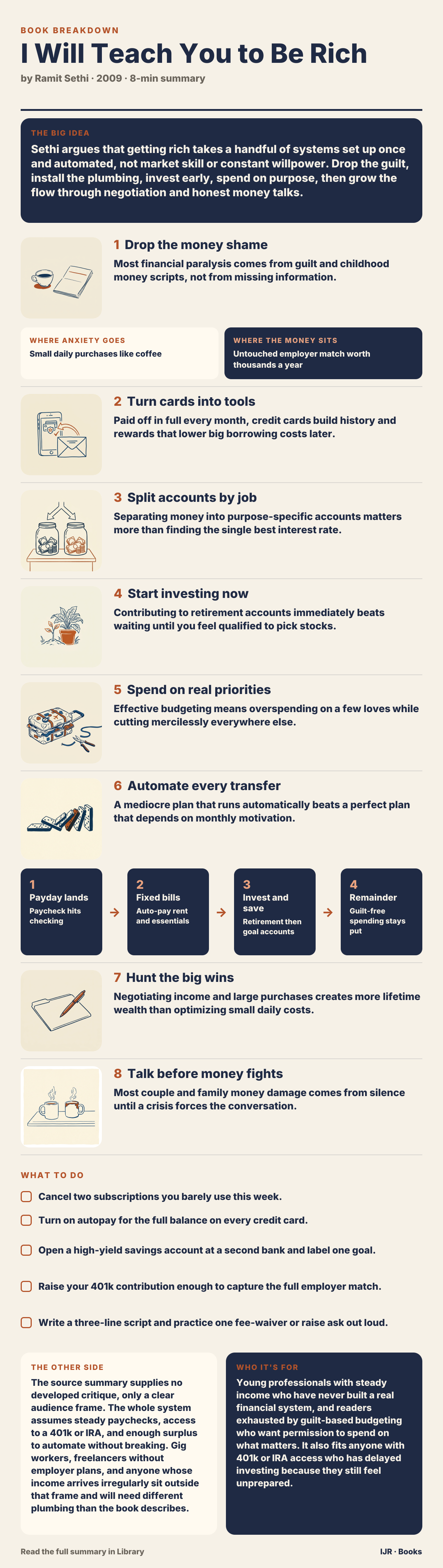
Sethi argues that getting rich takes a handful of systems set up once and automated, not market skill or constant willpower. Drop the guilt, install the plumbing, invest early, spend on purpose, then grow the flow through negotiation and honest money talks.
The book in brief
The book opens on a blunt diagnosis: young earners already know they should save and invest, yet stay frozen by guilt over past mistakes and shame about not understanding markets. More tips will not unstick them. A new stance that drops moral judgment and replaces it with systems will.
From that reset the argument builds outward through infrastructure. Credit cards come first, treated as tools when balances are paid in full. Checking and savings accounts follow, split by purpose so money meant to be saved is harder to raid. Investing is framed as something to begin immediately through employer matches and low-cost index funds, not after years of study.
With money able to flow to the right places, attention turns to spending. Instead of cutting every small pleasure, income is divided into fixed costs, investments, savings goals, and guilt-free spending, so readers can overspend on what they love by cutting what they do not. Automation then wires every transfer to run shortly after payday, removing the need for monthly willpower.
The final stretch shifts from internal systems to external leverage. Negotiating raises, rent, and large purchases grows the dollars entering the system far more than optimizing daily habits. Closing pages push the same clarity into relationships, urging regular low-stakes money conversations before a crisis forces a fight.
Context
Ramit Sethi published the book in 2009 for people in their twenties and thirties paralyzed by guilt or complexity around money. It mattered because it pushed automation and low-cost index investing into mainstream advice and offered a permission-based alternative to shame-driven personal finance writing.
The key ideas

1
Drop the money shame
Most financial paralysis comes from guilt and childhood money scripts, not from missing information.
Where anxiety goes
Small daily purchases like coffee
Where the money sits
Untouched employer match worth thousands a year
People already know, in rough terms, that saving more and investing earlier is smart. What freezes them is guilt over past mistakes, shame about the stock market, or the sense that talking about money is rude. Childhood money scripts run quietly underneath: growing up around visible scarcity can lock someone onto price tags for life, while a house where money was never discussed can make adult conversations feel impossible.
The fix is not another tip sheet. It is stripping guilt out of the process so later systems have a chance. Treating every purchase as a moral test will sabotage even a clean setup. Start today without waiting to feel pure or fully educated.
Every later move—automated transfers, a raise ask, spending on travel while cutting cable—depends on this reset. Money decisions stop being referendums on character.
In practice: Someone frets over a four-dollar coffee while leaving an employer 401k match worth thousands on the table each year.

2
Turn cards into tools
Paid off in full every month, credit cards build history and rewards that lower big borrowing costs later.
The non-negotiable rule is paying the full balance so interest never matters. Inside that rule, cards do two jobs: they build the credit history that shapes mortgage rates decades later, and they pull rewards on spending that was happening anyway.
Retention departments will often waive annual fees or cut rates when the call is framed around canceling for a competitor. Disputing fraud and watching utilization also protect the score. A strong score compounds like an investment; a half-percentage-point gap on a thirty-year mortgage dwarfs any savings from avoiding cards altogether.
Skip the history in your twenties and you pay for the gap when you need a loan in your thirties. Cards are the first piece of plumbing to install before banking and investing.
In practice: Calling the retention line and mentioning a competitor’s offer can wipe an annual fee that ordinary customer service would keep.
3
Split accounts by job
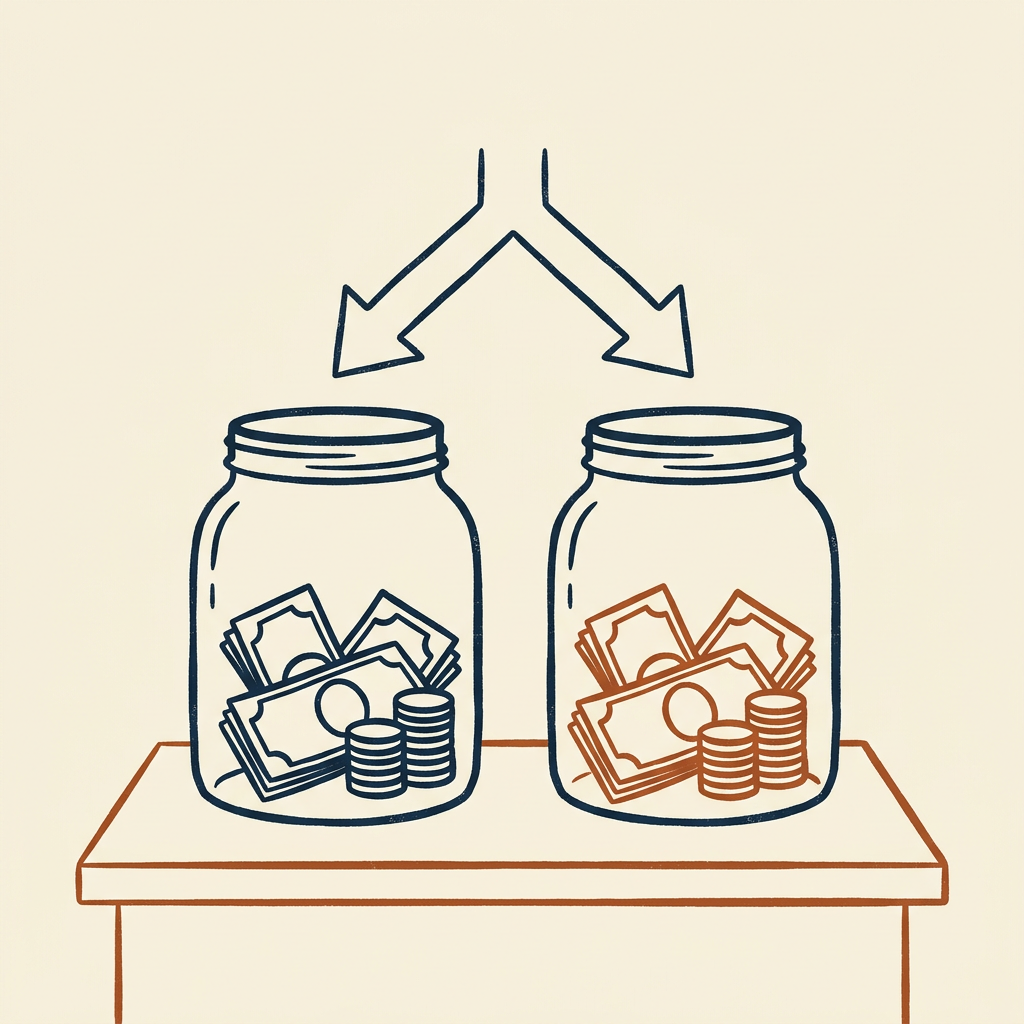
Separating money into purpose-specific accounts matters more than finding the single best interest rate.
Use at least two institutions: a checking account for daily spending and a high-yield online savings account for money that should stay put. The distance is deliberate friction. Dollars sitting next to everyday spending get spent.
Sub-accounts labeled for a vacation or holiday gifts change behavior even though the cash is fungible. That is mental accounting in action—people treat money differently by category even when the economics are identical. Negotiate away monthly fees, watch minimum balances, and time outgoing transfers to payday.
The specific bank matters less than structure that makes saving the default and spending the exception.
In practice: A trip-to-Japan savings account is harder to raid for a night out than the same dollars in a generic balance.

4
Start investing now
Contributing to retirement accounts immediately beats waiting until you feel qualified to pick stocks.
Order of operations comes first: grab the full employer 401k match—it is a guaranteed return no market strategy beats. Then max a Roth IRA for tax-free growth. Then return to the 401k or open a taxable brokerage. Prefer low-cost target-date or index funds over active managers who rarely beat their benchmarks after fees across long stretches.
Time in the market outweighs skill for most people. Advisors who charge asset-based fees without clear outperformance get a hard pass. Obsessing over single stocks distracts from the move that actually works: contribute early and automatically.
This turns the earlier account plumbing into a real destination for money.
In practice: Someone investing six thousand dollars a year from age 25 reaches sixty-five hundreds of thousands ahead of someone who starts the same habit at thirty-five, almost entirely from compounding.

5
Spend on real priorities
Effective budgeting means overspending on a few loves while cutting mercilessly everywhere else.
Replace the line-item diet with a conscious spending plan. Divide take-home pay into four buckets: fixed costs, long-term investments, savings goals, and guilt-free spending. Rough starting ranges sit around fifty to sixty percent fixed, ten percent investments, five to ten percent savings, and twenty to thirty-five percent guilt-free.
Permission is half the point. Love travel? Fund it by killing the gym membership and premium cable you never use. Policing four-dollar coffees makes people miserable and rarely sticks; big conscious cuts do the real work.
Keep the investment bucket automatic and non-negotiable so the plan survives busy months.
In practice: One reader cancels unused subscriptions and a barely driven car to free three hundred dollars a month for travel and ends up happier without falling behind.

6
Automate every transfer
A mediocre plan that runs automatically beats a perfect plan that depends on monthly motivation.
- 1Payday landsPaycheck hits checking
- 2Fixed billsAuto-pay rent and essentials
- 3Invest and saveRetirement then goal accounts
- 4RemainderGuilt-free spending stays put
Wire the pieces together so no ongoing decisions are required. After each paycheck, automatic transfers hit fixed bills first, then retirement and investment accounts, then savings goals. Whatever remains stays in checking as guilt-free money.
Willpower swings with stress and mood. A scheduled transfer does not care how you feel. Most failures are not dramatic blow-ups; they are months of skipped contributions that quietly stack into years.
Automate bill pay too so late fees do not undo earlier credit work. The system has to survive contact with a busy life.
In practice: Transfers timed a day or two after payday move money to bills, investments, and goals before it can be spent by accident.

7
Hunt the big wins
Negotiating income and large purchases creates more lifetime wealth than optimizing small daily costs.
Once the system runs, the highest leverage left is growing what flows into it. Future raises and some retirement contributions often scale off base salary, so a larger number early compounds for decades beyond the face value of one raise.
The same logic covers rent, insurance, and car prices. Scripts and sample language turn the asks into practiced conversations rather than confrontations.
Daily coffee math stays small even with aggressive cuts. A single successful negotiation of a few thousand dollars, invested, leaves those cuts far behind—and the latte can stay.
In practice: A raise of a few thousand dollars early in a career, compounded over decades, outpaces years of skipping small daily purchases.

8
Talk before money fights
Most couple and family money damage comes from silence until a crisis forces the conversation.
Surprise credit card bills, wedding budgets that spiral, or a parent who suddenly needs help all share one root: nobody talked while the stakes were low. The numbers are rarely the real conflict; the missing habit of discussion is.
A recurring, low-stakes check-in keeps small mismatches from becoming relational and financial emergencies. Make the conversation routine so it does not depend on courage in a panic.
This extends the same systems mindset outward into the relationships that actually share the money.
In practice: Waiting until a wedding budget blows up or a parent needs sudden help makes the talk far harder than a regular calm review would have.
Key terms
- money scripts Unspoken childhood lessons about money that quietly drive adult habits
- conscious spending plan A four-bucket split of take-home pay that funds priorities instead of restricting every category
- guilt-free spending The share of income left for whatever you value after fixed costs, investing, and saving
- mental accounting Treating identical dollars differently because of the labels attached to them
- utilization ratio How much of your available credit you are using, which feeds your credit score
- target-date fund A low-cost fund that automatically shifts toward safer assets as a chosen year nears
- employer match Free money a company adds to your retirement contributions up to a set limit
What to do
- Cancel two subscriptions you barely use this week.
- Turn on autopay for the full balance on every credit card.
- Open a high-yield savings account at a second bank and label one goal.
- Raise your 401k contribution enough to capture the full employer match.
- Write a three-line script and practice one fee-waiver or raise ask out loud.
Questions to think with
- Where does your money anxiety actually go, and where does the largest unclaimed dollar sit?
- Which purchases truly improve your days, and which could vanish without pain?
- If every transfer already ran on autopilot, what would still need a human decision each month?
- What money conversation with a partner or family member have you been postponing?
- Are you polishing small daily costs while leaving a raise or large purchase un-negotiated?
The other side
The source summary supplies no developed critique, only a clear audience frame. The whole system assumes steady paychecks, access to a 401k or IRA, and enough surplus to automate without breaking. Gig workers, freelancers without employer plans, and anyone whose income arrives irregularly sit outside that frame and will need different plumbing than the book describes.
Who it's for
Young professionals with steady income who have never built a real financial system, and readers exhausted by guilt-based budgeting who want permission to spend on what matters. It also fits anyone with 401k or IRA access who has delayed investing because they still feel unprepared.