




Distraction starts with discomfort, not your phone
Dek: For knowledge workers who refresh chat constantly, always-on managers, and parents fretting over screens—Eyal’s method, plus Gloria Mark’s finding that focus takes over twenty minutes to regain after an interruption.
IJR · Oct 11, 2026 · 14 min read
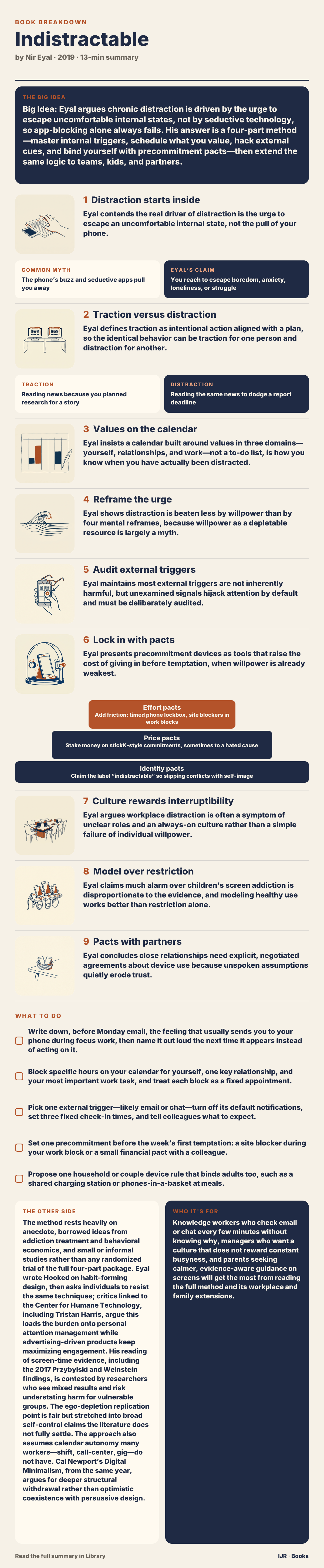
In 60 seconds
- Eyal argues distraction is something you do to escape internal discomfort—boredom, loneliness, anxiety, fatigue—not something a notification does to you.
- The same action is traction when it matches a deliberate plan and distraction when it does not; intent, not the app, decides.
- A values-based calendar for yourself, relationships, and work gives you a baseline so distraction becomes measurable instead of vague guilt.
- Four reframes beat willpower myths: surf the urge, get curious about the feeling, add play to the task, and drop the belief that self-control is a finite tank.
- Audit external triggers only after intentions are clear; then use effort, price, and identity pacts as a backstop made in calm moments.
- Workplaces, parenting, and partnerships shape distraction through culture and unspoken norms as much as individual habits do.
The big idea
Big Idea: Eyal argues chronic distraction is driven by the urge to escape uncomfortable internal states, not by seductive technology, so app-blocking alone always fails. His answer is a four-part method—master internal triggers, schedule what you value, hack external cues, and bind yourself with precommitment pacts—then extend the same logic to teams, kids, and partners.
The book in brief
Book in Brief: Eyal starts from a misdiagnosis. Popular panic blames phones and feeds; he says the reaching hand is fleeing boredom, loneliness, uncertainty, anxiety, or fatigue. Remove one escape and the mind invents another—snacking, gossip, busywork—until the feeling itself is faced.
He then splits behavior by intent. Traction is any action you meant to take; distraction is the same action used to escape. Without a stated plan, you cannot even tell which you did, which is why vague goals like “be productive” offer no protection.
That forces the next move: put values on a calendar in three domains—yourself, relationships, work—so time is finite and missing a block is breaking a promise, not skipping a to-do. Only then do the psychological tools matter: surf urges, reimagine the trigger, the task, and your temperament, including the claim that willpower-as-fuel failed large replication efforts.
Environment comes second. Interrogate every ping and badge—does it serve you?—and redesign email, chat, home screens, and meetings accordingly. Precommitment pacts add friction, money stakes, or identity labels before temptation peaks. The same stack is applied outward to always-on workplaces that punish focus, to families where modeling beats pure restriction, and to couples who need explicit device agreements instead of silent resentment. The arc closes where it began: time management is pain management.
Context
Context: Nir Eyal published the book in 2019 after years of alarm about phones and social media, reframing focus as a trainable skill rather than a battle against evil design. He had earlier written Hooked, a guide for making products habit-forming—the techniques Indistractable then asks readers to resist.
The key ideas

1
Distraction starts inside
Eyal contends the real driver of distraction is the urge to escape an uncomfortable internal state, not the pull of your phone.
Common myth
The phone’s buzz and seductive apps pull you away
Eyal’s claim
You reach to escape boredom, anxiety, loneliness, or struggle
He reframes distraction as something you do to yourself. The reflex to check a phone or open a new tab usually traces back to boredom, loneliness, uncertainty, anxiety, or fatigue—a feeling you want relief from. He noticed he reached for his phone not when it buzzed but when a paragraph got difficult; the trigger was the discomfort of struggling.
Popular fixes treat the symptom. Delete an app or silence notifications and the mind finds another exit: snacking, gossip, busywork, endless email refreshing. Drawing on pain-avoidance theories of behavior, he argues nearly all human action, including distraction, is an attempt to move away from discomfort toward relief.
So before hacking a device, name the feeling you were trying to numb. Once it has a name, you can work the real problem instead of monitoring a window for fake progress. Fixes aimed only at external temptations stay temporary because the discomfort that drives the reach has not been touched; every later tactic in the method depends on accepting this starting point.
In practice: A marketing manager compulsively refreshed a team chat channel; when she paused to identify the feeling, it was fear that a project was failing and she had no way to fix it, so watching the channel felt like doing something useful.

2
Traction versus distraction
Eyal defines traction as intentional action aligned with a plan, so the identical behavior can be traction for one person and distraction for another.
Traction
Reading news because you planned research for a story
Distraction
Reading the same news to dodge a report deadline
Traction is the mirror of distraction: any action taken with intention, in line with what you actually planned, moves you forward. The same action taken to escape discomfort pulls you away. Browsing news is traction for a journalist researching a story and distraction for someone avoiding a report deadline.
You therefore cannot label social media, television, or even exercise as inherently good or bad without knowing what you intended in that moment. Distraction cannot be diagnosed after the fact by looking only at what someone did; it has to be compared with what they meant to do.
That is why device-blocking apps that assume a fixed list of bad apps fail so often. The real distinction is intent, not content. Without a stated plan for time, there is no baseline against which distraction can be measured, and vague intentions cannot be violated.
In practice: Eyal describes catching himself checking sports scores at his desk and asking whether it was a planned break or an escape from a hard task; the answer, not the scores, decided whether it counted as traction or distraction.
3
Values on the calendar
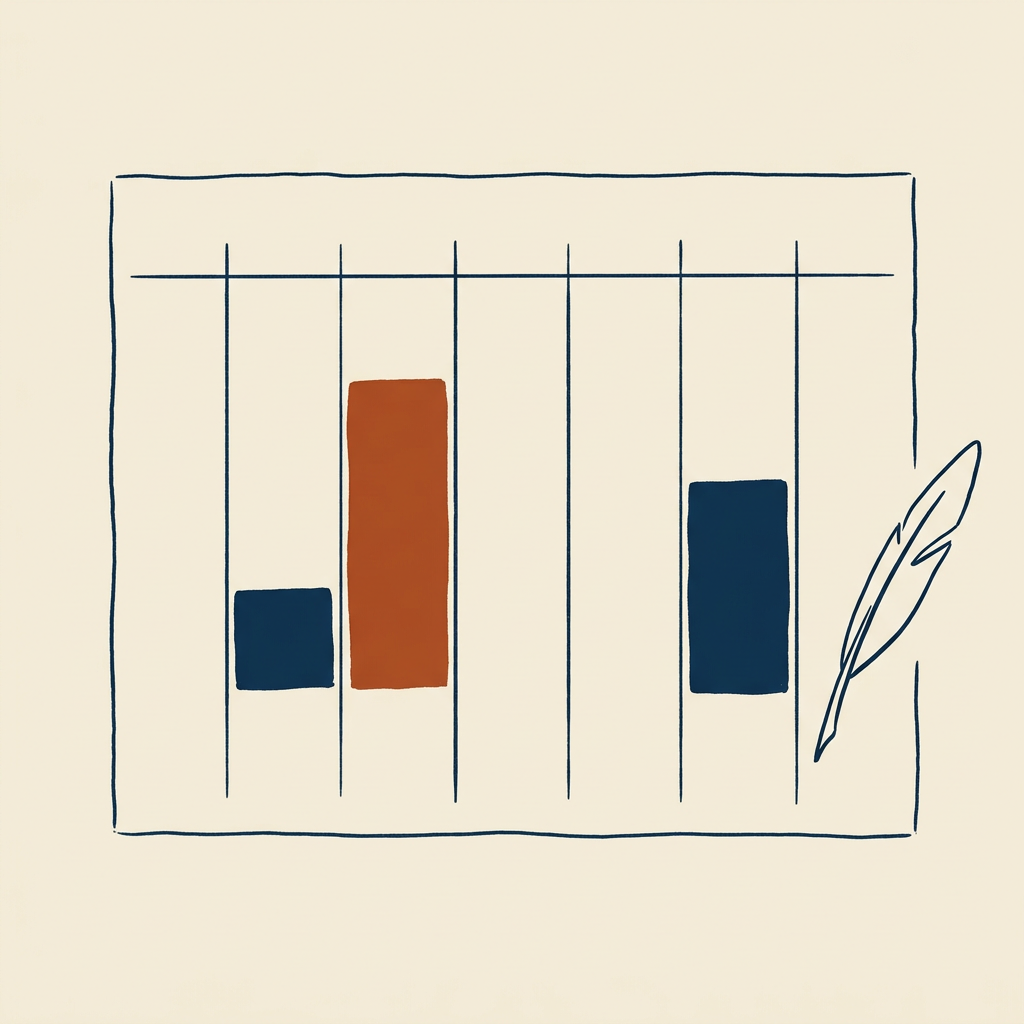
Eyal insists a calendar built around values in three domains—yourself, relationships, and work—not a to-do list, is how you know when you have actually been distracted.
Once distraction requires a defined intention, time has to be scheduled around roles and values rather than endless tasks. Block an hour for exercise, an evening for uninterrupted conversation with a partner, a morning for deep work, and treat missing the block as breaking a promise to yourself.
A to-do list has no boundaries and expands forever. A calendar forces tradeoffs by making time visible and finite. If a task has no home on the calendar, it competes for the same open time as everything else, and low-value activity slips in by default.
He also schedules domains people usually neglect—rest, hobbies, unstructured thinking—because leaving them off the calendar makes them look expendable next to work. Without this step you cannot answer whether a given hour was traction or distraction; with it, any discomfort-driven departure from the block becomes visible and nameable.
In practice: Eyal blocks time labeled simply “husband,” a period reserved for his wife with no other purpose, so the relationship—not an activity checklist—keeps him honest about why the time exists.

4
Reframe the urge
Eyal shows distraction is beaten less by willpower than by four mental reframes, because willpower as a depletable resource is largely a myth.
Once internal triggers arise, he offers specific techniques instead of white-knuckling. Surfing the urge treats a craving to check a phone like a wave: notice it, expect it to peak and pass within about ten minutes, and do not act immediately—a method borrowed from addiction treatment.
Reimagining the internal trigger means meeting the discomfort with curiosity rather than resistance, asking what the feeling actually is. Reimagining the task means adding play or novelty so tedious work becomes closer to a game with self-set rules. Reimagining temperament challenges the belief that self-control is a finite tank that runs dry; he points to the failure of large-scale replication efforts, including a 2016 multi-lab registered replication report led by Hagger and colleagues, to confirm the original ego-depletion effect.
Believing you have limited willpower may itself cause more failures than any actual resource shortage. Since distraction stems from discomfort, the durable fix is changing your relationship to that discomfort, not only hiding temptations that will reappear in another form.
In practice: A person dreading a memo reframes it as a puzzle to be solved, which reduces the urge to avoid the work.

5
Audit external triggers
Eyal maintains most external triggers are not inherently harmful, but unexamined signals hijack attention by default and must be deliberately audited.
After internal work, every ping, badge, and open tab faces one question: is this trigger serving me, or am I serving it. Email moves to three set check times with an autoresponder that sets reply expectations. Group chat loses default notifications so checking becomes a choice. Phone home screens keep tools only, so entertainment requires a deliberate search. Desktops stay clear of unrelated tabs during focus blocks, sometimes with blocking software during scheduled traction time.
These hacks only protect something if the calendar already defined what is being interrupted. Without a known intention there is nothing to defend. The same audit hits meetings: many recurring ones survive from habit and should be challenged like a badge.
Environment design is real and effective, yet it is a second line of defense. Hacking externals before addressing internal discomfort tends to fail because a determined mind opens a new escape channel.
In practice: Eyal removed app icons and switched his phone to grayscale, which reduced the screen’s visual pull enough to change checking behavior without extra willpower.

6
Lock in with pacts
Eyal presents precommitment devices as tools that raise the cost of giving in before temptation, when willpower is already weakest.
- Effort pactsAdd friction: timed phone lockbox, site blockers in work blocks
- Price pactsStake money on stickK-style commitments, sometimes to a hated cause
- Identity pactsClaim the label “indistractable” so slipping conflicts with self-image
Pacts are made in advance, in a calm moment when judgment about what you actually want is clearest. Effort pacts add friction—locking a phone in a timed box such as a kSafe, or a browser extension that blocks distracting sites during scheduled work.
Price pacts put money at stake on platforms such as stickK; you lose a sum, sometimes donated to a cause you dislike, if you break the plan. Identity pacts work differently: you adopt a self-label as someone who is indistractable, so giving in becomes inconsistent with self-image rather than merely against a rule.
Waiting until the moment of temptation to rely on willpower is unreliable, because that is when discomfort is highest and judgment is most compromised. Pacts close the four-part loop as a backstop when reframing, scheduling, and external hacks are not enough.
In practice: Eyal used a public price pact, announcing a writing deadline with a financial penalty for missing it, so public accountability sharpened the cost of failure.

7
Culture rewards interruptibility
Eyal argues workplace distraction is often a symptom of unclear roles and an always-on culture rather than a simple failure of individual willpower.
Individual techniques cannot fully fix distraction if the surrounding culture punishes focus. Drawing on Amy Edmondson’s psychological safety, he suggests employees who feel unsafe raising concerns or admitting uncertainty stay visibly busy—checking messages as a performance of diligence rather than a real need.
Open floor plans and instant messaging create a norm where being interruptible signals importance. People who protect focus blocks can look less committed even when they are more productive. Organizations pay for this: work on the cost of task-switching, including Gloria Mark’s finding that regaining full concentration after an interruption can take over twenty minutes, shows the hidden bill for normalized interruption.
Companies like Basecamp, whose founders have argued for fewer meetings and asynchronous communication, try to redesign norms instead of leaving every employee to fight the culture alone. Hold explicit conversations about response-time expectations, meeting necessity, and communication norms—treat them as design questions, not personal productivity failures. A person can master the personal stack and still be undone by a boss who expects instant replies at all hours.
In practice: Basecamp’s public push for fewer meetings and asynchronous communication stands as an attempt to change the norm rather than demand heroic individual resistance.
8
Model over restriction
Eyal claims much alarm over children’s screen addiction is disproportionate to the evidence, and modeling healthy use works better than restriction alone.
He challenges the framing of children as uniquely vulnerable to phone and game addiction, citing a 2017 study by Andrew Przybylski and Netta Weinstein in Psychological Science and related work that found a curvilinear relationship: moderate screen use correlated with better adolescent wellbeing than either abstinence or heavy use.
True behavioral addiction—compulsive use despite serious harm—is real but relatively rare, and distinct from the ordinary heavy engagement that worries most parents. Treating all screen use as addiction alarms families without helping the smaller number of children who need real care.
He sketches three parenting stances: the model, who shows a healthy relationship with devices; the mentor, who holds open conversations about values rather than issuing bans; and the hoverer, who over-restricts and tends to produce secretive rebellion instead of self-regulation. A household device curfew that binds parents too, plus ongoing talk about why limits exist, beats unexplained rules aimed only at kids.
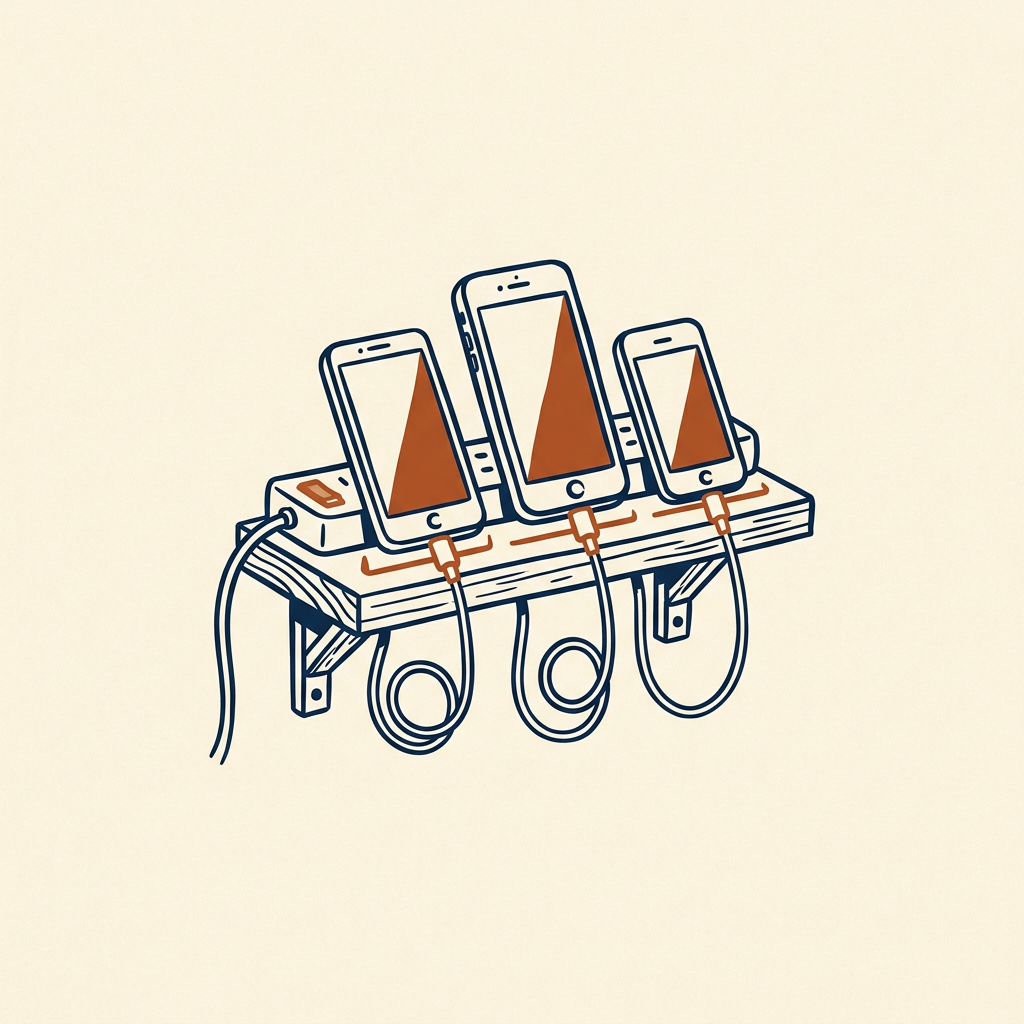
In practice: A family agrees on a shared charging station outside bedrooms for all devices, adults included, framed as a household value rather than a punishment for children.

9
Pacts with partners
Eyal concludes close relationships need explicit, negotiated agreements about device use because unspoken assumptions quietly erode trust.
Many fights about phones in a relationship come from mismatched, unstated expectations rather than genuine indifference. He cites research on phubbing—phone-snubbing during conversation—including work by James Roberts linking frequent phubbing to lower relationship satisfaction, to show the harm is measurable, not mere etiquette.
Partners make an explicit pact, in the spirit of earlier effort and price pacts: phones in a shared basket during meals, or one protected device-free evening a week, then check whether the pact still works instead of assuming it holds forever.
This is the four-part method applied to the relationship people say matters most and protect least. Internal triggers are acknowledged—reaching during talk is often escape from silence or disagreement. Time is scheduled. External triggers are removed from the setting. A pact holds when discomfort tempts a reach. Couples who see what discomfort drives the phone can address the relationship issue directly instead of treating the device as the enemy.
In practice: Partners place phones in a shared basket during meals or protect one device-free evening a week, then revisit whether the agreement is actually working.
Key terms
- Traction Any action you take on purpose, in line with what you planned to do.
- Distraction The same kind of action when it pulls you away from what you intended.
- Internal triggers Uncomfortable feelings—boredom, loneliness, anxiety, fatigue—that spark the urge to escape.
- External triggers Pings, badges, open tabs, and other outside cues that can hijack attention if left unexamined.
- Timeboxing Scheduling fixed calendar blocks for values and roles instead of relying on an endless to-do list.
- Urge surfing Noticing a craving, letting it rise and fall for about ten minutes, and not acting on it right away.
- Precommitment pact A deal you make in advance—friction, money, or identity—that raises the cost of slipping later.
- Effort pact Added friction that makes the unwanted behavior harder, like a timed lockbox or site blocker.
- Price pact Money on the line if you break the plan, sometimes paid to a cause you dislike.
- Phubbing Snubbing someone in conversation by paying attention to your phone instead.
What to do
- Write down, before Monday email, the feeling that usually sends you to your phone during focus work, then name it out loud the next time it appears instead of acting on it.
- Block specific hours on your calendar for yourself, one key relationship, and your most important work task, and treat each block as a fixed appointment.
- Pick one external trigger—likely email or chat—turn off its default notifications, set three fixed check-in times, and tell colleagues what to expect.
- Set one precommitment before the week’s first temptation: a site blocker during your work block or a small financial pact with a colleague.
- Propose one household or couple device rule that binds adults too, such as a shared charging station or phones-in-a-basket at meals.
Questions to think with
- What uncomfortable feeling usually arrives just before you reach for a distraction, and what would addressing that feeling directly look like?
- If you audited yesterday hour by hour against a values-based calendar, where did intent and action actually diverge?
- Which external triggers at work serve your stated priorities, and which exist only because the culture rewards instant interruptibility?
- In your household or partnership, what device expectations are still unspoken, and what explicit pact would make them testable?
- Where do you lack schedule autonomy—and what smaller version of timeboxing or pacts is still within your control?
The other side
The method rests heavily on anecdote, borrowed ideas from addiction treatment and behavioral economics, and small or informal studies rather than any randomized trial of the full four-part package. Eyal wrote Hooked on habit-forming design, then asks individuals to resist the same techniques; critics linked to the Center for Humane Technology, including Tristan Harris, argue this loads the burden onto personal attention management while advertising-driven products keep maximizing engagement. His reading of screen-time evidence, including the 2017 Przybylski and Weinstein findings, is contested by researchers who see mixed results and risk understating harm for vulnerable groups. The ego-depletion replication point is fair but stretched into broad self-control claims the literature does not fully settle. The approach also assumes calendar autonomy many workers—shift, call-center, gig—do not have. Cal Newport’s Digital Minimalism, from the same year, argues for deeper structural withdrawal rather than optimistic coexistence with persuasive design.
Who it's for
Knowledge workers who check email or chat every few minutes without knowing why, managers who want a culture that does not reward constant busyness, and parents seeking calmer, evidence-aware guidance on screens will get the most from reading the full method and its workplace and family extensions.