




Purpose kept people going when strength and luck could not
Frankl argues that among camp prisoners who still had a chance, orientation toward a future task or person made the difference between keeping function and collapsing within days.
IJR · Oct 11, 2026 · 10 min read
In 60 seconds
- Frankl argues the core human drive is a will to meaning, not Freud's pleasure or Adler's power.
- He claims prisoners who kept a future purpose often outlasted equally starved inmates who had none.
- Unavoidable suffering, he says, can still be met as a task through the stance one chooses.
- He treats camp apathy as psychic armor, not proof that character had already collapsed.
- Logotherapy points to three routes: purposeful work, full love of someone, and attitude toward pain one cannot fix.
- He extends the same diagnosis to peacetime boredom he called the existential vacuum.
The big idea
Frankl argues people endure less by chasing comfort or control than by holding a reason—work left unfinished, a person to return to, a stance toward pain they cannot remove. Meaning, on his account, is a stance toward remaining possibilities, still available when almost everything external has been stripped away.
The book in brief
The book opens inside the camps as an extreme test of what still orders a human life once names, clothes, and safety are gone. Frankl reports that inmates who lost every future aim often stopped fighting, while those who still answered to a task or a person kept eating, moving, and resisting the slide into fatal numbness—without denying that selection lines and chance killed without regard to attitude.
From that observation he widens the claim: when suffering can be changed, the task is to change it; when it cannot, the remaining freedom is how one bears it. He ties dignity to that narrow space between pressure and response, which he says he watched diverge even among men under identical hunger.
He then maps the inner weather of imprisonment—arrival shock, the adaptive shutdown of feeling, and the strange flatness of liberation—so attitude is not mistaken for a simple switch. Survival with purpose intact, he insists, did not automatically restore ordinary feeling or decency.
The second movement names his therapy. Against the will to pleasure and the will to power he sets a will to meaning, reached through work, through loving another fully, or through the stance taken toward unavoidable pain. He closes by reading modern boredom and hollow comfort as a milder form of the same vacuum, still answered by those three concrete routes rather than by more distraction.
Context
Viktor E. Frankl was a psychiatrist and Holocaust survivor whose 1946 book joined camp memoir to the outline of logotherapy. It mattered because it gave psychology and general readers a vocabulary for purpose under extremity, and later for ordinary drift, that complicated purely pleasure- or power-based models of motivation.
The key ideas
1
Future purpose sustained life
Frankl claims that among prisoners who still had a chance, a sense of future purpose tracked continued functioning more closely than raw strength or luck.
No future aim
Last cigarette given up; collapse often followed within days
Held a why
Unfinished work or a person to reach still ordered daily effort
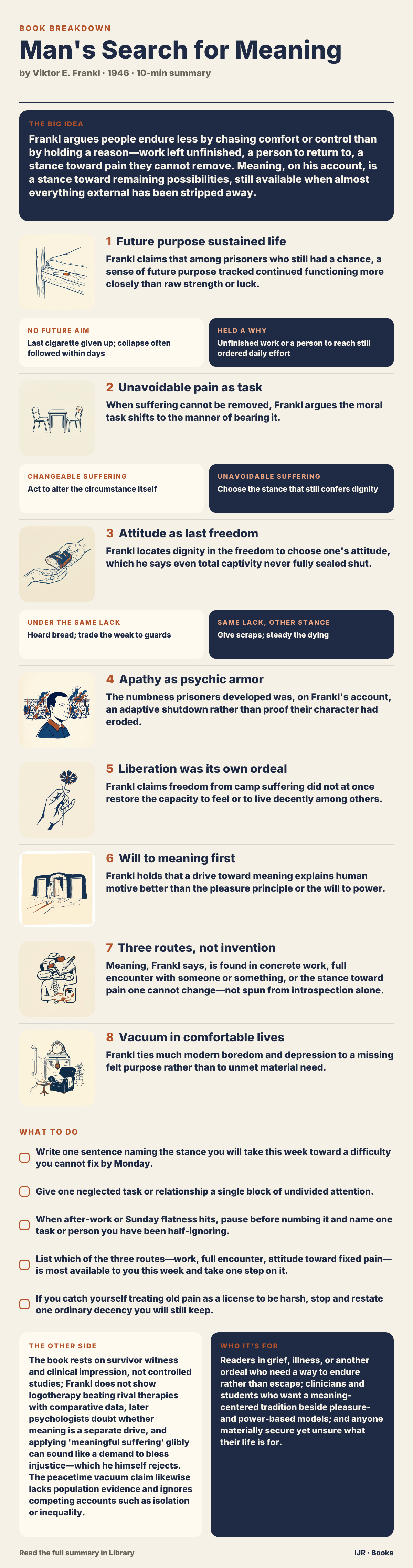
He watched men who abandoned every tomorrow collapse fast, sometimes within days, even when no new blow had fallen. The tell, among inmates, was giving up the last cigarette—an outward sign that waiting had ended.
His narrower point is not that willpower rewrote selection lines or typhus. Chance still killed without justice. Among those not immediately destroyed, though, orientation toward a remaining task or person helped determine who still ate, moved, and refused the apathy that preceded death.
Meaning here is not a mood. It is a stance toward what is still possible, adoptable after almost every external good is gone. He treats the camp as the harshest laboratory for a pattern he says also orders ordinary endurance.
In practice: Frankl credits the drive to rebuild a confiscated manuscript and an imagined conversation with his wife, whose fate he did not then know, with keeping him pointed forward.
2
Unavoidable pain as task
When suffering cannot be removed, Frankl argues the moral task shifts to the manner of bearing it.
Changeable suffering
Act to alter the circumstance itself
Unavoidable suffering
Choose the stance that still confers dignity
He splits pain that still yields to action from pain that will not—terminal illness, permanent loss, genocide. For the first, the duty is to change the fact. For the second, he says the person is not finished choosing.
The remaining freedom is attitudinal: how one carries what cannot be undone. That stance does not cancel grief; it gives grief a shape a life can still inhabit.
He refuses to romanticize suffering or call it required for meaning. The claim is only that pain already present need not be empty pain if the bearer still chooses a response.
In practice: An elderly patient stuck on his wife's death was asked to picture the reverse; he saw his grief as having spared her that burden, which did not lift the loss but made it bearable.
3
Attitude as last freedom
Frankl locates dignity in the freedom to choose one's attitude, which he says even total captivity never fully sealed shut.
Under the same lack
Hoard bread; trade the weak to guards
Same lack, other stance
Give scraps; steady the dying
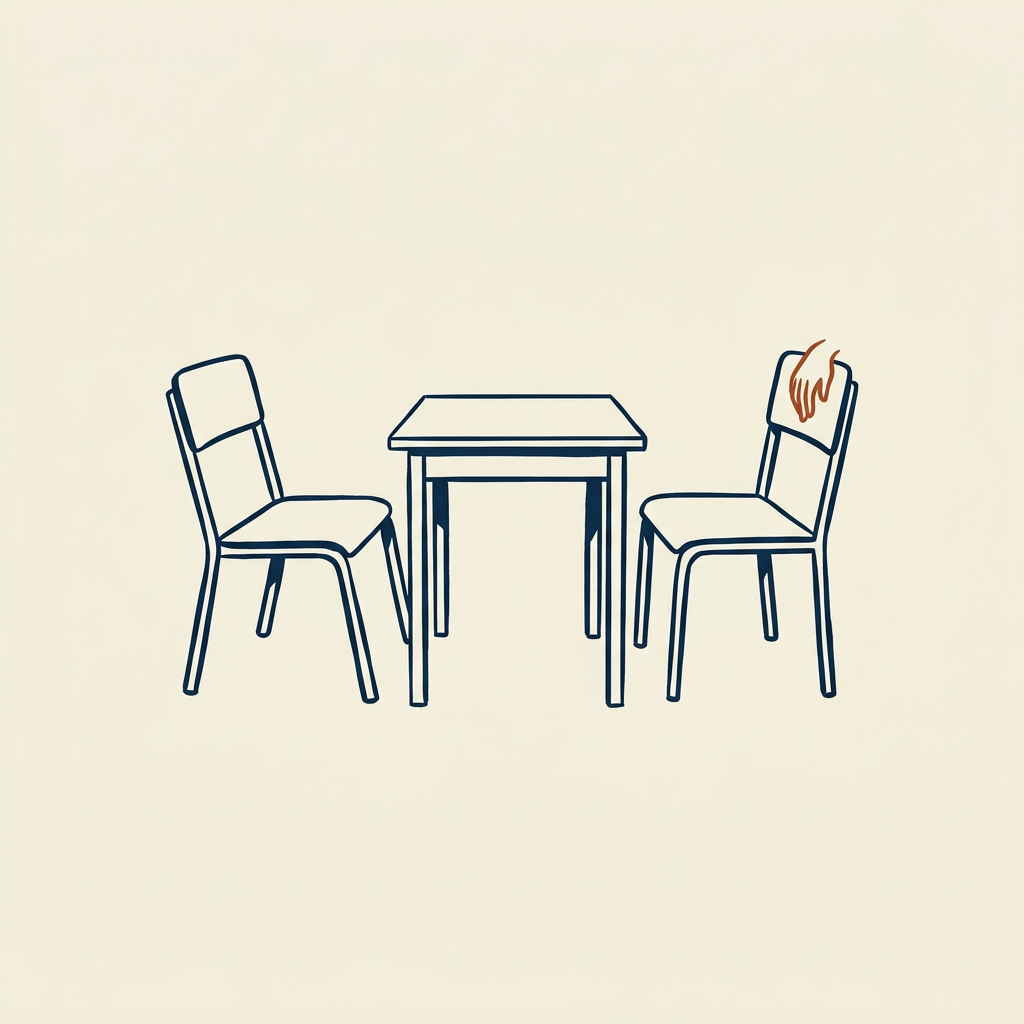
Men stripped of names, clothes, and property still differed in the barracks. Under the same hunger, some hoarded and traded weaker inmates to guards; others gave scraps or comforted the dying.
He reads that split as evidence that the gap between stimulus and response never fully closes. The 'last of the human freedoms,' on his telling, is the stance taken inside circumstances one does not pick.
He does not claim equal capacity for every prisoner—health, luck, and prior resources varied. The witnessed claim is simply that behavior diverged under matching deprivation, so meaning-making is not a peacetime luxury.
In practice: Some inmates betrayed others for small privileges while equally starved men still handed over their own bread.
4
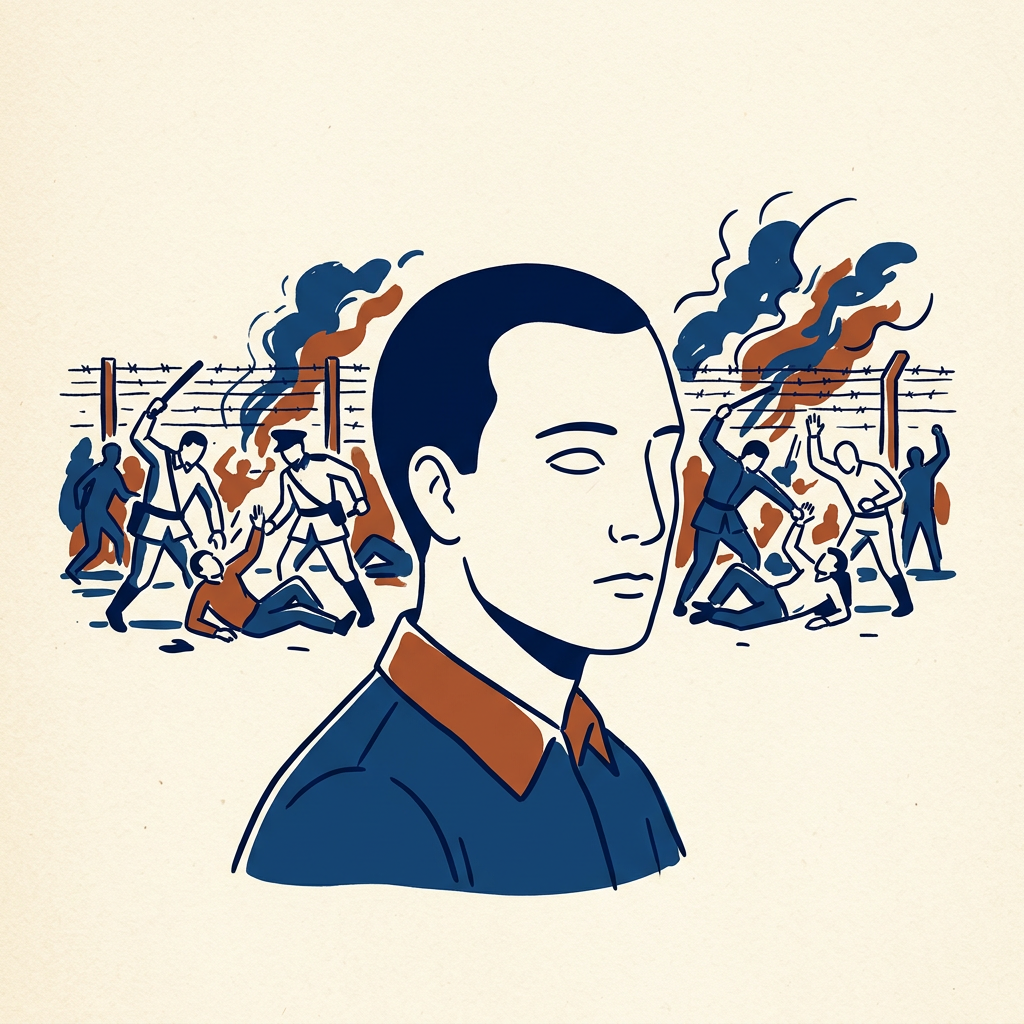
Apathy as psychic armor
The numbness prisoners developed was, on Frankl's account, an adaptive shutdown rather than proof their character had eroded.
He sketches three phases: the shock of arrival, a relative apathy once camp routine closed in, and, for those freed, a later depersonalization. The middle phase looked like moral ruin to outsiders.
Men who would once have recoiled at a public beating learned to watch without reaction. He compares the bluntness to a limb gone numb under continuous injury—necessary if the psyche was to keep any function at all.
That reading protects his larger claim: outer flatness did not always mean the inner future-orientation was dead. Apathy could still tip into true resignation and death if no goal or bond broke it, so he describes maintenance of inner life as fragile and effortful, not a toggle.
In practice: Prisoners capable of watching a beating without visible response were, he argues, often defending the mind rather than becoming the brutes the SS preferred.

5
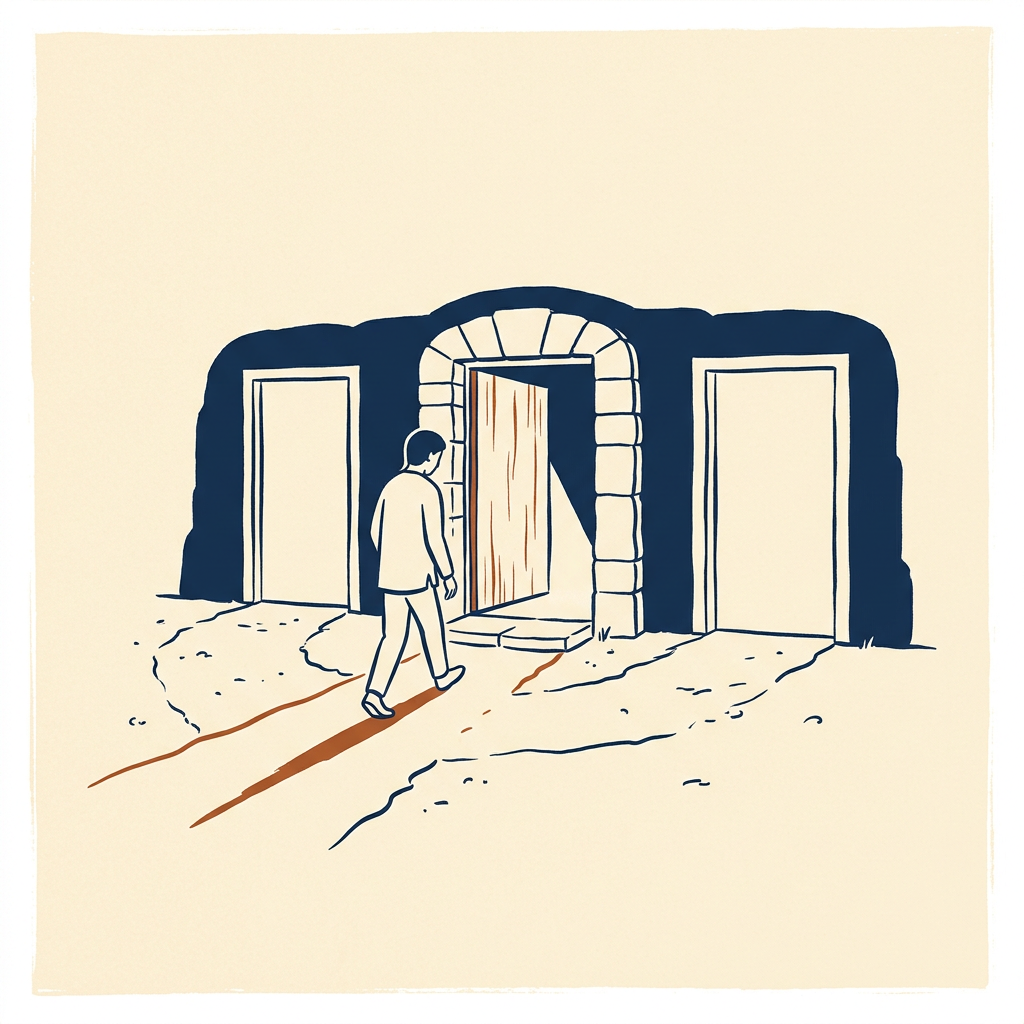
Liberation was its own ordeal
Frankl claims freedom from camp suffering did not at once restore the capacity to feel or to live decently among others.
His own release felt flat, not euphoric—more like divers' decompression sickness than triumph. Ordinary sensations returned late, if at all, in the first days.
Some survivors, he reports, treated their pain as a license for hardness: cruelty toward former captors or bystanders, as if suffering had canceled ordinary limits. He reads that bitterness as delayed trauma, not proof that ordeal builds character by itself.
Others came home to a world that had moved on, neighbors who did not want the details, and, for some, the discovery that their families were gone. Adjustment to freedom, he says, still required the same attention to purpose the camps had demanded.
In practice: Walking into fields after liberation, he picked flowers and felt almost nothing.
6
Will to meaning first
Frankl holds that a drive toward meaning explains human motive better than the pleasure principle or the will to power.
He positions logotherapy against the schools he knew best. Freud's person, in his reading, seeks tension-reduction and drive discharge; Adler's seeks power, status, or cover for inferiority.
A third motive—the will to meaning—better fits, he argues, both camp inmates who surrendered comfort for a cause or person and peacetime patients who felt hollow though pleasure and status needs were met. He tied some depression and addiction to a missing why rather than to repressed drive or inferiority alone.
The three-way map is his construction. He offers clinical description and camp witness here, not controlled head-to-head proof that logotherapy outperforms the other two.
In practice: He describes patients whose symptoms seemed to track a felt absence of purpose even after material and status wants were satisfied.

7
Three routes, not invention
Meaning, Frankl says, is found in concrete work, full encounter with someone or something, or the stance toward pain one cannot change—not spun from introspection alone.
He refuses a single universal answer to what life means. Meaning is always tied to a person, a moment, and a situation—like asking for the best chess move without the board position.
The first route is creating a work or finishing a task that gives a day shape. The second is experiencing something or someone fully; love, on his account, grasps another's unique potential and is already meaningful apart from outcome. The third is the attitude taken toward suffering that will not move.
The modest yield is practical: three directions to check when life feels empty, not a cosmic slogan. He gives less help for the case when all three routes are blocked, as they were for many who died before any could open.
In practice: He compares the hunt for a general 'meaning of life' to demanding the best move in chess without specifying the position on the board.

8
Vacuum in comfortable lives
Frankl ties much modern boredom and depression to a missing felt purpose rather than to unmet material need.
As inherited answers from religion and fixed roles thinned, he argues, many never replaced them with a why of their own. The resulting gap—the existential vacuum—showed up in his clinic as boredom-linked depression, addiction, and aggression among people who lacked little outwardly.
It is not mere idleness. Direction can be absent in the middle of busy days, and it often bit hardest when the work week stopped masking the question—Sundays, retirement.
That mid-century diagnosis is why the book reached readers who never saw a camp: the extreme pattern had an everyday twin, and the same three routes still applied. The support here is clinical impression, not population data.
In practice: He notes the vacuum often surfaced most sharply on Sundays or in retirement, when routine no longer hid the missing why.
Key terms
- will to meaning Frankl's claimed primary drive: the need for a why, ahead of pleasure or power
- logotherapy His therapy built on finding concrete meaning rather than only analyzing drives or inferiority
- attitudinal value The worth located in how one chooses to face suffering that cannot be changed
- last of the human freedoms The capacity, never fully erased, to choose one's stance inside any circumstance
- existential vacuum A felt absence of purpose that can haunt even comfortable, busy lives
- camp apathy The middle-phase emotional numbness he read as defense, not automatic moral collapse
What to do
- Write one sentence naming the stance you will take this week toward a difficulty you cannot fix by Monday.
- Give one neglected task or relationship a single block of undivided attention.
- When after-work or Sunday flatness hits, pause before numbing it and name one task or person you have been half-ignoring.
- List which of the three routes—work, full encounter, attitude toward fixed pain—is most available to you this week and take one step on it.
- If you catch yourself treating old pain as a license to be harsh, stop and restate one ordinary decency you will still keep.
Questions to think with
- What future task or person is actually ordering your effort right now, if any?
- Which sufferings in your life are still changeable, and which only answer to stance?
- Where are you half-attending to work or someone who might become a source of meaning if fully met?
- Does your numbness feel like temporary armor, or like resignation that needs a why to interrupt it?
- If comfort is already present and purpose is not, what inherited answer did you lose and what concrete one might replace it?
The other side
The book rests on survivor witness and clinical impression, not controlled studies; Frankl does not show logotherapy beating rival therapies with comparative data, later psychologists doubt whether meaning is a separate drive, and applying 'meaningful suffering' glibly can sound like a demand to bless injustice—which he himself rejects. The peacetime vacuum claim likewise lacks population evidence and ignores competing accounts such as isolation or inequality.
Who it's for
Readers in grief, illness, or another ordeal who need a way to endure rather than escape; clinicians and students who want a meaning-centered tradition beside pleasure- and power-based models; and anyone materially secure yet unsure what their life is for.