




How ordinary choices erase an organization's founding purpose
Greer shows faith-based groups repeatedly ending as secular providers after centuries of small grant, hiring, and metric shifts.
IJR · Oct 8, 2026 · 8 min read
In 60 seconds
- Greer argues mission drift begins with small rational choices on grants, staff, and metrics that compound into fundamental change.
- He shows financial and scale numbers crowding out purpose measures, so groups optimize for growth over original impact.
- Succession without mission screening, Greer claims, installs leaders who run the organization as a generic enterprise.
- Revenue from government and secular foundations creates incentives that rewrite identity around funder terms rather than charter.
- Organizations that keep purpose, he finds, use recurring practices such as annual mission audits and values-aligned hiring rubrics.
- Reversing drift, Greer insists, requires costly structural steps like declining revenue and changing leadership, not just new rhetoric.
The big idea
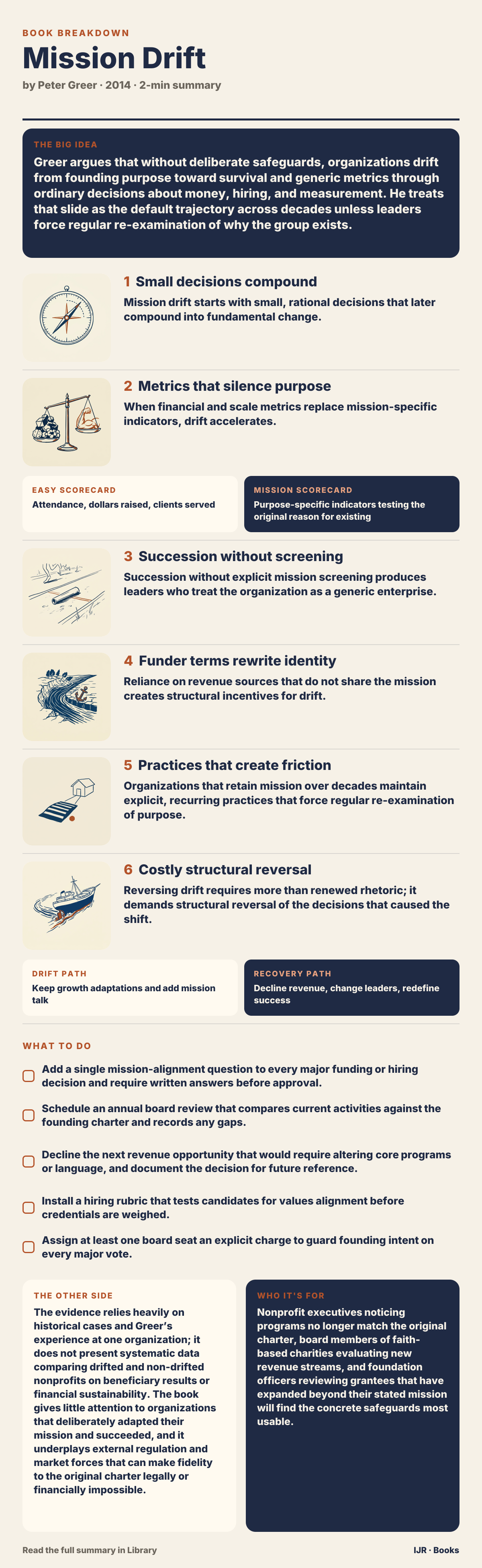
Greer argues that without deliberate safeguards, organizations drift from founding purpose toward survival and generic metrics through ordinary decisions about money, hiring, and measurement. He treats that slide as the default trajectory across decades unless leaders force regular re-examination of why the group exists.
The book in brief
Greer starts from the quiet problem that organizations, especially faith-based nonprofits, lose their original reason for being without ever announcing the change. Small, sensible moves—accepting a grant with new metrics, hiring for credentials over conviction, tracking growth instead of fidelity—pile up until the group no longer matches its charter.
He walks through how measurement drives the slide. Leaders face pressure to report attendance, dollars, and clients served because funders understand those figures. Without parallel purpose indicators, the organization treats mission as something to fix later and optimizes for the visible scorecard.
Leadership handoffs accelerate the shift. Founders carry the mission personally; boards then pick successors for professional skill or fundraising power. The new leader may never have internalized the founding convictions, so the place starts to look like any efficient service provider.
Funding sources that do not share the mission lock in the new direction. Government contracts and large secular foundations demand standardized outcomes and often bar religious elements. The largest checks rewrite priorities and identity over time.
Greer then turns to what holds. Groups that retain mission for decades install concrete practices: annual mission audits, hiring rubrics testing values alignment, boards that include guardians of founding intent. These create operational friction when proposals conflict with core purpose.
He closes on recovery. Some organizations have reversed the distance by declining certain revenue, changing leadership, and redefining success. The short-term cost is real because it undoes the adaptations that produced growth. Without accepting that cost, he warns, drift continues as the default path.
Context
Greer draws on historical cases and his experience at one organization. The 2014 book maps how purpose erodes under ordinary nonprofit pressures.
The key ideas

1
Small decisions compound
Mission drift starts with small, rational decisions that later compound into fundamental change.
Greer shows organizations rarely declare they are leaving their core purpose. They accept a grant that requires new metrics, hire staff without the founding values, or measure success by growth rather than fidelity to the original charter.
Over years these choices accumulate until the institution no longer resembles its start. Each step feels sensible in the moment, which is why the drift goes unnoticed until the distance is large.
He treats the pattern as repeating across centuries rather than appearing suddenly. The mechanism is incremental substitution: every decision replaces a piece of founding intent with a more convenient alternative that still looks like progress.
In practice leaders must treat each grant, hire, and metric change as a potential charter rewrite, not a one-off operational tweak.
In practice: The long religious-to-secular path he traces begins with exactly these ordinary, defensible choices.

2
Metrics that silence purpose
When financial and scale metrics replace mission-specific indicators, drift accelerates.
Easy scorecard
Attendance, dollars raised, clients served
Mission scorecard
Purpose-specific indicators testing the original reason for existing
Leaders face pressure to report numbers funders understand. Attendance, dollars raised, and clients served become the public scorecard.
Greer notes these figures are easy to track but silent on whether the original reason for existence still holds. Without parallel measures tied to purpose, the organization optimizes for the visible numbers.
Mission adherence turns into a secondary concern that can be addressed later. The dashboard stays green while the charter quietly loses force.
What to do inside this frame is keep purpose indicators on the same scorecard so they cannot be deferred when money or scale look strong.
In practice: A nonprofit that counts only clients served and dollars raised while dropping any check on whether programs still match the founding intent.

3
Succession without screening
Succession without explicit mission screening produces leaders who treat the organization as a generic enterprise.
Founders often carry the mission in personal conviction. When they leave, boards frequently select replacements based on professional credentials or fundraising ability.
Greer argues the new leader may never have internalized the founding convictions. Without structured transmission of the core purpose, the organization begins to resemble any other efficient service provider.
The handoff is the point where personal conviction fails to transfer. Credentials look safer than values tests, so boards skip the harder screen.
The application is to treat mission alignment as a non-negotiable hiring gate rather than an assumed carry-over from the founder’s era.
In practice: A board that picks a proven fundraiser who has never worked inside the founding values and then watches the culture shift toward generic efficiency.

4
Funder terms rewrite identity
Reliance on revenue sources that do not share the mission creates structural incentives for drift.
Government contracts and large secular foundations often require standardized outcomes and prohibit certain religious elements. Accepting these funds solves immediate budget gaps.
Greer shows the acceptance shifts internal priorities toward compliance with the funder. Over time the organization’s identity is rewritten by the terms of the largest checks rather than by its founding documents.
The structural incentive is simple: the biggest revenue stream sets the real rules. Survival pressure makes the trade feel necessary in the moment.
Leaders who want to resist have to treat funder alignment as a mission risk equal to any program decision, not just a finance issue.
In practice: A charity that takes a government contract barring religious language and later finds its programs and staff culture rewritten around the contract’s standardized outcomes.

5
Practices that create friction
Organizations that retain mission over decades maintain explicit, recurring practices that force regular re-examination of purpose.
Greer describes concrete mechanisms such as annual mission audits, hiring rubrics that test for values alignment, and board compositions that include guardians of the founding intent.
These are not symbolic statements but operational requirements that trigger when a proposed action conflicts with the core purpose. The practices create friction against incremental drift.
Without the friction, every new grant or hire feels harmless. With it, the organization must pause and justify the move against the charter before it proceeds.
The point is to make purpose review a routine gate rather than an occasional speech from the podium.
In practice: A board that runs an annual mission audit and rejects a promising grant because the required metrics would pull programs off the founding charter.

6
Costly structural reversal
Reversing drift requires more than renewed rhetoric; it demands structural reversal of the decisions that caused the shift.
Drift path
Keep growth adaptations and add mission talk
Recovery path
Decline revenue, change leaders, redefine success
Some organizations have returned to their original mission after recognizing the distance traveled. Recovery involved declining certain revenue, changing leadership, and redefining success measures.
Greer insists the process proved costly in the short term because it reversed the very adaptations that had produced growth. Without willingness to accept that cost, drift continues.
Rhetoric alone leaves the structural incentives in place. Only undoing the funding, hiring, and metric choices that caused the slide can restore the charter.
Leaders considering recovery have to budget for the lost growth and the internal resistance that follows the reversal.
In practice: An organization that cuts a major secular funding stream, replaces leadership, and rebuilds its scorecard around original purpose measures despite a temporary drop in scale.
Key terms
- Mission drift Gradual, often unnoticed loss of founding purpose through small shifts in priorities, funding, and leadership
- Mission-specific indicators Measures tied directly to original purpose rather than generic counts of money, attendance, or clients
- Annual mission audit Recurring board review that compares current activities against the founding charter and records gaps
- Hiring rubric Structured test for values alignment used when selecting staff or leaders
- Guardians of founding intent Board members whose explicit role is to protect the original mission during decisions
- Structural reversal Undoing the funding, leadership, and measurement choices that produced drift, not merely adding new language
What to do
- Add a single mission-alignment question to every major funding or hiring decision and require written answers before approval.
- Schedule an annual board review that compares current activities against the founding charter and records any gaps.
- Decline the next revenue opportunity that would require altering core programs or language, and document the decision for future reference.
- Install a hiring rubric that tests candidates for values alignment before credentials are weighed.
- Assign at least one board seat an explicit charge to guard founding intent on every major vote.
Questions to think with
- Which current metric would still look good if the founding purpose had already disappeared?
- What revenue source most strongly shapes internal priorities today?
- When the next leader is chosen, what concrete test will show they carry the original mission?
- Which recent decision would fail an honest annual mission audit?
- What short-term cost would the organization actually accept to reverse a clear drift?
The other side
The evidence relies heavily on historical cases and Greer’s experience at one organization; it does not present systematic data comparing drifted and non-drifted nonprofits on beneficiary results or financial sustainability. The book gives little attention to organizations that deliberately adapted their mission and succeeded, and it underplays external regulation and market forces that can make fidelity to the original charter legally or financially impossible.
Who it's for
Nonprofit executives noticing programs no longer match the original charter, board members of faith-based charities evaluating new revenue streams, and foundation officers reviewing grantees that have expanded beyond their stated mission will find the concrete safeguards most usable.