




Stop chasing yes and start listening for fear
Deals stick when the other side feels safe and understood, not when you land on a fair split.
IJR · Oct 9, 2026 · 12 min read
In 60 seconds
- Standard negotiation theory fails because real decisions run on fear and security needs, not rational spreadsheets.
- Mirroring the last few words someone says pulls out more information than direct questions ever do.
- Labeling a negative emotion out loud with 'It seems like...' lowers its grip before bargaining starts.
- A quick yes is often counterfeit; engineering a safe no gives the other side control and opens real progress.
- The breakthrough phrase is 'that's right,' not 'you're right,' and it arrives only after a full emotional summary.
- Calibrated how-and-what questions, the Rule of Three, and hunting Black Swans turn understanding into deals that actually get executed.
The big idea
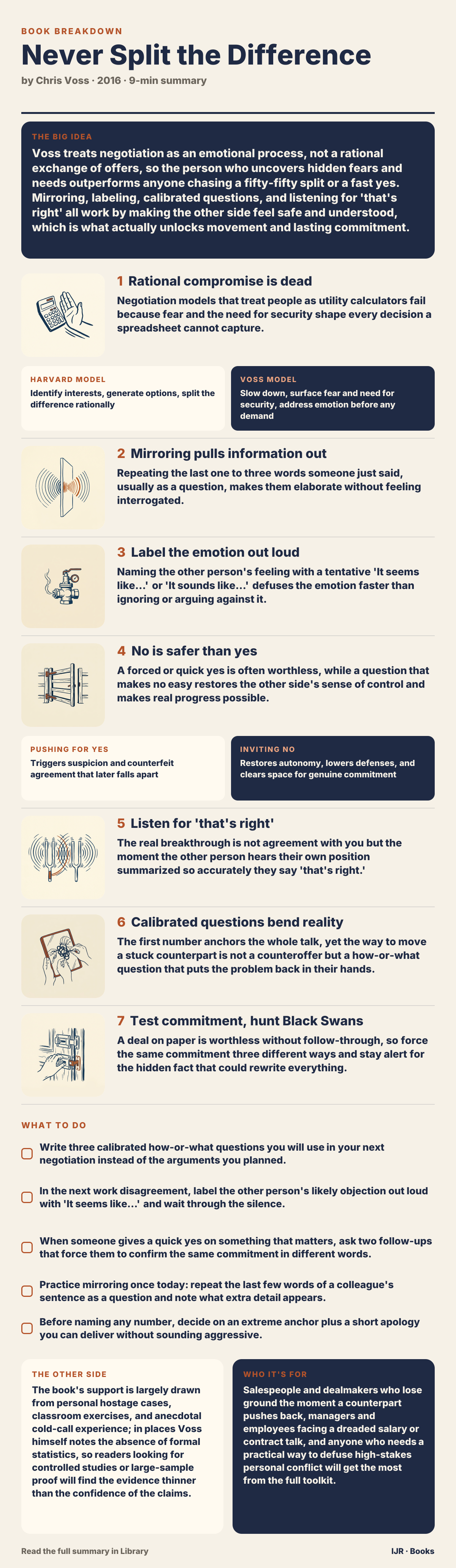
Voss treats negotiation as an emotional process, not a rational exchange of offers, so the person who uncovers hidden fears and needs outperforms anyone chasing a fifty-fifty split or a fast yes. Mirroring, labeling, calibrated questions, and listening for 'that's right' all work by making the other side feel safe and understood, which is what actually unlocks movement and lasting commitment.
The book in brief
Voss starts by tearing down the Harvard-style model of principled negotiation that assumes both sides are rational calculators who can identify interests, generate options, and split the difference. His years as the FBI's lead international kidnapping negotiator showed him the opposite: in a standoff, people are scared, angry, or desperate, and those emotions drive every word. The same pattern, he says, shows up in salary talks and vendor contracts. A fast yes is often counterfeit, given just to end discomfort, so the real job is to slow down and address the unspoken fear before touching the stated demand.
He then hands readers the entry-level tool: mirroring. Repeat the last one to three words the other person said, usually as a question, and they keep talking instead of defending. That simple nudge, borrowed from therapy, surfaces the emotional undercurrent without interrogation. From there he adds tactical empathy through labeling: start with 'It seems like...' or 'It sounds like...' and name the feeling. Once named, the negative emotion loses force, the other person can correct the guess, and the temperature drops enough for real bargaining.
Next he flips the sales obsession with yes. People treat yes as the word that precedes being sold something, so counterfeit agreement is common and deals collapse later. Questions that invite a comfortable no restore autonomy and make cooperation possible. The psychological hinge that follows is the phrase 'that's right'—not 'you're right'—which arrives only after you summarize both the facts and the emotions attached to them in the other side's own language.
With emotional groundwork in place, Voss turns to movement on numbers and terms. Extreme anchors paired with an apology widen the range in your favor; calibrated questions beginning with how or what hand the problem back so the other side feels authorship over the solution. Why-questions are avoided because they sound accusatory across cultures. Finally he insists an agreement means nothing without execution. The Rule of Three forces the same commitment to be confirmed three different ways, and the hunt for Black Swans—hidden facts that would change everything—keeps the negotiator alert past the handshake. The arc closes where it began: people give you what you want only after they feel you understand what they need.
Context
Chris Voss spent years as the FBI's lead international kidnapping negotiator before publishing the book in 2016. He draws directly on cases such as the 1998 Chase Manhattan Bank robbery and domestic hostage standoffs, then translates those high-stakes lessons into salary talks, vendor contracts, and everyday conflict. The book mattered because it offered a blunt alternative to the rational, interest-based model that had dominated business-school teaching for decades.
The key ideas

1
Rational compromise is dead
Negotiation models that treat people as utility calculators fail because fear and the need for security shape every decision a spreadsheet cannot capture.
Harvard model
Identify interests, generate options, split the difference rationally
Voss model
Slow down, surface fear and need for security, address emotion before any demand
Voss opens by dismantling the long-dominant Harvard approach: identify interests, invent options, land on a mutually rational outcome. In a hostage standoff nobody is running utility functions; they are scared, angry, or desperate, and those emotions dictate the words that come out. He insists the same emotional engine drives a salary conversation or a vendor dispute.
Demands, he learned, are rarely the real issue. The emotion behind the demand is. When hostage-takers felt heard they grew calmer and more flexible even before any concession appeared on the table. That observation led him to reject the rush toward 'getting to yes.' A quick yes is often counterfeit, offered only to escape discomfort.
The negotiator's actual job is therefore to slow down, tolerate silence and repetition, and address the unspoken fear first. The approach can feel inefficient in the moment, yet the payoff is a deal that holds because the other side received what it needed emotionally, not merely what it asked for on paper. Chasing understanding, not agreement, becomes the prerequisite for any lasting deal.
In practice: In the 1998 Chase Manhattan Bank robbery, two armed men held hostages; Voss saw that making them feel heard calmed them and opened flexibility long before any material concession.

2
Mirroring pulls information out
Repeating the last one to three words someone just said, usually as a question, makes them elaborate without feeling interrogated.
Mirroring is borrowed from Rogerian therapy and is almost absurdly simple to execute. If a counterpart says they cannot go above forty thousand, you reply 'forty thousand?' The move signals pure attentiveness without contradiction, so the other person keeps talking rather than defending a position.
Most negotiators do the opposite: they talk too much, trying to persuade with arguments. Voss argues the more powerful combination is silence plus a tiny verbal nudge that keeps the other side elaborating. Every extra sentence supplies more material and, in high-stakes settings, reduces the chance of rash action.
He is frank that mirroring alone will not win a negotiation; it is the entry-point technique you can start using immediately. Overuse turns it into mockery, so the skill lies in sparing, curious repetition rather than parroting every line. Once emotion is on the table, the later tools have something real to work with.
In practice: In a USC business-school exercise, students who mirrored extracted far more information from partners than students who asked direct follow-up questions.

3
Label the emotion out loud
Naming the other person's feeling with a tentative 'It seems like...' or 'It sounds like...' defuses the emotion faster than ignoring or arguing against it.
Tactical empathy is not ordinary sympathy; it is the deliberate verbalizing of the other side's feelings for strategic effect. The delivery vehicle is the label: a hypothesis, never a diagnosis, phrased so the counterpart can correct it and thereby reveal still more.
Once a negative emotion is named it tends to lose grip. Voss links this loosely to affect-labeling work in psychology, where putting a feeling into words reduces intensity in the brain's threat-response system. Labeling the negative first—getting ahead of the accusation—preempts an attack before it lands.
In business the same move works on a frustrated client: acknowledge the missed deadlines before the client weaponizes them. The corrected label itself becomes useful data, and the lowered emotional temperature creates calmer ground for the actual bargain. Mirroring draws information out; labeling processes it back so both sides can move.
In practice: In a domestic hostage case Voss labeled a suicidal man's fear of being seen as a failure; the man's tone shifted once he felt understood rather than judged.

4
No is safer than yes
A forced or quick yes is often worthless, while a question that makes no easy restores the other side's sense of control and makes real progress possible.
Pushing for yes
Triggers suspicion and counterfeit agreement that later falls apart
Inviting no
Restores autonomy, lowers defenses, and clears space for genuine commitment
Sales training worships yes, yet people are conditioned to treat yes as the word that precedes being sold. Voss sorts yes into three kinds—commitment, confirmation, and counterfeit—and warns that the counterfeit version, given only to escape the conversation, is far more common than negotiators admit. That is why deals that looked agreed later collapse.
The remedy is to engineer questions that invite a comfortable no. 'Is now a bad time to talk?' lets the person refuse without feeling cornered; the no actually clears the way for a later real yes. Cornered people fight; people who feel autonomous cooperate.
A related move replaces 'Are you still interested?' with 'Have you given up on this project?' The defensive no that follows reasserts commitment. Safety, not agreement, is the true currency; no is frequently the safest word the other side can utter, and offering it freely is what unlocks movement.
In practice: Switching cold-call scripts from 'Do you have a few minutes?' to a question that invited refusal produced markedly better response rates in Voss's experience.

5
Listen for 'that's right'
The real breakthrough is not agreement with you but the moment the other person hears their own position summarized so accurately they say 'that's right.'
'You're right' is often a brush-off, a polite way to end the conversation without true alignment. 'That's right' signals that the person feels fully understood; Voss treats it as the psychological hinge after which a counteroffer will be heard rather than resisted.
Reaching that phrase requires periodic summaries that restate both the facts and the emotions attached to them, using language the other side would use themselves. Skip the emotional half and the summary feels accurate but hollow, prompting only a flat 'you're right.' Then pause and let them confirm or correct.
The technique scales from hostage standoffs to a curfew talk with a teenager. It also reframes persuasion itself: the goal is no longer to deliver the best argument but to make the other person feel their argument has been completely absorbed before you offer your own. Readers now have an audible checkpoint instead of guessing whether rapport exists.
In practice: Voss used a full emotional summary in a negotiation over his own son's curfew and heard the shift to 'that's right' that unlocked movement.

6
Calibrated questions bend reality
The first number anchors the whole talk, yet the way to move a stuck counterpart is not a counteroffer but a how-or-what question that puts the problem back in their hands.
Voss accepts that whoever names the first figure shapes the negotiation, then adds a twist: extreme anchors delivered with an apology for their extremity widen the range in your favor while preserving goodwill. Ranges rather than single numbers can soften the same high anchor.
The larger tool is the calibrated question—open prompts that begin with how or what. 'How am I supposed to do that?' or 'What's making this difficult?' hands the problem to the other side so they solve it with their own creativity and authority instead of feeling ordered. Direct demands trigger defensiveness; these questions create authorship.
Why-questions are banned because they read as accusatory in nearly every language and culture Voss has worked in. Mirroring and labeling built the emotional floor; calibrated questions convert that floor into concrete movement on price, terms, or proof of life, all while the counterpart feels they remain in charge of the outcome.
In practice: In a kidnapping negotiation the question 'How do I know he's alive?' produced actionable proof, whereas a blunt demand for proof might have been heard as an accusation of bluffing and escalated the standoff.

7
Test commitment, hunt Black Swans
A deal on paper is worthless without follow-through, so force the same commitment three different ways and stay alert for the hidden fact that could rewrite everything.
Hostage cases taught Voss that a suspect's yes to surrender terms sometimes masked zero intention to comply. The Rule of Three counters that risk: obtain confirmation of the identical commitment three separate times, under three different framings—a summary, a calibrated question, a labeled emotion—so a lie becomes hard to sustain and the confirmations never feel like badgering.
He also imports the Black Swan idea, repurposed to mean the unknown piece of information that, once found, changes the entire negotiation. Every deal hides at least three such facts; people rarely volunteer anything that weakens their position. Mirroring, labeling, and calibrated questions exist partly to surface those hidden drivers.
The negotiator's job therefore does not end at yes or even at 'that's right.' It continues through implementation, where overlooked details and undisclosed motives most often collapse the agreement. Discovery of a single Black Swan can reframe price, timing, or structure entirely.
In practice: Learning a kidnapper's financial desperation—unrelated to the stated ransom—let the FBI reframe the negotiation around a smaller, faster payment.
Key terms
- Mirroring Repeating the last one to three words the other person said, usually as a question, to make them keep talking.
- Tactical empathy Understanding and saying aloud the other side's feelings, not out of kindness but to gain strategic effect.
- Labeling Starting with 'It seems like…' or 'It sounds like…' and guessing the emotion so it loses force and can be corrected.
- Counterfeit yes An agreement given only to escape the conversation, not because the person truly commits.
- That's right The phrase that signals the other person feels fully understood; the hinge after which real movement becomes possible.
- Calibrated question An open how-or-what prompt that hands the problem back so the other side solves it and feels in control.
- Rule of Three Getting the same commitment confirmed three different ways to test whether the agreement is real.
- Black Swan A hidden piece of information that, once discovered, would change the entire negotiation.
What to do
- Write three calibrated how-or-what questions you will use in your next negotiation instead of the arguments you planned.
- In the next work disagreement, label the other person's likely objection out loud with 'It seems like…' and wait through the silence.
- When someone gives a quick yes on something that matters, ask two follow-ups that force them to confirm the same commitment in different words.
- Practice mirroring once today: repeat the last few words of a colleague's sentence as a question and note what extra detail appears.
- Before naming any number, decide on an extreme anchor plus a short apology you can deliver without sounding aggressive.
Questions to think with
- Where in your last stalled deal did you push for a fast yes instead of making no feel safe?
- What unspoken fear might be sitting underneath the demand your counterpart keeps repeating?
- If you summarized both the facts and the emotions of the other side's position right now, would they say 'that's right'?
- Which commitment you recently accepted has been confirmed only once, and how could you test it two more ways?
- What piece of information, if it surfaced tomorrow, would force you to rewrite the deal you think you already understand?
The other side
The book's support is largely drawn from personal hostage cases, classroom exercises, and anecdotal cold-call experience; in places Voss himself notes the absence of formal statistics, so readers looking for controlled studies or large-sample proof will find the evidence thinner than the confidence of the claims.
Who it's for
Salespeople and dealmakers who lose ground the moment a counterpart pushes back, managers and employees facing a dreaded salary or contract talk, and anyone who needs a practical way to defuse high-stakes personal conflict will get the most from the full toolkit.