


Society built an extrovert ideal that wastes quiet talent
Cain argues Western culture prizes charisma and constant sociability, sidelining roughly a third to half the population who invent, lead, and think deeply in quieter ways.
IJR · Oct 11, 2026 · 12 min read
In 60 seconds
- Early-twentieth-century America shifted from valuing character to valuing outward personality, making boldness a proxy for competence.
- Introversion is a preference for lower stimulation, not shyness, with roots visible in infant reactivity and amygdala response.
- Group brainstorming and open-plan offices yield fewer, weaker ideas than solitary work followed by pooling.
- Introverted leaders managing proactive employees earned roughly fourteen percent higher profits by listening rather than dominating.
- People can act against type for valued goals, but only if they repay the cost with deliberate restorative solitude.
- Schools, offices, and parents unlock wasted talent by making quiet work and optional participation legitimate again.
The big idea
Cain argues that modern Western culture built a narrow ideal self around charisma, speed, and constant sociability, then mistook that model for the only path to competence. Introverts think, decide, and lead differently rather than worse, and institutions that treat solitude as second-best systematically underuse a large share of their most capable people.
The book in brief
Cain starts from a cultural problem: Western society, especially the United States, spent the twentieth century constructing an Extrovert Ideal that treats boldness and constant sociability as moral and professional worth. She traces how that ideal narrowed the definition of a successful self and quietly pathologized calm temperaments.
She then clarifies what introversion actually is—a stimulation preference, not shyness—and grounds it in temperament research, including infant reactivity studies that link early biology to later quiet or bold styles without claiming personality is fixed at birth.
The middle of the book attacks workplace orthodoxy. Cain walks through evidence that unstructured group brainstorming and open offices suppress original thought, then shows introverted leaders outperforming extroverted ones when employees take initiative. She extends the risk argument to trading-floor culture before the 2008 crash, where reward-seeking confidence crowded out caution.
She softens the picture with Free Trait Theory: introverts can perform extroversion for causes they care about, but only if they recover in restorative niches. A cultural chapter from Cupertino shows the Extrovert Ideal is not universal; quiet, humility-oriented norms can coexist with high achievement.
She lands on design. Schools, offices, and parenting practices built only for the loud waste talent; small structural changes that legitimize solitude and optional participation unlock contributions constant group activity suppresses. The closing claim is institutional respect for quiet work, not a call for anyone to change temperament.
Context
Susan Cain published Quiet in 2012, drawing on temperament research, workplace studies, and interviews to challenge the Extrovert Ideal that twentieth-century America had constructed around boldness, charisma, and persuasion.
The key ideas
1
From character to personality
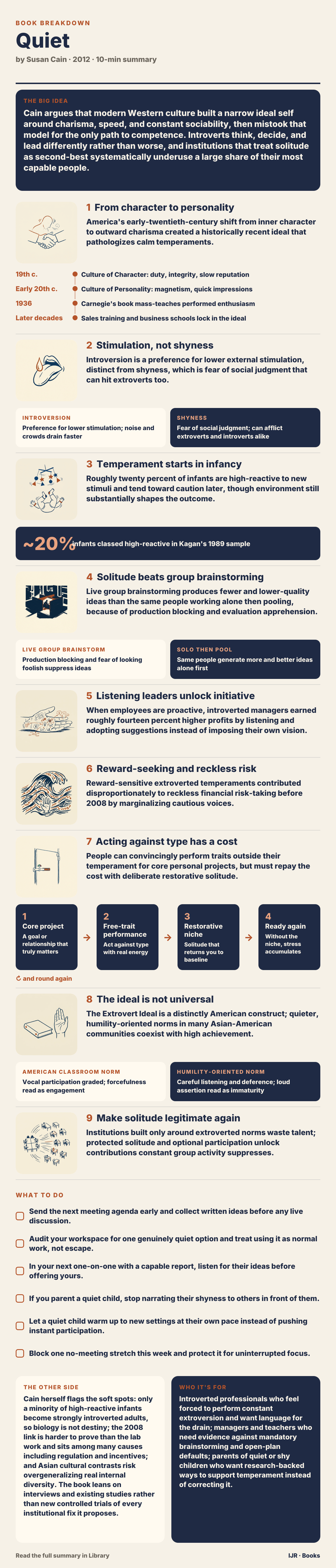
America's early-twentieth-century shift from inner character to outward charisma created a historically recent ideal that pathologizes calm temperaments.
- 19th c.Culture of Character: duty, integrity, slow reputation
- Early 20th c.Culture of Personality: magnetism, quick impressions
- 1936Carnegie's book mass-teaches performed enthusiasm
- Later decadesSales training and business schools lock in the ideal
Cain follows historian Warren Susman in describing a move from a Culture of Character to a Culture of Personality. Nineteenth-century advice urged duty, integrity, and citizenship. Early twentieth-century manuals promised magnetism, fascination, and dominance instead.
Dale Carnegie is her hinge figure: a Missouri farm boy terrified of public speaking who reinvented himself as a teacher of charm. His 1936 book, which sold in the millions and remains in print, taught readers to win friends by performing enthusiasm rather than proving trustworthiness over years.
Urbanization and big business made the shift practical. In small towns reputation grew slowly among neighbors; in cities and corporations people had to impress strangers fast. Sales training, personnel departments, and business schools institutionalized the preference for performance over modesty.
The lasting result, Cain argues, is that workplaces, schools, and even family expectations still treat assertiveness as a proxy for competence and moral worth without examining the assumption.
In practice: Carnegie's own arc—from fearful farm boy to salesman of confidence—mirrors the cultural turn he helped popularize.
2
Stimulation, not shyness
Introversion is a preference for lower external stimulation, distinct from shyness, which is fear of social judgment that can hit extroverts too.
Introversion
Preference for lower stimulation; noise and crowds drain faster
Shyness
Fear of social judgment; can afflict extroverts and introverts alike
Cain leans on Hans Eysenck's arousal theory to pry apart two traits people constantly confuse. Shyness is fear of being judged. Introversion is how much outside noise, crowd energy, and multitasking a nervous system can take before it floods.
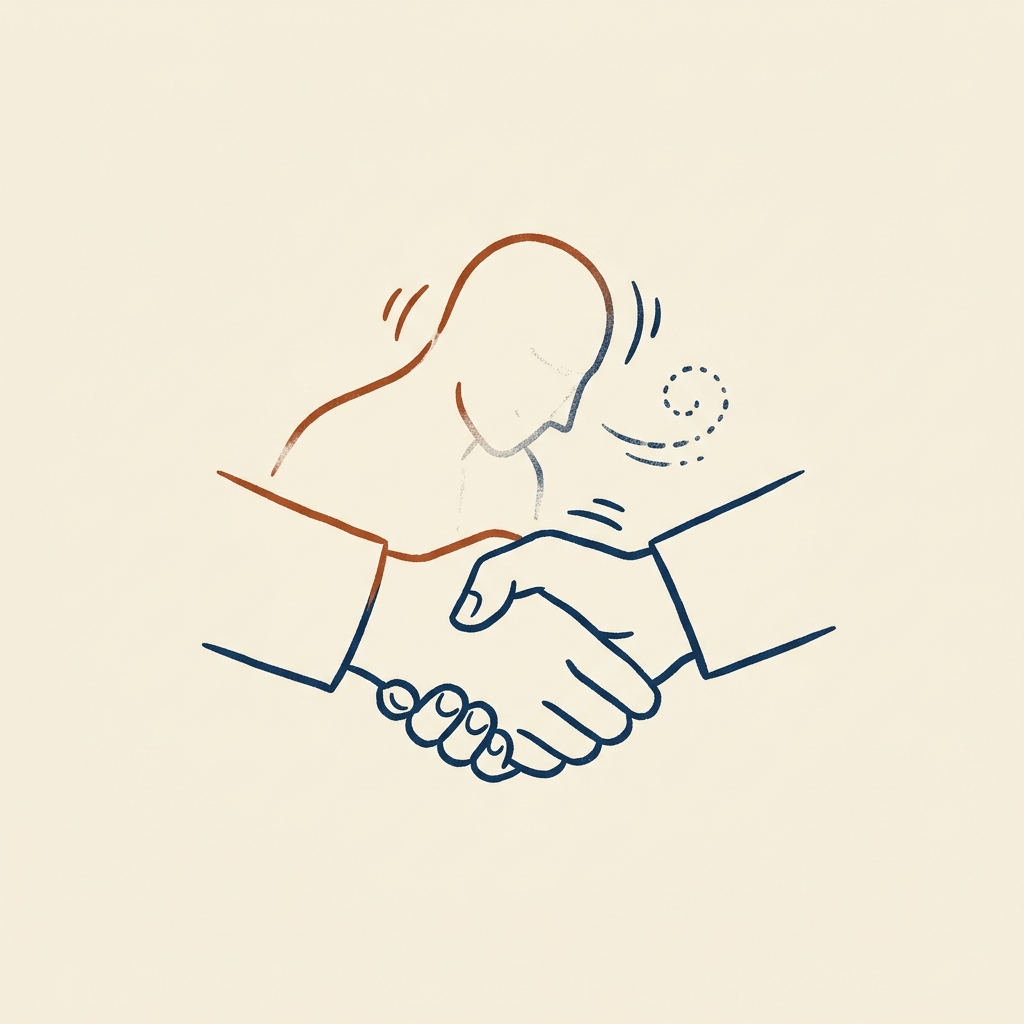
A rough physiological marker she cites is the lemon-juice test: a drop on the tongue tends to produce more salivation in introverts, read as higher baseline arousal to stimuli. Extroverts often feel understimulated by quiet; introverts feel drained by the same room that energizes them.
The practical stakes are high. Workplaces and parents often try to cure both traits with more group exposure. That may help shyness. Applied to introversion, it pushes people into constant stimulation that genuinely depletes them rather than merely stretches them.
Getting the diagnosis right changes the support that actually works. A courtroom lawyer can be articulate all day and still need hours alone afterward; a gregarious partygoer who panics before a small talk is shy without being introverted.
In practice: The lawyer who thrives before a jury yet collapses into solitude after is introverted; the tireless party guest who freezes at a presentation is shy.
3
Temperament starts in infancy
Roughly twenty percent of infants are high-reactive to new stimuli and tend toward caution later, though environment still substantially shapes the outcome.
~20%
infants classed high-reactive in Kagan's 1989 sample
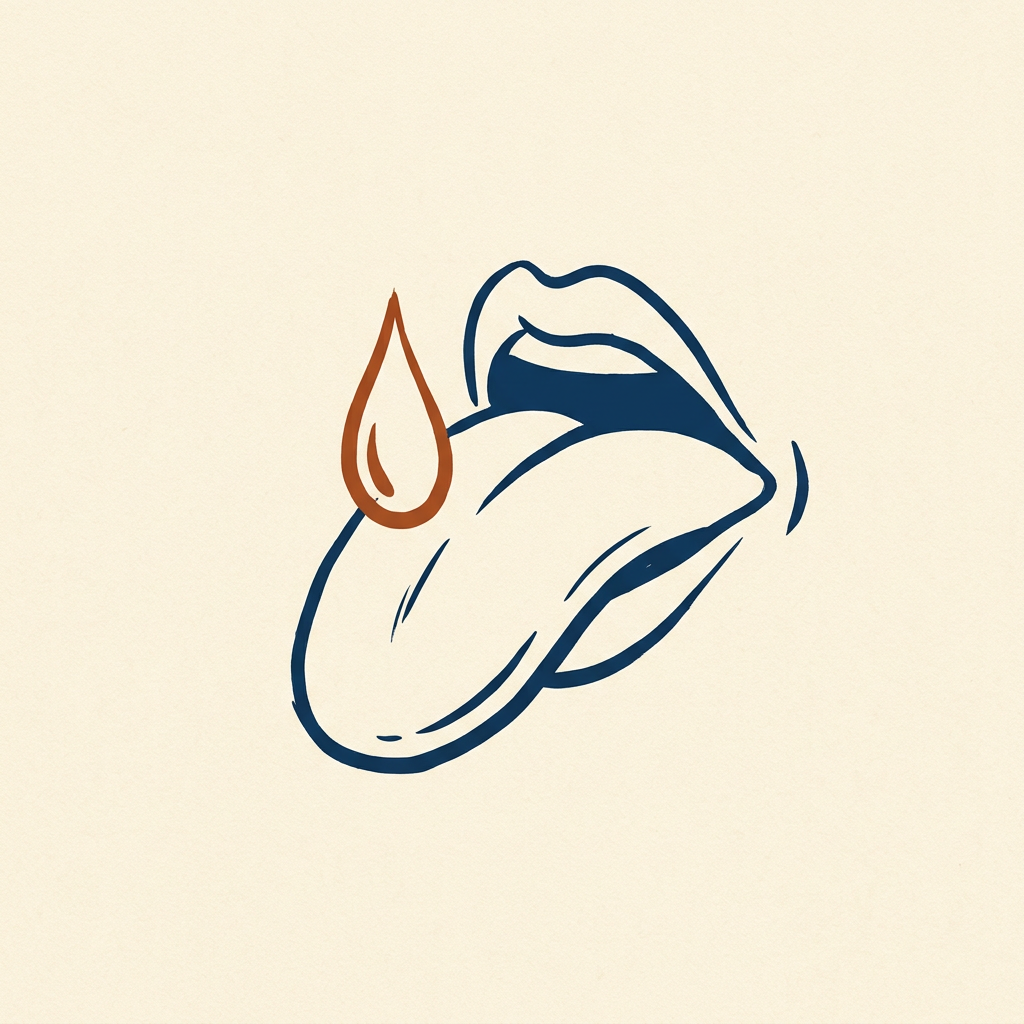
In 1989 Jerome Kagan began tracking about 500 four-month-olds' physical reactions to mobiles, unfamiliar voices, and alcohol on a cotton swab. About twenty percent thrashed and cried hard—high-reactive. About forty percent stayed calm—low-reactive. The rest fell in between.
Followed into adolescence, high-reactive babies showed a strong tendency, not a certainty, to become cautious, quiet teens; low-reactive babies tended toward bold sociability. Later brain scans linked the pattern to amygdala excitability around novel faces.
Cain is careful with the limits. Only a minority of high-reactive infants became strongly introverted adults, and some low-reactive infants grew shy anyway. Parenting, culture, and experience modify the biology.
She offers the work not as destiny but as proof that temperament has a physiological foundation. That should discourage treating introversion as a mere habit that can be argued or trained away at no cost.
In practice: Kagan's high-reactive infants, startled by a spinning mobile, were more likely—though far from guaranteed—to become quiet teenagers.
4
Solitude beats group brainstorming
Live group brainstorming produces fewer and lower-quality ideas than the same people working alone then pooling, because of production blocking and evaluation apprehension.
Live group brainstorm
Production blocking and fear of looking foolish suppress ideas
Solo then pool
Same people generate more and better ideas alone first
Alex Osborn popularized brainstorming in 1948: generate freely in a group, defer all criticism. The method swept corporate America and helped justify open-plan offices meant to spark spontaneous collaboration.
Marvin Diehl and Wolfgang Stroebe's late-1980s experiments kept finding the opposite. Individuals working alone, then combining results, beat face-to-face groups on both quantity and quality. Only one person can speak at a time, so others lose ideas; fear of looking foolish makes people self-censor.
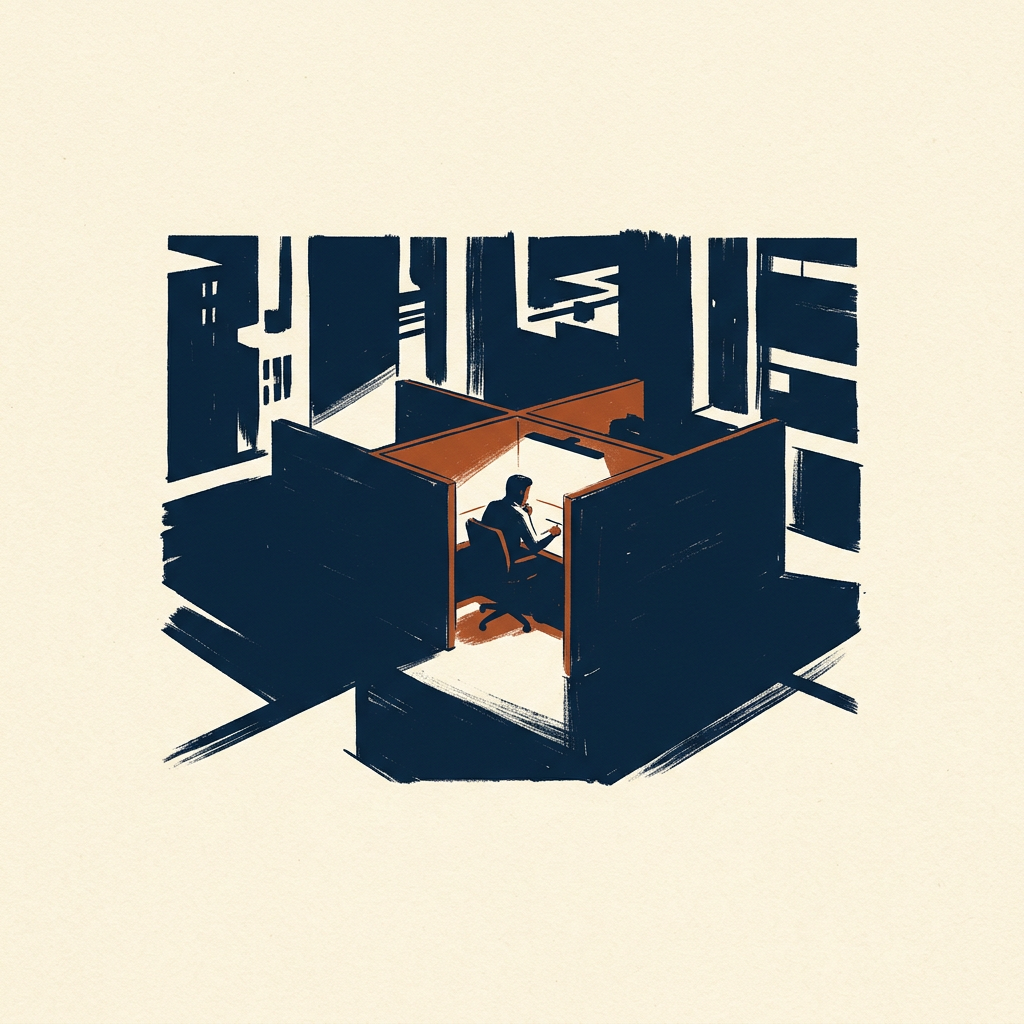
Cain ties the pattern to deep work. Open plans raise interruption and noise, cutting concentration and raising stress. Anders Ericsson's deliberate-practice research needs uninterrupted focus that those spaces undermine.
Her point is not that collaboration is worthless. Unstructured, face-to-face group idea generation is often the wrong tool, and organizations mistake visible chatter for productive thinking.
In practice: Steve Wozniak designed the Apple II largely alone at night in a Hewlett-Packard cubicle, not in brainstorming sessions.
5
Listening leaders unlock initiative
When employees are proactive, introverted managers earned roughly fourteen percent higher profits by listening and adopting suggestions instead of imposing their own vision.
Adam Grant's 2011 study of pizza-delivery franchises compared branch results under introverted versus extroverted managers and checked whether staff were proactive or passive. The interaction mattered more than either trait alone.
With proactive employees, introverted managers' branches earned meaningfully more—roughly fourteen percent in Grant's data—because those managers tended to hear and implement floor-level ideas. Extroverted managers did better only when staff were passive and needed energy and direction from above.
Cain reads this as a strike against the assumption that charismatic dominance is always superior. Hiring for confident interview performance optimizes for the wrong trait when the real job is absorbing and amplifying other people's judgment.
Quiet historical catalysts fit the same logic: unyielding refusal without theater, patient correspondence and behind-the-scenes persuasion rather than stage presence.
In practice: Grant's pizza franchises with proactive crews and introverted bosses posted roughly fourteen percent higher profits than the reverse pairing.

6
Reward-seeking and reckless risk
Reward-sensitive extroverted temperaments contributed disproportionately to reckless financial risk-taking before 2008 by marginalizing cautious voices.
Cain draws on Richard Depue's link between extroversion and dopamine-driven reward sensitivity, which tracks with greater willingness to chase payoff through risk. Trading-floor culture, in interviews with figures such as Boykin Curry, treated caution as weakness and rewarded bold, fast bets.
Studies of traders on gambling-style tasks found lower anxiety and stronger reward-seeking predicted larger real-world losses in volatile markets. The calm confidence the culture prized could blur into dangerous overconfidence.
She is candid that the claim is harder to prove than the temperament chapters. Regulatory failure, incentives, and institutional culture all drove 2008; extroverted personalities alone did not cause the crash.
The modest version she defends is that selecting almost exclusively for confident risk-takers removes a natural check. Temperament diversity on boards and floors may lower the odds that everyone believes the same convenient story at once.
In practice: Wall Street voices Cain interviews describe a floor where careful dissent was socially punished even when it later proved right.
7
Acting against type has a cost
People can convincingly perform traits outside their temperament for core personal projects, but must repay the cost with deliberate restorative solitude.
- 1Core projectA goal or relationship that truly matters
- 2Free-trait performanceAct against type with real energy
- 3Restorative nicheSolitude that returns you to baseline
- 4Ready againWithout the niche, stress accumulates
↻ and round again
Brian Little's Free Trait Theory holds that fixed biological temperaments coexist with the capacity to adopt free traits temporarily in service of goals and relationships people genuinely care about. The performance is real; the bill comes due afterward.
Little, a self-described introvert, delivers animated high-energy lectures because teaching matters to him, then retreats—sometimes to a bathroom stall—to recover. Cain calls these recovery periods restorative niches: a closed door, a solitary walk, a quiet commute.
Modern workplaces increasingly demand constant availability, open collaboration, and visible enthusiasm. That asks introverts to run free traits almost continuously without acknowledging recovery time. Sustained self-monitoring of this kind links to elevated stress markers and, in some research, weakened immune response.
The double edge matters. Introverts are not fragile and can thrive in extroverted roles when purpose is real. Organizations that treat the capacity as infinite, denying private space, eventually burn out people who looked perfectly comfortable on stage.
In practice: Little finishes a charged lecture, then hides in a bathroom stall to let his nervous system return to baseline.
8
The ideal is not universal
The Extrovert Ideal is a distinctly American construct; quieter, humility-oriented norms in many Asian-American communities coexist with high achievement.
American classroom norm
Vocal participation graded; forcefulness read as engagement
Humility-oriented norm
Careful listening and deference; loud assertion read as immaturity
Cain visits a Cupertino high school with a large Asian-American population. Students describe pressure from teachers and American-born peers to speak up more often and more forcefully, even when their instinct is to think first or yield the floor.
She contrasts the American classroom's graded vocal participation with Confucian-influenced values that prize humility, careful listening, and group harmony, reading loud self-assertion as immaturity rather than confidence.
Teachers still found quieter Asian-American students frequently outperforming more vocal classmates. Classroom talkativeness, Cain argues, is a poor proxy for intelligence or engagement.
She refuses to essentialize a continent. Diversity within Asian-American communities and gaps between immigrant parents and American-raised children are real. The broader reveal is that American business and school norms treat one cultural answer as simply how effective people behave.
In practice: Quieter Cupertino students, pressed to be more forceful in class, still often posted stronger academic results than louder peers.
9
Make solitude legitimate again
Institutions built only around extroverted norms waste talent; protected solitude and optional participation unlock contributions constant group activity suppresses.
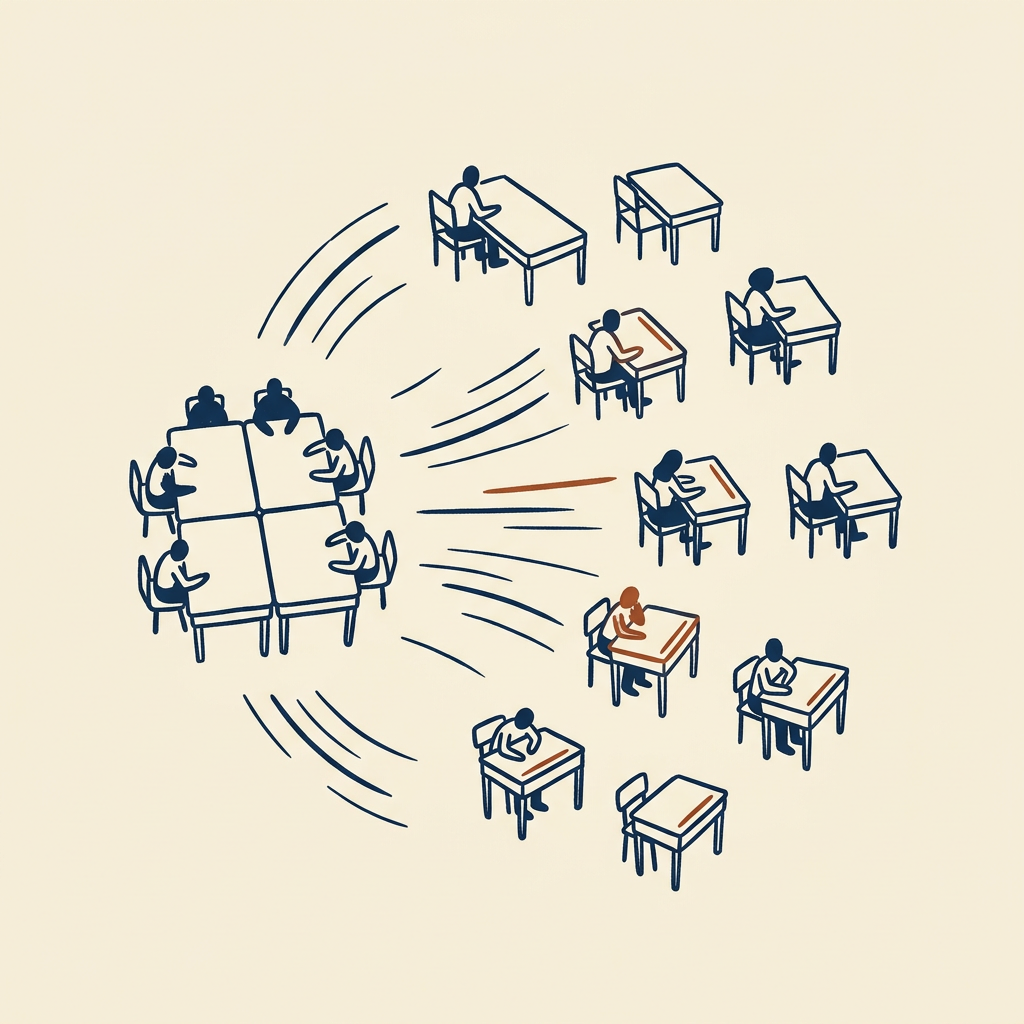
Cain turns the research into design. In schools she criticizes clustered desks and graded participation. A temporary return to rows of individual desks visibly re-engaged quieter students who had vanished inside groups dominated by louder classmates.
At work she wants real choice about private space instead of default open floors, and brainstorming restructured so people write ideas alone before any discussion—the pattern Diehl and Stroebe showed beats live groups.
For parents of quiet or high-reactive children she advises against forcing constant socializing or treating shyness as a defect to erase. Gentle new experiences at a tolerable pace, matching Kagan's finding that supportive, moderately challenging parenting builds confidence without wiping out temperament, work better.
Across domains the claim is the same. Solitude is not a remedial accommodation for people who cannot handle normal life. It is sometimes the superior condition for thinking, learning, and leading.
In practice: Classrooms that slid desks back into rows saw quieter students reappear who had been disappearing inside cluster work.
Key terms
- Extrovert Ideal The cultural preference for boldness, charisma, and constant sociability as the measure of a successful self.
- Culture of Character Nineteenth-century ideal that prized duty, integrity, and reputation built slowly among neighbors.
- Culture of Personality Early-twentieth-century ideal that prized magnetism, quick impressions, and performed confidence.
- High-reactive Kagan's label for infants who thrash and cry hard at new stimuli; many later trend cautious and quiet.
- Free Trait Theory Little's idea that people can act outside their fixed temperament for deeply valued goals, at a recoverable cost.
- Restorative niche A pocket of solitude—closed door, walk, quiet commute—that returns someone to their natural baseline after performing against type.
- Production blocking In live brainstorming, only one person can speak at a time while others forget their own ideas.
- Evaluation apprehension Self-censoring in groups out of fear of looking foolish in front of peers.
What to do
- Send the next meeting agenda early and collect written ideas before any live discussion.
- Audit your workspace for one genuinely quiet option and treat using it as normal work, not escape.
- In your next one-on-one with a capable report, listen for their ideas before offering yours.
- If you parent a quiet child, stop narrating their shyness to others in front of them.
- Let a quiet child warm up to new settings at their own pace instead of pushing instant participation.
- Block one no-meeting stretch this week and protect it for uninterrupted focus.
Questions to think with
- Where does your workplace or classroom still treat visible energy as proof of competence?
- When you last acted against your temperament for something you cared about, did you schedule recovery?
- Which of your best ideas arrived alone first, and would a group have improved or diluted them?
- If you manage people, do you hire for interview charisma or for listening under real work conditions?
- What would change if solitude counted as contribution rather than absence?
The other side
Cain herself flags the soft spots: only a minority of high-reactive infants become strongly introverted adults, so biology is not destiny; the 2008 link is harder to prove than the lab work and sits among many causes including regulation and incentives; and Asian cultural contrasts risk overgeneralizing real internal diversity. The book leans on interviews and existing studies rather than new controlled trials of every institutional fix it proposes.
Who it's for
Introverted professionals who feel forced to perform constant extroversion and want language for the drain; managers and teachers who need evidence against mandatory brainstorming and open-plan defaults; parents of quiet or shy children who want research-backed ways to support temperament instead of correcting it.