




Nike grew from a fifty-dollar loan and a car trunk
Knight’s memoir treats a global brand as nearly two decades of near-failure—useful shock for anyone mid-build.
IJR · Oct 9, 2026 · 13 min read
In 60 seconds
- In 1962 Knight borrowed fifty dollars from his father, invented Blue Ribbon Sports on the spot in Japan, and sold Onitsuka shoes from his car trunk at Oregon track meets while keeping an accounting job.
- Coach Bill Bowerman joined with five hundred dollars, design obsession, and coaching credibility that opened retailers; the waffle sole grew from his tinkering.
- Sales rose for over a decade while cash stayed desperate; Bank of California and First National Bank repeatedly threatened the credit line as shipments and payroll hung in the balance.
- A 1971 rupture with Onitsuka, which had never signed an airtight exclusive, forced the Nike name, a thirty-five-dollar swoosh, and a shift to switchable factories.
- Early hires were trusted misfits given real ownership; manufacturing chased lower costs across Asia; athlete bets favored unproven talent, including the 1984 Air Jordan deal.
- The 1980 IPO ended the bank crises and traded founder control for shareholders, quarterly scrutiny, and a real board.
The big idea
Knight shows entrepreneurship as a long string of near-failures survived through stubbornness, luck, and loyal partners, not a triumphant plan. The name, the swoosh, and the athlete bets that look like genius emerged from crisis and necessity.
The book in brief
In 1962 Phil Knight borrowed fifty dollars from his father and ordered Japanese running shoes. He sold them from his car trunk at Oregon track meets while keeping an accounting job. Blue Ribbon Sports began as boxes in a car and a name invented on the spot when he pitched Onitsuka Tiger in Japan off a thin class paper.
Bill Bowerman, his old coach, put in five hundred dollars plus a reputation that opened doors, then cut shoes apart to shave ounces. Sales climbed. Cash did not. Bankers at Bank of California and later First National Bank periodically threatened to pull credit just as shipments arrived. Knight spent years hat in hand, even after revenue reached the tens of millions, stacking new debt to cover old debt.
In 1971 the Onitsuka relationship collapsed. No airtight exclusive protected Blue Ribbon when the supplier courted other distributors. The lawsuit could have ended the company. Out of that fight came the Nike name, suggested by employee Jeff Johnson, and a swoosh drawn by student Carolyn Davidson for thirty-five dollars. Independence meant switchable manufacturers instead of one foreign lifeline.
The early team was assembled from people Knight trusted: a one-legged accountant, a former Marine, Oregon running friends, Bob Woodell after a paralyzing track accident. Manufacturing moved from Japan to Taiwan and South Korea chasing costs, staying asset-light but fragile. Marketing bet on athletes before they were famous; the same upside-skewed logic later produced a personalized shoe line for a young player bigger rivals could have outspent.
The 1980 IPO finally stopped the bank-line threats and let Nike fund capacity and marketing with confidence. It also installed shareholder duties, quarterly pressure, and board authority over choices once made by handshake. Knight felt the oversight as loss as much as relief. The memoir lands on entrepreneurship as repeated improvisation under threat and stays mostly silent on the factory labor conditions that later stained the brand.
Context
Phil Knight’s 2016 memoir recounts how a vague hunch became Nike. It mattered because it stripped the mythology off the confident founder and showed the cash crises, legal threats, and self-doubt behind a cultural giant.
The key ideas

1
One order is enough
A company can start from a half-formed hunch because the founder learns the real business only by doing the work.
- 1PitchInvent Blue Ribbon Sports on the spot in Japan
- 2FundBorrow fifty dollars from his father
- 3StockKeep the shoes in the car
- 4SellOpen the trunk at track meets
Knight was twenty-four, holding a Stanford MBA and little direction, when he stopped in Japan in 1962. He pitched Onitsuka Tiger on U.S. distribution and invented the name Blue Ribbon Sports on the spot. His only prior thinking was a class paper arguing Japanese athletic shoes could beat German pairs like Adidas on price and quality.
His father lent fifty dollars for the first order. For years the company was boxes of shoes in his car. He drove Oregon track meets, sold from the trunk, watched which pairs moved, and kept the accounting job. Side income and unpaid hours covered the gap.
Growth outpaced capital almost immediately. He spent as much energy hunting money as selling shoes. Starting, on his evidence, does not need certainty. It needs enough conviction to place one order, make one call, take one trip, then face the next break.
He did not know how to run a shoe company. He learned standing at meets seeing what sold. Early customers were people he met face to face, one pair at a time. That undercuts the founder who arrives with a finished vision.
In practice: The first inventory lived in Knight’s car and moved only when he opened the trunk at Oregon track meets.
2
Credibility over capital
An early partner can matter more for reputation and technical obsession than for the cash they invest.
What he put in
Five hundred dollars plus relentless design tinkering
What it bought
Retail credibility and the technical edge Knight lacked
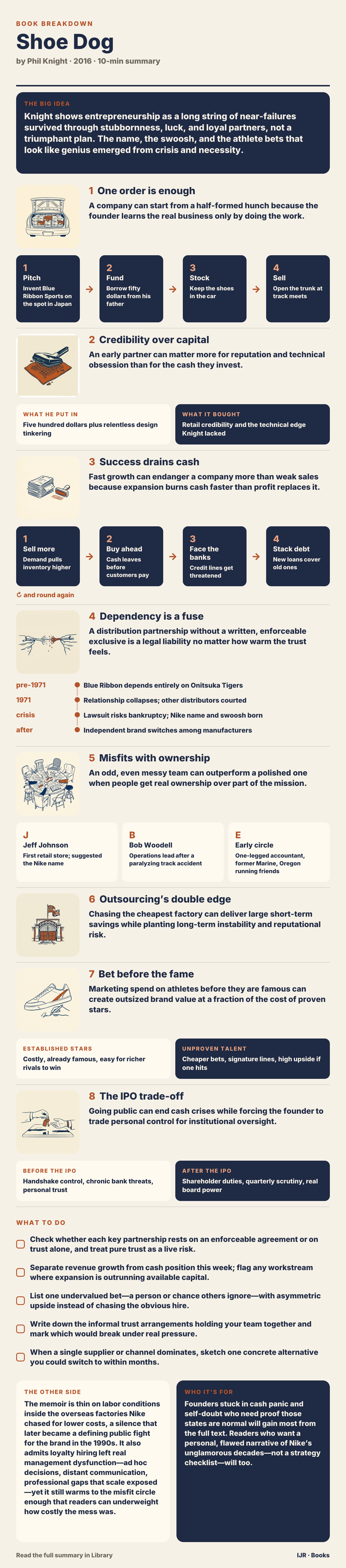
Bill Bowerman joined as founding partner with five hundred dollars and rarer currency: standing as one of America’s most respected track coaches. Retailers and athletes who already trusted him took Blue Ribbon seriously because his name sat behind the product.
He cut pairs apart, resewed them, and chased lighter materials. That obsession fed innovations like the waffle sole. Knight could run; he could not design. Bowerman closed the gap.
Friction appeared early. Bowerman pushed better shoes. Knight pushed a bigger, lasting business. Fights over design changes and spending previewed the permanent tug between product love and financial survival that later ran through the whole early staff.
Deals stayed on handshakes inside a small circle. Speed came with that looseness. So did legal fog, especially with Onitsuka, that nearly destroyed the company later. Partners who bring legitimacy and edge, Knight implies, outvalue partners who only write checks.
In practice: Bowerman’s five-hundred-dollar stake mattered less than his coaching reputation, which unlocked skeptical retailers.

3
Success drains cash
Fast growth can endanger a company more than weak sales because expansion burns cash faster than profit replaces it.
- 1Sell moreDemand pulls inventory higher
- 2Buy aheadCash leaves before customers pay
- 3Face the banksCredit lines get threatened
- 4Stack debtNew loans cover old ones
↻ and round again
Through the 1960s and 1970s the core threat was not demand. Shoes sold. Each dollar of growth meant buying more inventory before customers paid. Banks disliked a thin-margin, undercapitalized importer.
Knight lived in negotiation with Bank of California and later First National Bank. They threatened to cut the line right as shipments came due. He sometimes did not know whether payroll would clear.
The squeeze lasted more than a decade, even after revenue climbed into the tens of millions. He stacked fresh debt to retire old debt and ran for years near insolvency while looking, from outside, like a rocket.
He never fully fixed it with tighter planning. Outside capital and eventual profitability finally funded growth—nearly twenty years after the start. Success outrunning the balance sheet, on his account, kills as surely as failure.
In practice: Bank of California and First National both moved to pull credit at moments when shipments and payroll were simultaneously at risk.
4
Dependency is a fuse
A distribution partnership without a written, enforceable exclusive is a legal liability no matter how warm the trust feels.
- pre-1971Blue Ribbon depends entirely on Onitsuka Tigers
- 1971Relationship collapses; other distributors courted
- crisisLawsuit risks bankruptcy; Nike name and swoosh born
- afterIndependent brand switches among manufacturers
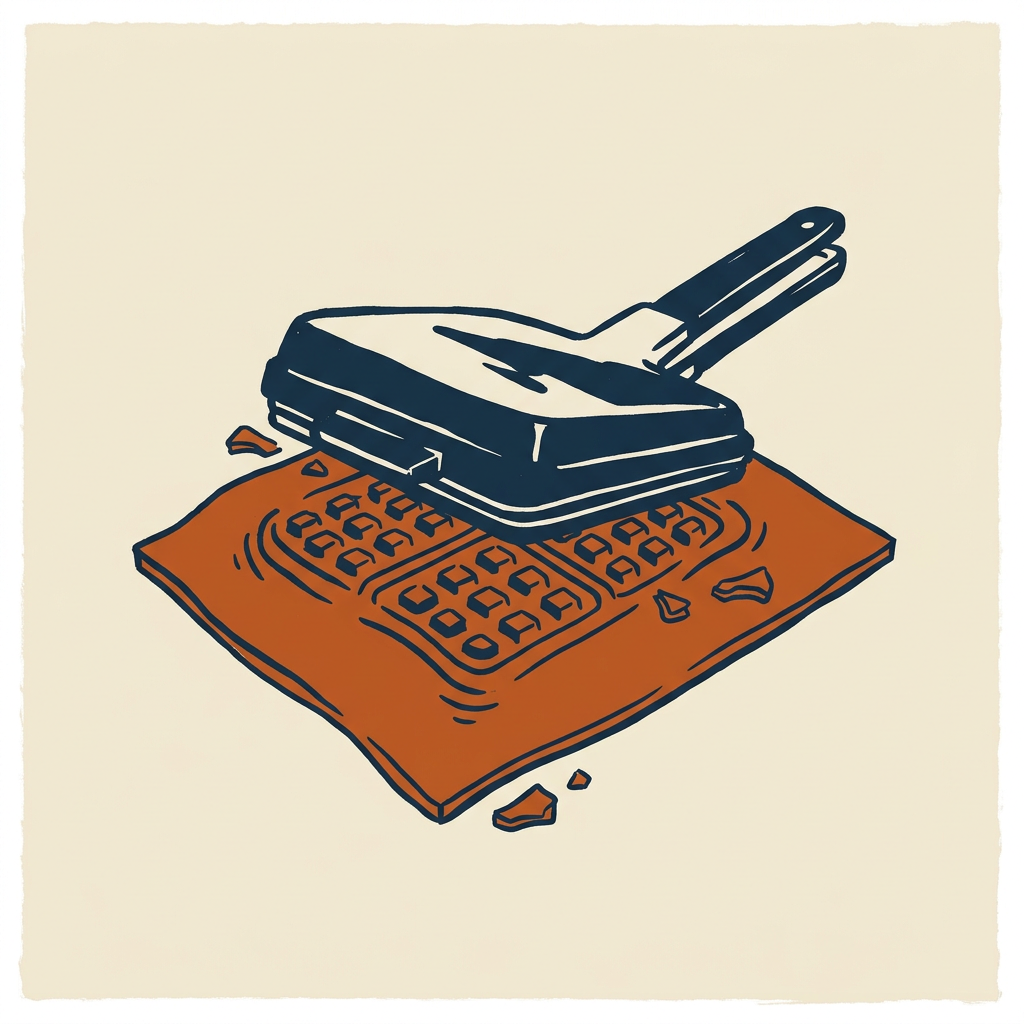
For years Blue Ribbon’s entire business was distributing Onitsuka Tiger shoes in the United States. The sides never locked an airtight exclusive. As volume rose, Knight correctly read that Onitsuka was courting other U.S. distributors, doubting a small Oregon outfit could handle national scale.
In 1971 the relationship blew open. Onitsuka moved on the distribution rights. Blue Ribbon sued to stay alive. The case dragged for years and could have bankrupted the company on a loss.
Crisis forced the pivot that created Nike. Staying chained to one foreign supplier who could cut him off was no longer tenable; he needed his own brand and factories he could switch. Jeff Johnson suggested the name. Carolyn Davidson, a design student, drew the swoosh for thirty-five dollars.
Before that rupture the story is an importer living on someone else’s product. After it, an independent brand. Single-supplier dependency is an existential risk you manage, not a comfort you assume from goodwill.
In practice: The Nike name and the thirty-five-dollar swoosh appeared only after the Onitsuka fight forced Knight to own the brand.
5
Misfits with ownership
An odd, even messy team can outperform a polished one when people get real ownership over part of the mission.
- JJeff JohnsonFirst retail store; suggested the Nike name
- BBob WoodellOperations lead after a paralyzing track accident
- EEarly circleOne-legged accountant, former Marine, Oregon running friends
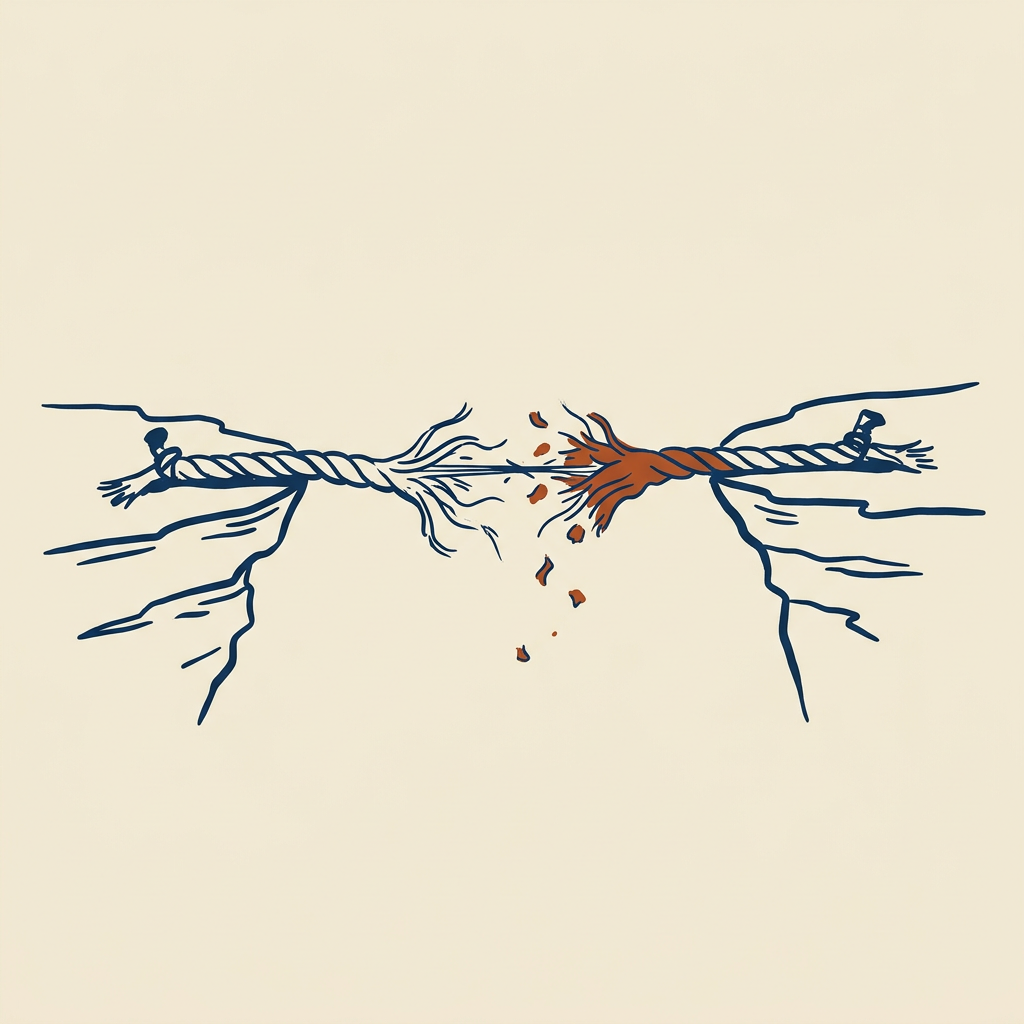
Early employees looked wrong on paper: a one-legged accountant, a former Marine, college friends, Oregon running acquaintances. Few held conventional credentials. Knight hired people he trusted, partly because pay could not compete and partly because he bet loyalty beat pedigree.
Jeff Johnson ran the first retail store and later proposed the Nike name. Bob Woodell became a central operations leader after a track accident left him paralyzed. Both received real authority long before formal structure existed.
Yearly retreats were chaotic and argumentative. They still forged cohesion among people who might never have shared a hallway. Culture was not designed by HR. It was whoever showed up and stayed.
The method cut both ways. Management stayed disorganized. Decisions were ad hoc. Knight struggled to speak directly with employees he counted as friends, preferring memos and distance. Loyalty built a resilient core and left professional gaps that later scale exposed.
In practice: Woodell took major operations authority after paralysis from a track accident; Johnson moved from the first store to naming the brand.
6
Outsourcing’s double edge
Chasing the cheapest factory can deliver large short-term savings while planting long-term instability and reputational risk.
As volume grew, production moved from Japan to Taiwan and South Korea and beyond, chasing labor costs, currency shifts, and capacity. Knight frames the hops as practical logistics. The memoir barely touches working conditions in those plants—a silence that lands harder because Nike later took intense public heat on that front in the 1990s, after this narrative mostly ends.
The strategic gain is clear in his telling. Outsourcing kept the company lean. It scaled without owning plants, freeing capital for marketing and design instead of fixed manufacturing assets. That asset-light pattern later spread across athletic apparel.
Fragility traveled with the savings. A strike, political shock, or currency swing could halt supply overnight. Years went into spreading orders across countries so no single site could sink the line—the Onitsuka lesson applied to factories.
Financial logic is spelled out. Human costs of the model are mostly absent. That omission is part of what the book leaves the reader holding.
In practice: Production hopped from Japan to Taiwan and South Korea whenever costs or capacity demanded, without Nike owning the plants.
7
Bet before the fame
Marketing spend on athletes before they are famous can create outsized brand value at a fraction of the cost of proven stars.
Established stars
Costly, already famous, easy for richer rivals to win
Unproven talent
Cheaper bets, signature lines, high upside if one hits
Early Nike could not outbid Adidas for established names. Knight courted runners and coaches on the rise, then other sports, wagering on potential instead of finished fame.
Endorsements were treated more like venture bets than classic ads. Cost stayed relatively low. Upside could be huge. Most individual wagers would miss. A rare breakthrough could cover the rest. He is frank that many athlete deals never matched the winners.
One defining case landed just after the memoir’s core stretch. In 1984 the team signed a basketball prospect who had leaned toward Adidas. Instead of folding him into an existing line, they built a personalized shoe around him. Necessity shaped the structure; richer rivals were not yet offering signature lines that way.
The pattern outlasted Knight’s daily role. When the obvious choice is unaffordable, hunt undervalued upside others skip, and set the deal so one large win pays for the misses.
In practice: In 1984 Nike won Michael Jordan away from an Adidas preference by offering a dedicated Air Jordan line rather than a standard roster slot.

8
The IPO trade-off
Going public can end cash crises while forcing the founder to trade personal control for institutional oversight.
Before the IPO
Handshake control, chronic bank threats, personal trust
After the IPO
Shareholder duties, quarterly scrutiny, real board power
By the late 1970s the permanent squeezes pushed Knight toward a step he had resisted. The 1980 IPO finally gave Nike stable capital. The recurring bank-line emergencies that fill earlier chapters stopped.
He describes the shift with more ambivalence than triumph. Public ownership brought duties to shareholders, quarterly earnings pressure, and a board with real power over choices once made informally among Knight and a few partners.
The personal trust and loose structure that built early Nike grew harder to keep once markets and outside directors had a say. He had run the firm more than a decade with minimal formal governance. New rules arrived overnight.
Capital let the company fund manufacturing capacity and marketing without constant fear of a pulled line. He still casts the IPO as the close of one era, not a pure win. Survival against suppliers, banks, and rivals yields to managing a complex institution—a quieter fight the memoir barely enters, because his narrative hunger stays with the scrappy years.
In practice: After 1980, quarterly earnings scrutiny and a board with authority replaced the old circle of handshake decisions.
Key terms
- Blue Ribbon Sports The company name Knight invented on the spot in Japan while pitching Onitsuka; Nike’s predecessor.
- Waffle sole A traction design that grew out of Bowerman’s habit of cutting, resewing, and molding shoes.
- Swoosh The logo a design student, Carolyn Davidson, drew for thirty-five dollars during the Onitsuka crisis.
- Handshake deal Informal trust arrangements that gave early speed and later left legal ambiguity.
- Cash crisis The pattern where sales grow while inventory and credit needs outrun available money for years.
- Asset-light Outsourcing factories so capital stays in design and marketing instead of owned plants.
- Onitsuka Tiger The Japanese shoe line Blue Ribbon distributed until the 1971 rupture forced an independent brand.
- Air Jordan The signature shoe line built around a then-unproven player as an asymmetric marketing bet.
What to do
- Check whether each key partnership rests on an enforceable agreement or on trust alone, and treat pure trust as a live risk.
- Separate revenue growth from cash position this week; flag any workstream where expansion is outrunning available capital.
- List one undervalued bet—a person or chance others ignore—with asymmetric upside instead of chasing the obvious hire.
- Write down the informal trust arrangements holding your team together and mark which would break under real pressure.
- When a single supplier or channel dominates, sketch one concrete alternative you could switch to within months.
Questions to think with
- Where does your project depend on one supplier, partner, or lender the way Blue Ribbon depended on Onitsuka?
- If growth jumped next month, would cash cover inventory and payroll until collections landed?
- Which teammates hold real ownership over a slice of the mission, and who is only filling a seat?
- What control would you trade for the capital that ends your version of the bank-line threat?
- Which hard costs does your own story skip the way this memoir skips factory labor conditions?
The other side
The memoir is thin on labor conditions inside the overseas factories Nike chased for lower costs, a silence that later became a defining public fight for the brand in the 1990s. It also admits loyalty hiring left real management dysfunction—ad hoc decisions, distant communication, professional gaps that scale exposed—yet it still warms to the misfit circle enough that readers can underweight how costly the mess was.
Who it's for
Founders stuck in cash panic and self-doubt who need proof those states are normal will gain most from the full text. Readers who want a personal, flawed narrative of Nike’s unglamorous decades—not a strategy checklist—will too.