


Temperament and a margin of safety beat market forecasts
Investing works through disciplined analysis, a cushion between price and value, and independence from crowd mood—not through predicting what prices will do next.
IJR · Oct 12, 2026 · 13 min read
In 60 seconds
- An operation counts as investing only when thorough analysis promises safety of principal and an adequate return; everything else is speculation, however confident the buyer feels.
- Inflation quietly drains pure bond portfolios, so the intelligent investor holds some claim on real assets while still demanding a reasonable price.
- Long market history shows valuations swing between expensive and cheap, so returns hinge on the price paid, not only on what is bought.
- Most people should follow a mechanical mix of high-grade bonds and diversified quality stocks, kept between fixed bounds and rebalanced on a schedule.
- Extra analytical work pays only when it finds a real gap between price and demonstrable value, not when it chases tips, trends, or growth stories.
- Treat daily quotes as Mr. Market’s optional offers, insist on a margin of safety in every purchase, and recalculate reported earnings and assets rather than trust them at face value.
The big idea
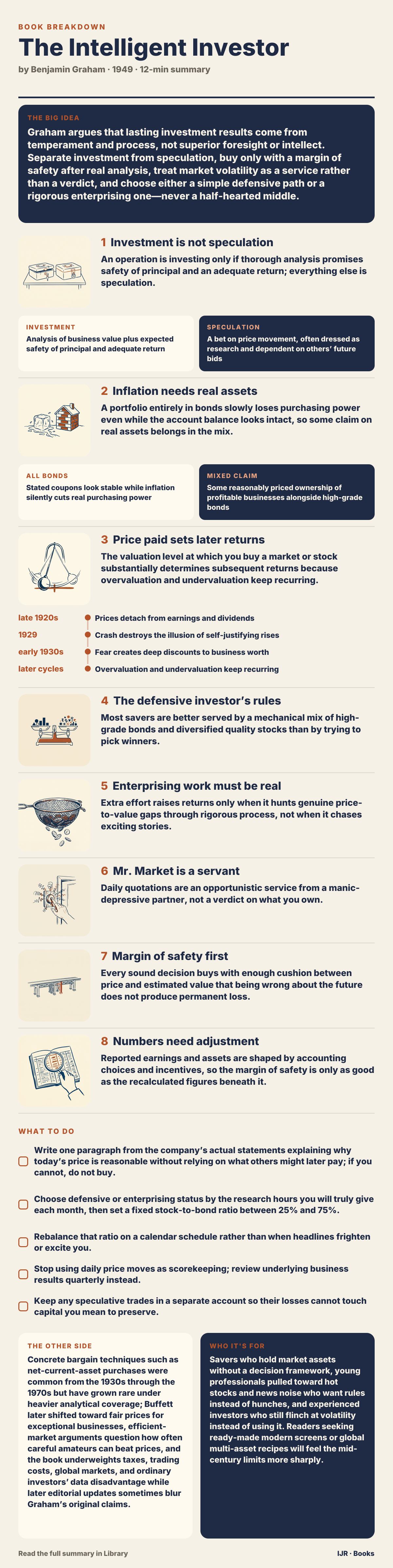
Graham argues that lasting investment results come from temperament and process, not superior foresight or intellect. Separate investment from speculation, buy only with a margin of safety after real analysis, treat market volatility as a service rather than a verdict, and choose either a simple defensive path or a rigorous enterprising one—never a half-hearted middle.
The book in brief
The book begins by forcing a clean distinction most market participants never make: true investment rests on analysis of underlying business value and a reasonable expectation of return, while speculation is a bet on price movement, often dressed up as research. Confusing the two is what turns ordinary savers into casualties when momentum reverses.
It then faces the silent problem of inflation. Fixed coupons look stable on paper while purchasing power slips away, so some ownership of real businesses belongs in a typical plan. Yet stocks are not an automatic hedge; only reasonably priced claims on sound enterprises help, and pure inflation stories without regard to price slide back into speculation.
Historical market levels come next. Valuations repeatedly detach from earnings and later correct, or sink below reasonable worth and create opportunity. The point is not short-term timing but a baseline habit: notice whether the overall market is expensive or cheap relative to long norms, and let that modestly shape how much sits in stocks versus bonds.
Two practical paths follow. The defensive investor, unwilling or unable to do deep security work, uses a simple, rule-bound mix of high-grade bonds and prominent, profitable, conservatively financed stocks, diversified and rebalanced without reacting to headlines. The enterprising investor may pursue higher returns, but only through unglamorous bargain methods—out-of-favor large companies, deep asset discounts, or special situations with calculable payoffs—never through tips or narratives.
The emotional core is the daily price theater. Quotes are reframed as an opportunistic partner’s offers rather than judgments on your holdings; you deal only when the price is clearly favorable. Everything then unifies under one operating principle: a margin of safety large enough that being wrong about the future does not produce permanent loss. That cushion is only as good as the numbers behind it, so reported earnings and assets must be adjusted with skepticism for accounting choices and management incentives.
The book lands on a durable claim. Success is less about brilliance than about honest classification of your activity, price discipline, diversification, and the nerve to ignore daily noise while staying positioned so error is survivable.
Context
Benjamin Graham wrote the book for the ordinary person rather than the professional speculator, arguing that temperament—not intellect—decides financial outcomes. It built the intellectual foundation for value investing and was later credited by investors such as Warren Buffett as the most important book on the subject ever written.
The key ideas

1
Investment is not speculation
An operation is investing only if thorough analysis promises safety of principal and an adequate return; everything else is speculation.
Investment
Analysis of business value plus expected safety of principal and adequate return
Speculation
A bet on price movement, often dressed as research and dependent on others’ future bids
Graham draws a line most participants never draw. Investment requires facts about a business’s earnings, assets, and financial position that justify the price independent of what someone else might later pay. Speculation is a bet on price movement, often wearing the language of research.
The danger is not speculation itself, which he concedes has a place, but speculation mistaken for investment. When buyers treat rising prices as proof of value, they are no longer investing. The late 1920s showed the pattern: margin buying and faith in perpetual appreciation collapsed when the illusion that rising prices were self-justifying broke.
The practical test is simple. Before purchase, state why the price is reasonable from the company’s own figures. If the case rests on the stock going up because it has been going up, it is speculation. Keep speculative funds in a separate account so a loss there never threatens capital meant to be preserved.
This definitional discipline governs everything that follows—portfolio construction, security selection, and any response to market levels—because honesty about which activity you are in comes first.
In practice: Brokers and ordinary citizens in the late 1920s bought stocks on margin as if price momentum were a fact about value; the 1929 crash erased both paper wealth and that illusion.

2
Inflation needs real assets
A portfolio entirely in bonds slowly loses purchasing power even while the account balance looks intact, so some claim on real assets belongs in the mix.
All bonds
Stated coupons look stable while inflation silently cuts real purchasing power
Mixed claim
Some reasonably priced ownership of profitable businesses alongside high-grade bonds
Graham weighs stated bond returns against stocks, which offer no guarantee yet have historically outpaced inflation because businesses can raise prices and grow earnings. He refuses to overclaim: stocks are not automatic inflation hedges, and equity returns have lagged for extended stretches.
The quiet damage is the point. A fixed coupon becomes worth less in real terms every year prices rise, and the investor may not notice because the nominal balance looks stable. That is why he rejects both all-bond and all-stock extremes for the typical investor.
He favors a mixed allocation adjusted with market conditions, generally not exceeding three-quarters in either direction. Buying stocks purely because inflation is expected, without regard to price, simply converts the decision back into speculation.
The intelligent response widens analysis rather than abandoning it: treat a firm’s pricing power and capital structure as part of the safety calculation, not just a single day’s balance sheet.
In practice: Graham uses U.S. price levels and corporate earnings across the first half of the twentieth century to show pure bond holdings eroding in real terms while looking nominally fine.

3
Price paid sets later returns
The valuation level at which you buy a market or stock substantially determines subsequent returns because overvaluation and undervaluation keep recurring.
- late 1920sPrices detach from earnings and dividends
- 1929Crash destroys the illusion of self-justifying rises
- early 1930sFear creates deep discounts to business worth
- later cyclesOvervaluation and undervaluation keep recurring
Graham surveys decades of market levels to land a point that sounds obvious and is routinely ignored. When price-earnings ratios detach from earnings and dividends, painful corrections follow; when fear pushes prices below reasonable business worth, opportunity appears.
This is not a license to forecast short-term moves. He explicitly warns against that. It establishes a baseline: valuations oscillate, indiscriminate buying at every level produces mediocre results, and noticing whether the whole market is cheap or expensive relative to historical norms lets an investor adjust sensibly.
That observation supports a later portfolio habit—leaning somewhat more toward bonds when stocks are broadly expensive and more toward stocks when they are broadly cheap. The same history does psychological work: severe downturns and euphoric bubbles are recurring features, not aberrations.
Without that grounding, advice to buy during pessimism and resist euphoria would feel like abstract virtue instead of a pattern with precedent.
In practice: Years leading into 1929 showed prices detached from earnings and dividends, followed by correction; other periods pushed valuations well below reasonable estimates of worth.

4
The defensive investor’s rules
Most savers are better served by a mechanical mix of high-grade bonds and diversified quality stocks than by trying to pick winners.
Graham defines the defensive investor as someone unwilling or unable to devote serious time to security analysis—the majority of people with savings. The goal shifts from maximum return to minimum chance of serious error while still capturing broad economic growth.
The policy is plain: hold high-grade bonds and stocks, keep the stock share from falling below a quarter or rising above three-quarters, and rebalance on a schedule rather than on news. Stock picks favor large, prominent companies with long profitability and dividend records, conservative finances, reasonable prices relative to earnings, and diversification across many issues.
Departures from the discipline are what hurt. Concentration in a single favored industry or company because of a compelling story repeatedly produced outsized losses when the story failed. The average person’s disadvantage is not raw intelligence but time, temperament, and information.
A rule-bound approach is therefore protection against the emotional decisions that wreck amateur portfolios, not passive stupidity. It gives ordinary readers a workable path that does not require heroics.
In practice: Investors who concentrated in one favored industry on a compelling story suffered outsized losses when that story failed—a pattern Graham saw across cycles.

5
Enterprising work must be real
Extra effort raises returns only when it hunts genuine price-to-value gaps through rigorous process, not when it chases exciting stories.
The enterprising investor is willing to spend real time on research and accept more complexity for potentially higher returns. Graham insists the path is not for everyone. Half-hearted enterprise—dabbling without the required discipline—produces worse results than the plain defensive approach.
Legitimate strategies share one thread with defense: price paid relative to demonstrable value. They include large unpopular companies trading below a conservative value estimate; secondary companies with strong balance sheets priced below net current asset value, a method he used in his own partnership; and special situations such as mergers or reorganizations with a calculable, near-certain payoff.
Most people who call themselves enterprising are undisciplined speculators buying on tips or trends and labeling it research. The real version keeps detailed records, demands a margin of safety every time, and stays willing to be out of step—buying when others sell and the reverse.
Extra work is wasted if aimed at market direction or corporate charisma, games where amateurs are structurally outmatched. It pays only when aimed at a measurable gap between price and value.
In practice: Graham’s own partnership extensively bought secondary companies with strong balance sheets at prices below net current asset value.

6
Mr. Market is a servant
Daily quotations are an opportunistic service from a manic-depressive partner, not a verdict on what you own.
Graham’s allegory gives you an imaginary business partner who appears every day offering to buy your shares or sell you his at a quoted price. Some days he is euphoric and names an absurdly high figure; other days he is despondent and offers far less than the business is worth.
You are under no obligation to trade. Transact only when his price is clearly favorable; ignore him the rest of the time. Investors who let his daily mood dictate their feelings about sound holdings surrender independent judgment.
The failure pattern is familiar: buy a solid stock, watch the price drop on no change in the business, sell in panic, and turn a paper fluctuation into a real loss. The reverse failure is buying purely because a price is rising, then suffering when the mood reverses.
Volatility, experienced by most as threat, becomes the source of opportunity. Without his mood swings there would be no gap between price and value for an analytical investor to use. Every later technical rule works only if you can resist the daily theater.
In practice: Investors bought fundamentally sound stocks, saw temporary price drops with no business change, panicked, and sold—converting paper fluctuations into permanent losses.

7
Margin of safety first
Every sound decision buys with enough cushion between price and estimated value that being wrong about the future does not produce permanent loss.
Graham names margin of safety the concept that unifies the book. For a bond it may mean earnings covering interest several times over, so a moderate downturn does not threaten default. For a stock it means a price sufficiently below a conservative intrinsic-value estimate—from earnings power, assets, and financial strength—that errors and bad luck are absorbed by the discount.
It is not a guarantee on any single holding. It is statistical protection across a diversified group chosen the same way. One illustration is buying below net current asset value—current assets minus all liabilities—so fixed assets and future earnings come free. Such chances were common in depressed markets and recurred periodically, though they grow scarcer as obvious bargains attract more capital.
The same idea explains distrust of high-growth names priced for perfection. When the purchase already assumes flawless execution, any disappointment passes straight through as a sharp loss. Defensive rules, enterprising tactics, historical valuation sense, and the Mr. Market stance all collapse into one job: not being right about the future, but being positioned so wrongness is survivable.
In practice: Net-current-asset buying—stocks priced below current assets minus all liabilities—was common in the early 1930s and gave the buyer the fixed assets and future earnings for nothing.

8
Numbers need adjustment
Reported earnings and assets are shaped by accounting choices and incentives, so the margin of safety is only as good as the recalculated figures beneath it.
Graham focuses on the gap between reported figures and economic reality. Depreciation schedules, inventory valuation, one-time charges, and pension assumptions can flatter or depress earnings without matching actual performance. Single-year snapshots mislead; multi-year results smooth cycles and reveal managed trends.
He is wary of frequent ‘non-recurring’ losses that nonetheless recur, a signal that narrative is being managed as much as the business. Watered stock, optimistic goodwill, aggressive option treatment, and off-balance-sheet obligations can make weak enterprises look strong on paper.
A wide apparent discount to book value means little if book value itself is inflated. His practice was to recalculate key figures independently rather than trust broker summaries or polished reports—statements are a starting point for investigation, not a finished verdict.
That verification work is largely what justifies departing from a simple defensive portfolio. Without it, the central cushion is an illusion.
In practice: Companies that repeatedly report ‘non-recurring’ losses every few years tip off that management is shaping the story as much as running the business.
Key terms
- Investment An operation that, after thorough analysis, promises safety of principal and an adequate return
- Speculation A bet on price movement, however confident, that lacks that analytical basis
- Defensive investor Someone unwilling or unable to devote serious time to security analysis; best served by simple mechanical rules
- Enterprising investor Someone who commits real research time to hunt price-to-value gaps through disciplined, unglamorous methods
- Mr. Market An imaginary daily partner whose manic or depressive quotes are optional offers, not orders or verdicts
- Margin of safety A cushion between price paid and conservatively estimated value so error or bad luck need not mean permanent loss
- Net current asset value Current assets minus all liabilities; buying below it can mean obtaining fixed assets and future earnings for free
- Intrinsic value A conservative estimate of what a business is worth from earnings power, assets, and financial strength
What to do
- Write one paragraph from the company’s actual statements explaining why today’s price is reasonable without relying on what others might later pay; if you cannot, do not buy.
- Choose defensive or enterprising status by the research hours you will truly give each month, then set a fixed stock-to-bond ratio between 25% and 75%.
- Rebalance that ratio on a calendar schedule rather than when headlines frighten or excite you.
- Stop using daily price moves as scorekeeping; review underlying business results quarterly instead.
- Keep any speculative trades in a separate account so their losses cannot touch capital you mean to preserve.
Questions to think with
- Can I explain, from earnings and assets alone, why this price is reasonable even if no one else bids higher later?
- Am I truly willing to do the research hours enterprising work requires, or am I a defensive investor pretending otherwise?
- If Mr. Market offered me 40% less tomorrow for the same unchanged business, would I sell in fear or consider buying?
- Where is the concrete cushion if my growth assumptions prove too optimistic?
- Have I recalculated the key figures myself, or am I trusting the story the statements are telling?
The other side
Concrete bargain techniques such as net-current-asset purchases were common from the 1930s through the 1970s but have grown rare under heavier analytical coverage; Buffett later shifted toward fair prices for exceptional businesses, efficient-market arguments question how often careful amateurs can beat prices, and the book underweights taxes, trading costs, global markets, and ordinary investors’ data disadvantage while later editorial updates sometimes blur Graham’s original claims.
Who it's for
Savers who hold market assets without a decision framework, young professionals pulled toward hot stocks and news noise who want rules instead of hunches, and experienced investors who still flinch at volatility instead of using it. Readers seeking ready-made modern screens or global multi-asset recipes will feel the mid-century limits more sharply.