




Most millionaires run dull businesses and drive older cars
Scrap-metal dealers and welders often out-accumulate doctors because wealth is what you keep and invest, not what you earn.
IJR · Oct 12, 2026 · 10 min read
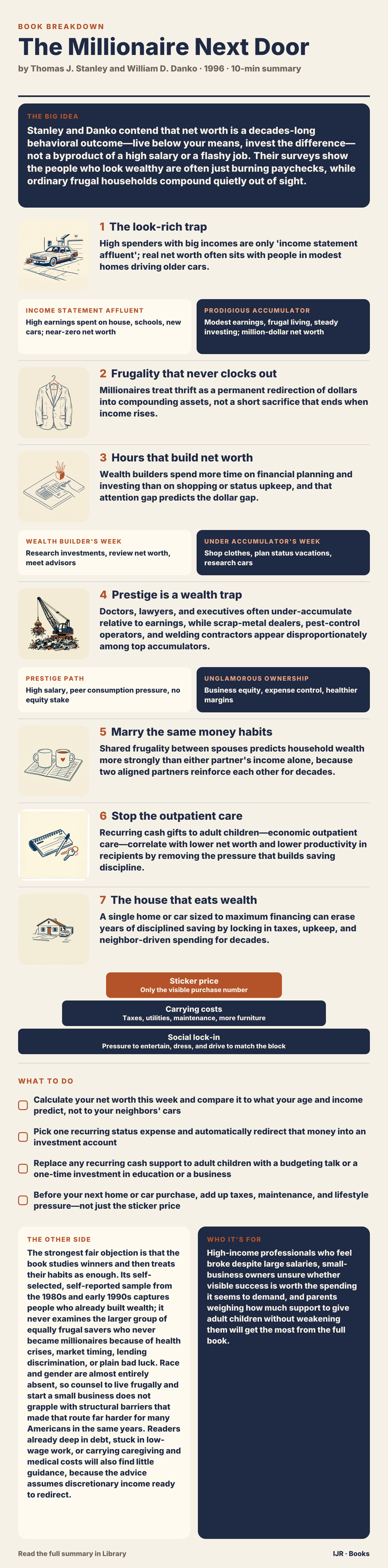
In 60 seconds
- People who look rich are often high earners spending nearly everything; true millionaires live modestly and invest the gap.
- Frugality builds wealth only as a permanent habit—when spending rises with income, compounding dies.
- Owners of unglamorous firms in scrap metal, pest control, and welding show up as top accumulators far more than prestige professionals.
- Shared thrift between spouses predicts household wealth better than either partner's salary alone.
- Ongoing cash gifts to adult children, called economic outpatient care, track with lower net worth and weaker discipline in the next generation.
- One oversized house or car can erase years of saving by locking in taxes, upkeep, and status pressure.
The big idea
Stanley and Danko contend that net worth is a decades-long behavioral outcome—live below your means, invest the difference—not a byproduct of a high salary or a flashy job. Their surveys show the people who look wealthy are often just burning paychecks, while ordinary frugal households compound quietly out of sight.
The book in brief
Stanley and Danko start from a recognition problem: outsiders, neighbors, even family routinely misread who holds real money because they treat visible spending as proof of wealth. Early chapters separate income from net worth and introduce an age-and-earnings benchmark that flags prodigious accumulators versus chronic under-accumulators.
From that diagnostic the book turns to mechanism. Daily thrift and resistance to lifestyle creep as pay rises redirect dollars into assets that compound, while wealth builders also spend disproportionate hours on planning rather than on shopping and display.
Career structure deepens the pattern. Prestige professions often wrap high earners in consumption pressure and offer no equity stake; owners of plain businesses build scalable assets and keep costs in check. The household becomes the next unit of analysis: spouses who share thrift multiply saving power, and parents who keep subsidizing adult children tend to undo the discipline that built the family money.
The closing practical move is the high-leverage purchase. A home or car sized to the maximum a lender will allow sets years of fixed costs and social pressure in motion. The arc ends on one principle tying income, occupation, marriage, and parenting together: shrink the permanent lifestyle bill before it shrinks future net worth.
Context
Thomas J. Stanley and William D. Danko drew on decades of surveys and interviews with American millionaires for this 1996 book. It overturned the popular image of the millionaire as a flashy consumer and reshaped popular thinking about personal finance in the 1990s by showing that the wealthy tend to be frugal business owners and professionals who prioritize saving over status.
The key ideas

1
The look-rich trap
High spenders with big incomes are only 'income statement affluent'; real net worth often sits with people in modest homes driving older cars.
Income statement affluent
High earnings spent on house, schools, new cars; near-zero net worth
Prodigious accumulator
Modest earnings, frugal living, steady investing; million-dollar net worth
Most observers assume millionaires announce themselves with mansions, luxury cars, and expensive suits. Stanley and Danko's surveys of high-net-worth households found the reverse: many who look rich are simply burning high incomes, while many who are rich look ordinary.
They used one diagnostic throughout the research—expected net worth from age and income set against actual net worth. Households that beat the benchmark are prodigious accumulators; those that lag are under accumulators. The gap turns on behavior sustained over decades, not this year's paycheck.
That shift reframes the whole question. Wealth becomes what you keep and grow, not what you earn. Neighbors, car dealers, and even a wealthy person's own children often have no idea how much is actually there, because the habits that build it stay invisible from outside.
In practice: A doctor earning $300,000 who pours it into a large house, private schools, and new cars every two years can sit near zero net worth, while a hardware-store owner earning $80,000 who lives frugally and invests can reach millions.

2
Frugality that never clocks out
Millionaires treat thrift as a permanent redirection of dollars into compounding assets, not a short sacrifice that ends when income rises.
The spending pattern among the millionaires studied was consistent and unflashy: careful budgets, used or modest cars, no designer wardrobe, possessions kept until they wear out. A large share had never paid full retail for a suit. Many drove vehicles several years old—not from necessity, but because a status premium looked pointless next to invested capital.
Frugality here is redirection. Every dollar not sunk into a depreciating status good can sit in an appreciating asset and compound. The critical detail is duration: households that stayed frugal as income climbed accumulated far more than those whose spending rose in lockstep.
So the prodigious-accumulator result is not luck or an outsized salary. It is the same daily choice to live below means, repeated long enough for compounding to do the heavy work.
In practice: Millionaires in the sample often kept driving older cars and refused full retail on clothes even after they could easily afford upgrades.

3
Hours that build net worth
Wealth builders spend more time on financial planning and investing than on shopping or status upkeep, and that attention gap predicts the dollar gap.
Wealth builder's week
Research investments, review net worth, meet advisors
Under accumulator's week
Shop clothes, plan status vacations, research cars
When Stanley and Danko tracked a typical week, their wealth-building subjects put significant hours into researching investments, reviewing net worth, and meeting advisors—often more time than they gave to shopping or upkeep of status possessions.
Under accumulators tilted the other way: more time on clothes shopping, appearance-driven vacations, and car research. Money habits and time habits travel together. How a household spends attention forecasts how it spends cash.
The book treats this as the active half of accumulation. Restraint alone is incomplete; regular goal-setting and net-worth reviews—annual or more often, and rare in the general population—turn saved dollars into a managed portfolio.
In practice: Two households with similar incomes diverged sharply: the one that treated financial planning as regular practice finished with several times the net worth of the other over a comparable span of years.

4
Prestige is a wealth trap
Doctors, lawyers, and executives often under-accumulate relative to earnings, while scrap-metal dealers, pest-control operators, and welding contractors appear disproportionately among top accumulators.
Prestige path
High salary, peer consumption pressure, no equity stake
Unglamorous ownership
Business equity, expense control, healthier margins
One of the more counterintuitive findings is occupational. High-prestige, high-income professions did not reliably produce high net worth. Owners of unglamorous businesses did.
The structural reasons stack up. Salaried professionals face peer and client pressure to consume at a matching level and own no scalable equity. Business owners build enterprise equity, control expenses, and often operate in fields with little talent competition because the work lacks prestige—keeping costs down and margins healthier.
Self-employed people in the sample also separated business risk from personal lifestyle more carefully, reinvesting profits instead of immediately upgrading homes and cars. Time spent building an asset compounds faster than a high salary spent as it arrives.
In practice: Scrap-metal dealers, pest-control operators, and welding contractors showed up as prodigious accumulators far out of proportion to their social prestige.

5
Marry the same money habits
Shared frugality between spouses predicts household wealth more strongly than either partner's income alone, because two aligned partners reinforce each other for decades.
Stanley and Danko found that couples who both described themselves as frugal, and who rarely fought about money because their attitudes already matched before marriage, sat near the top of the wealth distribution.
A high earner paired with a heavy spender recreates the under-accumulation pattern seen in prestige careers. One partner's discipline cannot fully offset the other's spending. Two disciplined partners do more than avoid conflict: they double the household's capacity to save and invest.
Interviews with self-made wealthy people often credited a spouse's thrift as central, not secondary. The real unit of analysis is household financial culture, not the primary earner's paycheck.
In practice: In many wealthy households studied, both partners independently called themselves frugal and reported few money fights because their saving attitudes were aligned before they married.

6
Stop the outpatient care
Recurring cash gifts to adult children—economic outpatient care—correlate with lower net worth and lower productivity in recipients by removing the pressure that builds saving discipline.
The authors labeled ongoing parental support for adult children's houses, cars, or living costs 'economic outpatient care.' Recipients tended to show lower net worth and lower productivity than adult children who got little or no such help.
The mechanism is direct. Expected subsidies blunt the incentive to develop parental-level saving habits, and the cash itself displaces accumulation the child would have done alone. Productive help looked different: investment in education or a modest business start. Recurring lifestyle subsidies did the opposite.
Support also flowed most often to children already weak at money management, entrenching dependency. Parents who built wealth through frugality frequently failed to transmit the discipline because they shielded the next generation from the pressures that forged it. Capital without the underlying behavior tends to fade within a generation or two.
In practice: Adult children receiving ongoing parental subsidies for housing and cars showed lower net worth than peers who received little support and had to build discipline themselves.

7
The house that eats wealth
A single home or car sized to maximum financing can erase years of disciplined saving by locking in taxes, upkeep, and neighbor-driven spending for decades.
- Sticker priceOnly the visible purchase number
- Carrying costsTaxes, utilities, maintenance, more furniture
- Social lock-inPressure to entertain, dress, and drive to match the block
Big infrequent purchases—especially houses and cars—carry outsized long-term consequences for net worth. Many prodigious accumulators chose homes well below what their income could finance, dodging large mortgages, heavy property taxes, and the pressure to match neighbors on landscaping, renovations, and vehicles.
One decision sets the frame for years of recurring costs. Stay in a modest house for decades and you avoid transaction costs and the lifestyle creep that follows each move to a bigger place. Size the purchase to the lender's limit and the fixed bill runs the household.
Unlike career or spouse choice, living in a smaller home relative to income is available to almost anyone. It concentrates the same compounding logic as daily frugality into one high-leverage decision: control fixed lifestyle costs before they control you.
In practice: Many wealthy households in the study had stayed in the same modest home for decades rather than trading up as income rose.
Key terms
- Income statement affluent A high earner who spends nearly everything and builds little real net worth
- Prodigious accumulator of wealth A household whose actual net worth far exceeds what its age and income would predict
- Under accumulator of wealth A household whose net worth falls short of the benchmark set by age and income
- Expected net worth A simple research benchmark derived from age and income, used to judge whether a household is pulling ahead or falling behind
- Economic outpatient care Ongoing parental cash gifts that subsidize an adult child's lifestyle and weaken that child's own wealth-building
- Lifestyle inflation Letting spending rise in step with income so higher pay never becomes higher saving
What to do
- Calculate your net worth this week and compare it to what your age and income predict, not to your neighbors' cars
- Pick one recurring status expense and automatically redirect that money into an investment account
- Replace any recurring cash support to adult children with a budgeting talk or a one-time investment in education or a business
- Before your next home or car purchase, add up taxes, maintenance, and lifestyle pressure—not just the sticker price
Questions to think with
- If a stranger saw only your car, house, and clothes, would they overestimate or underestimate your net worth?
- Which fixed costs in your life were set by one past purchase you could still reverse?
- Do you and your partner share the same spending rules, or does one of you quietly cancel the other out?
- If all financial help to adult children stopped tomorrow, what habits would they have to build?
- How many hours last month went to investment planning versus shopping or status upkeep?
The other side
The strongest fair objection is that the book studies winners and then treats their habits as enough. Its self-selected, self-reported sample from the 1980s and early 1990s captures people who already built wealth; it never examines the larger group of equally frugal savers who never became millionaires because of health crises, market timing, lending discrimination, or plain bad luck. Race and gender are almost entirely absent, so counsel to live frugally and start a small business does not grapple with structural barriers that made that route far harder for many Americans in the same years. Readers already deep in debt, stuck in low-wage work, or carrying caregiving and medical costs will also find little guidance, because the advice assumes discretionary income ready to redirect.
Who it's for
High-income professionals who feel broke despite large salaries, small-business owners unsure whether visible success is worth the spending it seems to demand, and parents weighing how much support to give adult children without weakening them will get the most from the full book.