




Money success is behavior, not spreadsheets or IQ
Housel shows most of Buffett’s roughly hundred-billion fortune piled up after age sixty because time, not brilliance, does the compounding.
IJR · Oct 9, 2026 · 14 min read
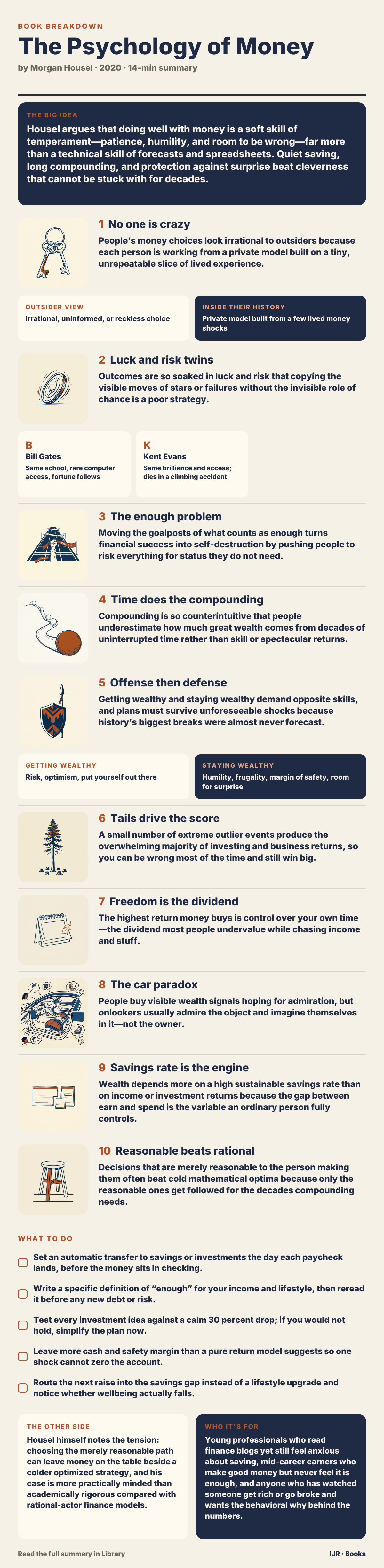
In 60 seconds
- Financial choices that look irrational usually make sense inside someone’s unrepeatable personal history with money.
- Luck and risk are twins, so copying famous winners or shaming losers without accounting for chance is a weak strategy.
- Moving the goalposts of “enough” turns already-won success into ruin through status chasing and unnecessary risk.
- Duration beats high returns: wealth compounds most in the long, boring stretches most people abandon.
- Getting rich takes offense; staying rich takes defense, a margin of safety, and room for unforeseeable shocks.
- The real dividend of money is control over your time, not cars, status, or a peak net-worth number.
The big idea
Housel argues that doing well with money is a soft skill of temperament—patience, humility, and room to be wrong—far more than a technical skill of forecasts and spreadsheets. Quiet saving, long compounding, and protection against surprise beat cleverness that cannot be stuck with for decades.
The book in brief
The book opens by rejecting the idea that people are shared rational calculators. The same crash or boom teaches opposite lifelong lessons depending on when you lived through it, so behavior that looks crazy from outside often fits a private model built from a thin slice of experience.
From there Housel pairs luck with risk. Extreme success stories hide improbable good fortune; extreme failures hide bad draws that could have hit the winners too. Studying only the visible playbook of Gates or Buffett without the invisible role of chance produces fragile advice. The same logic warns against open-ended ambition: once someone already has enough, social comparison keeps moving the finish line until people risk reputation and freedom for status they do not need.
The middle essays reframe how wealth actually accumulates. Compounding is so front-loaded in appearance and so back-loaded in reality that duration—not stock-picking skill—explains fortunes like Buffett’s. Building wealth and keeping it demand opposite muscles: optimism and risk to get rich, frugality and survival instincts to stay rich. A single wipeout erases every prior good year because you cannot compound from zero. History’s biggest shocks were almost never forecast, so plans need slack. Meanwhile a handful of outlier stocks and deals drive nearly all long-run gains, so being wrong often is compatible with spectacular success if losses stay capped and winners are allowed to run.
Later chapters redefine what money is for. Its highest return is autonomy over your calendar, not goods. Visible spending usually fails to buy the admiration people seek, because onlookers admire the object, not the owner, while real wealth is the invisible pile left unspent. Savings rate, fully under your control, matters more than income or market returns. Strategies that are merely reasonable to your temperament beat mathematically optimal ones you will abandon in a crash.
The book lands on a simple hierarchy: stay reasonable and patient for decades, protect the downside, let compounding work, and spend the surplus on freedom rather than signals.
Context
Morgan Housel gathers nineteen short essays arguing that money outcomes track behavior—ego, envy, personal history—more than financial knowledge. The book landed when most personal-finance writing still treated readers as rational actors and reframed the field as a study of temperament instead of math.
The key ideas

1
No one is crazy
People’s money choices look irrational to outsiders because each person is working from a private model built on a tiny, unrepeatable slice of lived experience.
Outsider view
Irrational, uninformed, or reckless choice
Inside their history
Private model built from a few lived money shocks
Housel starts from a plain observation: the identical market event stamps opposite lifelong attitudes depending on who met it and when. Someone formed by 1970s stagflation never prices inflation or stocks the same way as someone formed by the 1990s bull market, even when both are equally smart and equally informed.
A survey he cites finds that lifetime experience with money, not income or education, best predicts saving and risk attitudes. A person raised in scarcity who refuses stocks is not missing the compound-interest lecture; they are pricing a memory a textbook cannot overwrite. Advice that works for one biography can therefore be useless or harmful for another.
He rejects the economics habit of treating people as rational calculators sharing one set of facts. Everyone runs a private world-model assembled from a handful of personal episodes that feel like the whole world. The practical demand is humility before judging others’ choices or your own past ones: the decision was often rational inside a context you do not fully see.
That stance frames the rest of the book. Knowledge still matters, but temperament and history decide whether knowledge ever gets used.
In practice: A person raised in poverty who will not buy stocks is often pricing remembered scarcity, not ignoring compound interest.

2
Luck and risk twins
Outcomes are so soaked in luck and risk that copying the visible moves of stars or failures without the invisible role of chance is a poor strategy.
- BBill GatesSame school, rare computer access, fortune follows
- KKent EvansSame brilliance and access; dies in a climbing accident
Housel pairs Bill Gates with childhood friend Kent Evans. Both were brilliant; both attended Lakeside School, one of the few with a computer terminal in 1968. Gates has said Microsoft likely never happens without that access. Evans died in a mountaineering accident before finishing high school—capability intact, luck exhausted.
Luck and risk are two sides of the same coin: forces beyond individual effort steer every result. Studying only extreme winners to extract a formula ignores the improbable good draws inside their stories. Writing failures off as pure incompetence ignores the bad draws that never touched the winners.
The safer habit is to hunt broad patterns that repeat across many people and eras, because those are likelier to reflect cause and effect than one lucky path. Judge boldness versus recklessness with caution; the line is often invisible until after the outcome.
This is a standing check on the survivorship bias that fills most business and investing advice.
In practice: Gates and Evans shared brilliance and rare 1968 computer access; one path produced Microsoft, the other ended on a mountain.

3
The enough problem
Moving the goalposts of what counts as enough turns financial success into self-destruction by pushing people to risk everything for status they do not need.
Rajat Gupta had already reached an estimated hundred million dollars, board seats at Goldman Sachs and Procter & Gamble, and a McKinsey legacy—yet passed insider information to chase billionaire rank and went to prison. Bernie Madoff ran a legitimate profitable business before turning to fraud for returns he did not need.
Social comparison is the engine. Someone richer always exists, so the finish line for enough keeps receding. The treadmill pushes people who have already won the money game into a riskier game of status.
Housel’s counter-rule is blunt: define in advance what enough looks like for your own life, independent of peers, and treat that line as a stop rather than a new start. Modern media and proximity to wealthier circles constantly reset the comparison group upward, which is why the rule feels simple and proves hard.
The warning targets the specific moment after someone is already secure, when the next bet puts the whole pile at risk for a number that will not satisfy.
In practice: Gupta, already worth roughly a hundred million, risked freedom and reputation chasing billionaire status through insider tips.

4
Time does the compounding
Compounding is so counterintuitive that people underestimate how much great wealth comes from decades of uninterrupted time rather than skill or spectacular returns.
Of Buffett’s roughly one-hundred-billion fortune at the time of writing, the vast majority accumulated after his fiftieth birthday and almost all of it after sixty. He is a skilled investor, yet Housel locates the real edge in roughly eighty years of consistent investing that began in his early teens.
Had Buffett started in his thirties and stopped at sixty like a typical investor, the name would likely be a footnote. Most of the compounding happened in decades ordinary investors spend drawing assets down. Duration, not return rate, becomes the dominant variable.
People chase stories of high returns achieved fast. Decent returns left alone for decades without panic sales, bad-year exits, or simple quitting quietly beat interrupted brilliance. Patience itself becomes the primary investing skill because only patience lets compounding run through the long stretches where its power appears.
The chapter strips glamour from wealth-building and replaces it with calendar time most strategies never survive.
In practice: Almost all of Buffett’s fortune arrived after ordinary retirement age—years most investors spend withdrawing, not compounding.

5
Offense then defense
Getting wealthy and staying wealthy demand opposite skills, and plans must survive unforeseeable shocks because history’s biggest breaks were almost never forecast.
Getting wealthy
Risk, optimism, put yourself out there
Staying wealthy
Humility, frugality, margin of safety, room for surprise
Getting rich usually needs risk, optimism, and exposure. Staying rich needs humility, frugality, and a working fear of loss. Jesse Livermore, the early-twentieth-century trader, made and lost several fortunes—including one worth roughly a hundred million in 1929 dollars—before dying broke. He had rare offensive skill and almost no defensive temperament.
Housel treats survival—avoiding ruin—as the single most important financial goal, ahead of return optimization. One catastrophic loss that zeros the capital erases every prior good decision because nothing compounds from zero. So he favors a margin of safety, more cash than a pure return-maximizing model likes, and a willingness to leave potential gains on the table.
That margin also covers surprise. Reviewing the 2008 crisis and the Great Depression, he notes virtually none of the widely followed experts called the specific event beforehand despite abundant data. History is a record of breaks from prior patterns; useful lessons are broad behavioral habits under panic or greed, not precise average returns.
Most plans obsess over getting more and never ask what could take it all away. Defense and slack for being wrong deserve equal billing with offense.
In practice: Livermore repeatedly re-risked fortunes he had already made and ended broke; likewise, almost no consensus forecast named 2008 or the Depression in advance.

6
Tails drive the score
A small number of extreme outlier events produce the overwhelming majority of investing and business returns, so you can be wrong most of the time and still win big.
Research on the Russell 3000 that Housel cites shows a small fraction of stocks—well under ten percent—generated essentially all of the index’s net gains over multi-decade stretches. Most individual stocks were flat or lost money. Venture capital runs on the same asymmetry: firms expect the large majority of bets to fail because one or two enormous winners cover every loss many times over.
The payoff structure is lopsided, not symmetric. An investor right only a small percentage of the time can still succeed spectacularly if wins are large and losses are capped. Disney’s fortunes rested for years on a handful of hit films while many others underperformed; most business and even personal choices follow the same distribution.
Failure judgment has to change. A high rate of individual misses is not proof of a bad strategy when the strategy is built to let rare successes run. Frequent small losses can be the toll of staying in the game long enough for a tail to appear.
The human instinct to grade decisions by their most common outcome misses the full range that actually sets the score.
In practice: Well under ten percent of Russell 3000 stocks produced essentially all the index’s net gains across decades.

7
Freedom is the dividend
The highest return money buys is control over your own time—the dividend most people undervalue while chasing income and stuff.
Housel defines peak wealth as waking up able to decide how to spend the day without someone else’s permission. Psychological work on autonomy finds that control over schedule and decisions predicts life satisfaction strongly, often outweighing income past a point.
He contrasts a high salary locked to a rigid demanding calendar with a lower income deliberately structured so the person owns their hours. Money’s real utility is conversion into independence: switching careers, pausing for a health crisis, or refusing a bad job without panic.
That makes savings valuable long before any retirement date. Flexibility bought along the way can matter more than the eventual lump sum. People who save only to hit a distant number miss the present-tense freedom the reserve already purchases.
The chapter relocates the purpose of saving from a future trophy to an ongoing source of control, and it primes the later claim that financial lives should optimize for time autonomy rather than a single peak figure.
In practice: Someone earning less but owning their hours can outrank a higher-paid peer who needs permission for every free afternoon.

8
The car paradox
People buy visible wealth signals hoping for admiration, but onlookers usually admire the object and imagine themselves in it—not the owner.
Housel names the man-in-the-car paradox: the driver of an expensive car assumes spectators are impressed by him; most are picturing themselves in the seat and barely register the driver. Status spending therefore miscalculates its own mechanism. Admiration aimed at the person rarely arrives through objects.
If respect is the real wish, traits such as humility, kindness, and empathy aim attention at the human rather than the prop. True wealth—the savings and assets still held—is invisible by definition because it is money not spent. The driveway car, the kitchen remodel, and the suit are evidence of money that already left.
Society therefore fills with loud signals from people who converted income into things, while quieter holders of large invested balances blend in. Judging financial health from lifestyle becomes nearly useless.
Anyone serious about building real wealth has to resist spending meant to impress people who, per the paradox, are not really looking at them.
In practice: Onlookers seeing a costly car typically project themselves into it instead of admiring the driver.

9
Savings rate is the engine
Wealth depends more on a high sustainable savings rate than on income or investment returns because the gap between earn and spend is the variable an ordinary person fully controls.
Most people cannot dictate market returns; they can dictate how much income they refuse to spend. Wealth needs a gap, not a high salary. Ordinary incomes paired with a consistent multi-decade gap can build substantial savings; high earners whose spending rises lockstep with income—lifestyle inflation—can finish with almost nothing.
Housel treats savings less as a down payment on a named purchase and more as a general reserve against an unpredictable future. The value sits precisely in not knowing the eventual use. That differs from goal-based advice that waits for a house price or car sticker before saving feels justified.
A mindset shift helps: flexibility itself is the goal, so the target does not depend on hitting one purchase price. Past a certain income, extra earnings add little happiness, which means routing raises into savings rather than lifestyle upgrades costs less wellbeing than people assume.
Savings rate becomes the most reliable controllable engine of long-term wealth—more dependable than stock-picking or market timing.
In practice: Modest earners who keep a steady earn-spend gap for decades can out-save high earners whose lifestyle rises with every raise.

10
Reasonable beats rational
Decisions that are merely reasonable to the person making them often beat cold mathematical optima because only the reasonable ones get followed for the decades compounding needs.
Finance theory often crowns the mathematically optimal choice as best. Housel pushes back with the mortgage example: paying off a low-interest mortgage early can look suboptimal versus investing the difference given historical stock returns, yet survey data he cites show early payoff linked to far higher satisfaction and lower anxiety even when the investors won on paper.
A strategy that fits emotional temperament and can be endured will outperform a prettier strategy abandoned in a stressful downturn. Compounding’s value depends entirely on staying invested for years; any plan that triggers early exit has a real expected value far below its theoretical one.
Psychology is therefore a legitimate input, not a bug to engineer away. This challenges efficient-market and rational-actor habits that treat every deviation from optimum as pure error.
Housel is not discarding math. He is ranking stickiness above elegance when the two conflict, because decades of imperfect adherence beat a perfect model no one keeps.
In practice: People who paid mortgages off early reported much higher satisfaction than those who kept the debt to invest, even when the investors came out ahead on paper.
Key terms
- Enough A personal, pre-defined stopping point for money and status that does not move when peers get richer
- Luck and risk The twin, uncontrollable forces that help create extreme success and extreme failure beyond pure skill
- Margin of safety Extra cash, caution, and un-optimized returns kept on purpose so one shock cannot wipe you out
- Compounding Gains on prior gains that do most of their real work only when left alone for very long stretches of time
- Tails The rare outlier wins that produce nearly all long-run returns while most attempts break even or lose
- Man in the car paradox The mismatch where you buy a status object to be admired but onlookers admire the object and imagine themselves, not you
- Savings rate The controllable gap between what you earn and what you spend; the main engine of ordinary wealth
- Reasonable vs rational A plan you can emotionally stick with for decades versus the mathematically perfect plan you may abandon under stress
- Freedom dividend Control over your own time and choices—the highest use of money in Housel’s ranking
What to do
- Set an automatic transfer to savings or investments the day each paycheck lands, before the money sits in checking.
- Write a specific definition of “enough” for your income and lifestyle, then reread it before any new debt or risk.
- Test every investment idea against a calm 30 percent drop; if you would not hold, simplify the plan now.
- Leave more cash and safety margin than a pure return model suggests so one shock cannot zero the account.
- Route the next raise into the savings gap instead of a lifestyle upgrade and notice whether wellbeing actually falls.
Questions to think with
- What early money experiences still quietly set your risk and saving instincts?
- Where has your definition of enough moved in the last five years, and who caused the move?
- If your plan had to survive a surprise no expert is forecasting, what would break first?
- Are you optimizing for a larger number or for more hours you control?
- Which of your “rational” money moves would you actually abandon in a crash?
The other side
Housel himself notes the tension: choosing the merely reasonable path can leave money on the table beside a colder optimized strategy, and his case is more practically minded than academically rigorous compared with rational-actor finance models.
Who it's for
Young professionals who read finance blogs yet still feel anxious about saving, mid-career earners who make good money but never feel it is enough, and anyone who has watched someone get rich or go broke and wants the behavioral why behind the numbers.