




How tiny shifts tip ideas into sudden social epidemics
Marketers and change-makers who need to know why a brand can jump from under 30,000 pairs a year into the millions without a campaign.
IJR · Oct 12, 2026 · 13 min read
In 60 seconds
- Social trends spread like epidemics: flat for a long stretch, then tip into sudden explosion once a threshold is crossed.
- A tiny set of Connectors, Mavens, and Salesmen carries most of the transmission load.
- Stickiness comes from testable design—pacing, repetition, structure—not from louder broadcasting.
- Immediate environment shapes behavior more than fixed character, as New York transit crime showed after graffiti scrubbing and fare-beating crackdowns.
- Human groups hold stable trust-based ties up to roughly 150 people; past that, cohesion needs formal hierarchy.
- Right messengers, a sticky package, and supportive context can drive large change with modest resources.
The big idea
Gladwell argues that ideas, products, and behaviors spread the way epidemics do—slowly, then suddenly once they cross a critical threshold. Three forces govern the tip: the few people who carry the message, how sticky its packaging is, and the context that enables or blocks action.
The book in brief
Gladwell starts from a puzzle: why do some products, habits, and ideas crawl along unnoticed and then explode overnight? He treats social change as epidemic, not gradual accumulation. Most of the time an idea sits contained. At a specific moment it tips, and case numbers, sales, or opinion jump.
He names three conditions that decide whether and when the tip arrives. The Law of the Few says a small set of unusual people drive most transmission. The Stickiness Factor says content and packaging decide whether people act or forget. The Power of Context says surrounding conditions—not just character—shape whether someone follows an impulse.
The middle of the book walks each lever in turn. First come the personality types who move information: hyper-networked Connectors who bridge distant circles, information-obsessed Mavens whose help people trust, and emotionally expressive Salesmen who convert interest into yes. Then comes message design, tested in children’s television where tiny format changes held or lost toddler attention. Then comes environment, from graffiti-covered subway cars to the size of a working group.
Near the end he applies the three rules to harder cases—teen smoking, a wave of copycat suicides in Micronesia, and a novel that became a bestseller years after publication through reading-group word of mouth. The claim lands practical: large-scale change does not need large-scale budgets if the messengers, the package, and the setting are chosen with care.
The book closes as a wager that once you see the three levers, you can engineer a tip instead of waiting for luck.
Context
Malcolm Gladwell published the book in 2000. It turned “tipping point” into everyday vocabulary and reshaped how marketers, public health officials, and policymakers talk about social change.
The key ideas
1
Epidemics without germs
Social trends behave like contagious diseases, staying flat until they cross a threshold and explode.
Before the tip
Under 30,000 Hush Puppies pairs sold a year
After the tip
Sales rebound into the millions with no ad campaign
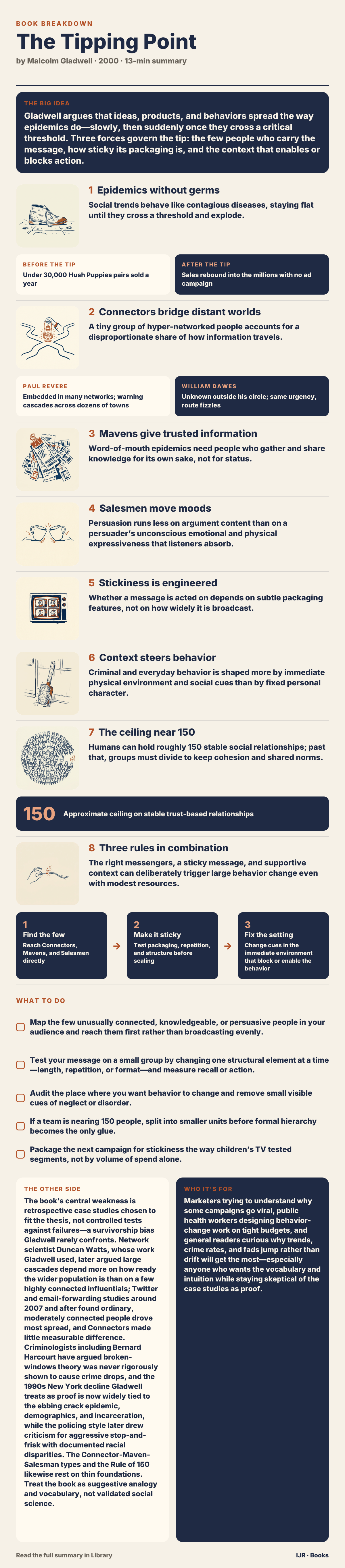
Gladwell opens with the sudden 1990s revival of Hush Puppies suede shoes. The brand had dwindled to under 30,000 pairs sold a year. Then a handful of downtown Manhattan kids started wearing them unironically, and sales rebounded into the millions. No advertising campaign caused it.
The style spread the way a virus spreads: from a few carriers, through casual contact, until it crossed an invisible line and became unstoppable. Social change, he argues, is not linear. An idea, product, or behavior can sit contained and unremarkable for a long stretch. Then, at a specific moment, it tips.
From this he draws three conditions that govern the tip. The Law of the Few holds that a small set of unusual people drive transmission. The Stickiness Factor holds that packaging decides whether a message is acted on or forgotten. The Power of Context holds that surrounding conditions shape whether people act on impulse.
Understanding those three levers, he wagers, lets you engineer a tipping point on purpose rather than waiting for one by luck. He draws on criminology, marketing research, developmental psychology, and real disease outbreaks such as a 1996 syphilis spike in Baltimore tied to changes in the built environment.
In practice: Hush Puppies went from under 30,000 pairs a year to sales in the millions after a few Manhattan kids wore them without irony.

2
Connectors bridge distant worlds
A tiny group of hyper-networked people accounts for a disproportionate share of how information travels.
Paul Revere
Embedded in many networks; warning cascades across dozens of towns
William Dawes
Unknown outside his circle; same urgency, route fizzles
To show the Law of the Few, Gladwell retells the night of April 18, 1775, when Paul Revere and William Dawes rode out to warn colonial militias that British troops were coming. Revere’s ride triggered alarms across dozens of towns. Dawes covered similar ground with the same urgency and fizzled.
The difference was not effort. Revere was a Connector—embedded in many overlapping networks, known to tavern keepers, militia captains, and Sons of Liberty members—so his warning hit the right hubs at once. Dawes was little known outside his own circle.
Gladwell generalizes with weak ties, Stanley Milgram’s 1967 six-degrees letter-forwarding experiments, and surveys of how people met spouses or found jobs. The same few individuals kept surfacing as people who seemed to know everyone. Connectors collect loose acquaintances across unrelated worlds and casually bridge them.
The practical move is to stop targeting the average person and find the few Connectors whose endorsement reaches many otherwise-unconnected clusters at once.
In practice: Paul Revere’s warning cascaded through dozens of towns while William Dawes’s parallel ride went nowhere, because Revere already knew the hubs.

3
Mavens give trusted information
Word-of-mouth epidemics need people who gather and share knowledge for its own sake, not for status.
Beside Connectors, Gladwell places the Maven—a Yiddish-rooted term for someone who accumulates knowledge. Market researchers Linda Price and Lawrence Feick coined “market maven” in a 1987 study for consumers who compulsively research prices and products and volunteer that knowledge.
His case is a man he calls Mark Alpert, who tracks retail overcharges almost as a hobby, and the shoppers who always know which store has the best deal on an appliance. Mavens matter because people trust their motives. They share to help, not to sell or look important, so recommendations land with unusual credibility.
He links this to research showing Maven complaints and praise travel further than paid ads because they arrive stripped of self-interest. Cult food items, obscure restaurants, and software tools often spread this way when a few obsessive early users insist on telling everyone.
The boundary between a Maven and an opinionated friend is fuzzier than the tidy type suggests, but the social role—someone who specializes in gathering and redistributing information without commercial motive—is real and recognizable.
In practice: Mark Alpert tracks down retail overcharges and complains as near-hobby, and people listen because he is not selling anything.

4
Salesmen move moods
Persuasion runs less on argument content than on a persuader’s unconscious emotional and physical expressiveness that listeners absorb.
The third type is the Salesman, who moves others through charisma, energy, and emotional contagion—the tendency of people to synchronize expressions, postures, and moods without noticing.
Gladwell profiles Tom Gau, a top financial planner, and watches how tone, pacing, and physical mirroring built client trust faster than the technical pitch. He cites Howard Friedman’s 1980s research measuring nonverbal expressiveness: highly expressive people could shift the moods of low-expressive strangers in short, silent interactions.
Experiments on interviewer synchrony show partners fall into matching speech and gesture rhythms within seconds. Persuasion partly works below awareness.
Salesmen complete the chain. Connectors expose an idea to many networks, Mavens supply credible information, and Salesmen give the emotional push that turns interest into action. Friedman’s work was peer-reviewed and replicated, though Gladwell stretches modest lab findings on mood transfer into a broad claim about deals, elections, and movements.
In practice: Tom Gau won client trust faster through tone, pacing, and mirroring than through his technical financial pitch.
5
Stickiness is engineered
Whether a message is acted on depends on subtle packaging features, not on how widely it is broadcast.
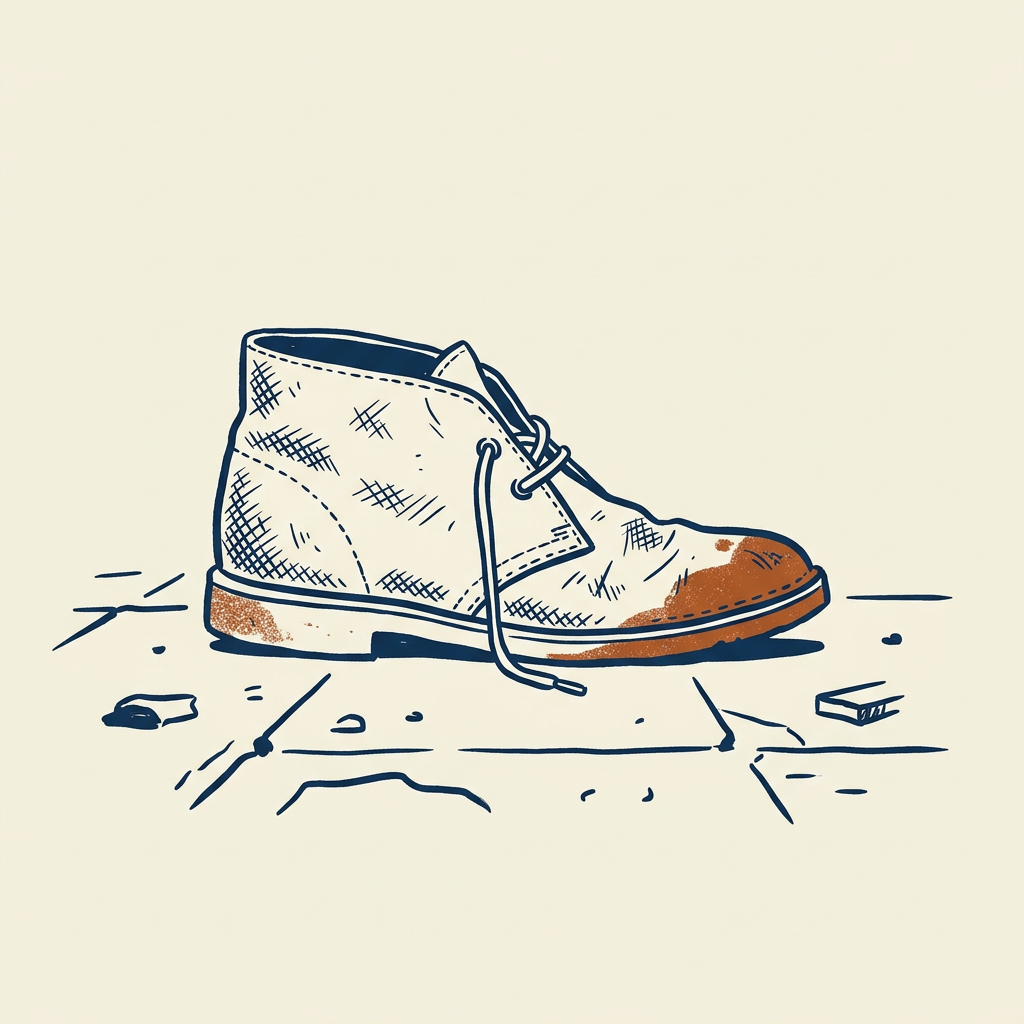
After who spreads a message, Gladwell asks what makes it worth keeping. Children’s television becomes his lab. Sesame Street’s creators in the late 1960s tested episodes against competing programming to see which segments held toddlers. Mixing fantasy characters with real-world footage confused children and dropped attention, so they redesigned for internal consistency.
Blue’s Clues producers, working with researcher Daniel Anderson, found that repeating the exact same episode five days in a row—rather than airing new content daily—sharply raised preschool comprehension and engagement. Repetition let children master material instead of merely hearing it.
He generalizes: stickiness is specific, testable design—pacing, repetition, the right mix of familiar and novel, structural cues that ease processing. Cigarette warning labels and safe-sex campaigns often failed despite heavy funding because they were memorable in tone but not structured to change behavior.
The method matters more than the volume. Message effectiveness can be iterated like a product test rather than left to hunches about what sounds compelling. Nearly all direct evidence here comes from kids’ educational TV; extension to adult advertising and politics stays more anecdotal.
In practice: Blue’s Clues aired the same episode five days running and preschoolers understood and engaged far more than with daily new shows.
6
Context steers behavior
Criminal and everyday behavior is shaped more by immediate physical environment and social cues than by fixed personal character.
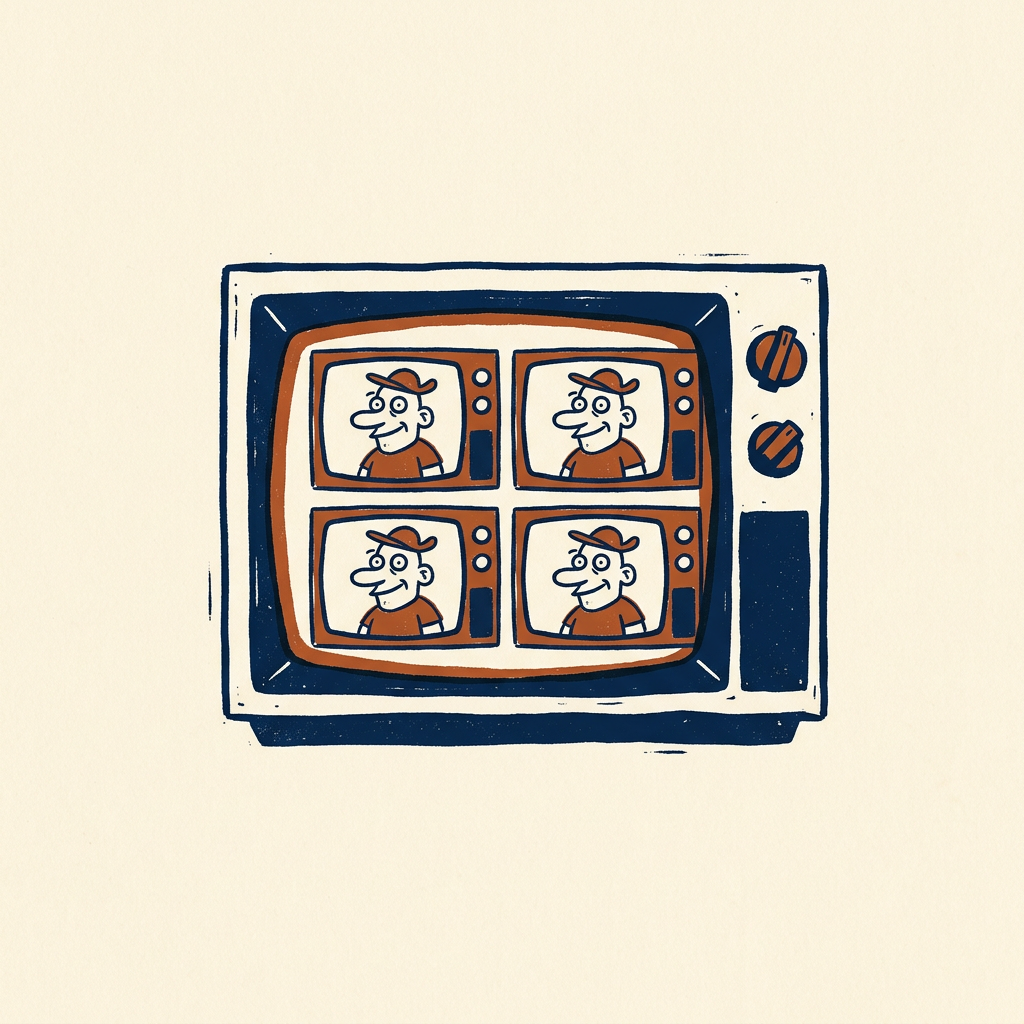
Gladwell challenges the idea that people who behave badly are simply bad people. He turns to New York City’s transit system in the late 1980s—graffiti-covered cars, widespread fare-beating—and the sharp drop in minor and violent crime after transit police chief William Bratton, guided by James Q. Wilson and George Kelling’s 1982 broken-windows theory, ordered graffiti scrubbed from every car nightly and cracked down on fare evasion starting around 1990.
Bratton later became NYPD commissioner and applied the approach citywide under Mayor Rudolph Giuliani. Crime fell substantially through the 1990s. Gladwell’s reading: visible disorder signals that no one is watching, which lowers the threshold for misbehavior. Fix the environment, and incidence changes.
He pairs this with the 1984 Bernie Goetz case—Goetz shot four young men on a graffiti-covered subway car—and argues the physical setting shaped how bystanders and the public read an ambiguous confrontation.
The before-and-after numbers feel dramatic, yet Gladwell treats broken-windows policing as a clean natural experiment while mentioning only in passing other forces criminologists stress: aging population, waning crack epidemic, increased incarceration, economic growth.
In practice: After graffiti was scrubbed from every subway car nightly and fare-beating was cracked down on around 1990, both minor and violent crime in the system fell sharply.
7
The ceiling near 150
Humans can hold roughly 150 stable social relationships; past that, groups must divide to keep cohesion and shared norms.
150
Approximate ceiling on stable trust-based relationships
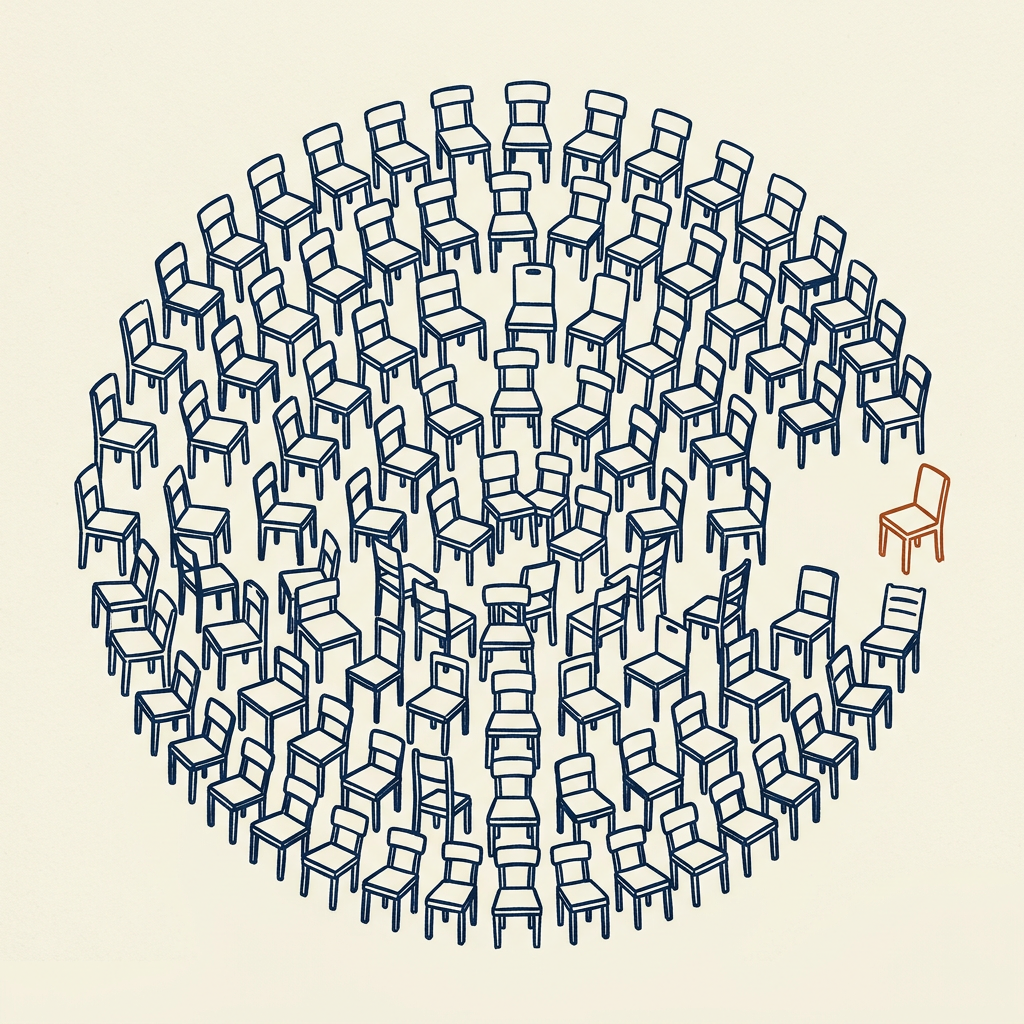
Drawing on anthropologist Robin Dunbar’s work linking primate neocortex size to social group size, Gladwell treats 150 as the natural upper limit for groups where everyone can keep personal, trust-based ties—an idea now often called Dunbar’s number.
Hutterite religious communities in North America split a colony into two once it approaches 150 members. Larger colonies grow harder to govern by consensus and peer pressure alone. Outdoor-apparel maker W. L. Gore & Associates caps plants and offices near 150 employees and builds a new facility rather than expand past the line, believing informal face-to-face coordination breaks down and must be replaced by costlier formal management.
Under the threshold, compliance and shared identity run on peer relationships and mutual accountability. Above it, rules, hierarchies, and surveillance take over—with real costs in flexibility and morale.
He extends the point: campaigns and organizations spreading an idea should work in cell-like units near this size rather than one undifferentiated mass. The evidence is illustrative—primate correlations extrapolated to humans, plus two documented organizational practices—not a controlled universal proof.
In practice: Hutterite colonies split once they near 150 members, and Gore builds a new plant rather than let any office grow past that size.

8
Three rules in combination
The right messengers, a sticky message, and supportive context can deliberately trigger large behavior change even with modest resources.
- 1Find the fewReach Connectors, Mavens, and Salesmen directly
- 2Make it stickyTest packaging, repetition, and structure before scaling
- 3Fix the settingChange cues in the immediate environment that block or enable the behavior
In the closing chapters Gladwell tests the three rules on harder problems. Teenage smoking campaigns often failed, he argues, because they pushed scary statistics without accounting for peer context and traits such as novelty-seeking and depression that predict which teens experiment and which become dependent. Research he cites suggests a small subset of adolescents are neurologically predisposed to nicotine dependence regardless of messaging.
He also examines a cluster of teenage suicides in Micronesia in the 1970s and 1980s, where copycat deaths spread partly through shared methods and cultural scripts reported in local media—contagion in literal, troubling form.
On a lighter track he revisits Divine Secrets of the Ya-Ya Sisterhood. Rebecca Wells’s novel drew little notice at first, then reading groups and author events—Connector- and Maven-like word of mouth among women’s circles—built it into a bestseller years after its 1996 release.
The practical claim: large change does not require large resources. Reach the right Connectors and Mavens, package for stickiness, reinforce with context, and a modest intervention can beat an expensive broad campaign. The claim is also the book’s most speculative—no controlled head-to-head test is offered.
In practice: Divine Secrets of the Ya-Ya Sisterhood sat quiet after its 1996 release until women’s reading circles and author events tipped it into bestseller status years later.
Key terms
- tipping point The moment a trend crosses a threshold and shifts from slow crawl to sudden explosion
- Law of the Few The claim that a small set of unusual people drives most social transmission
- Connector A hyper-networked person who bridges many otherwise separate social worlds
- Maven Someone who gathers information for its own sake and shares it to help, not to sell
- Salesman A persuader whose emotional expressiveness moves others to act
- Stickiness Factor How packaging and structure make a message memorable and actionable
- Power of Context The claim that immediate environment and social cues shape behavior more than fixed character
- broken windows The idea that visible disorder signals neglect and lowers the threshold for further misbehavior
- Rule of 150 The approximate ceiling on stable, trust-based relationships a person or cohesive group can hold
What to do
- Map the few unusually connected, knowledgeable, or persuasive people in your audience and reach them first rather than broadcasting evenly.
- Test your message on a small group by changing one structural element at a time—length, repetition, or format—and measure recall or action.
- Audit the place where you want behavior to change and remove small visible cues of neglect or disorder.
- If a team is nearing 150 people, split into smaller units before formal hierarchy becomes the only glue.
- Package the next campaign for stickiness the way children’s TV tested segments, not by volume of spend alone.
Questions to think with
- Who are the actual Connectors and Mavens in the community you want to change, and how would you find them without guessing?
- What single packaging change would make your current message easier to remember or act on?
- Which visible cues in the environment might be blocking the behavior you want?
- If your group crossed 150 people, what informal trust would you lose and how would you replace it?
- When have you seen a trend tip, and which of Gladwell’s three levers seems to have mattered most?
The other side
The book’s central weakness is retrospective case studies chosen to fit the thesis, not controlled tests against failures—a survivorship bias Gladwell rarely confronts. Network scientist Duncan Watts, whose work Gladwell used, later argued large cascades depend more on how ready the wider population is than on a few highly connected influentials; Twitter and email-forwarding studies around 2007 and after found ordinary, moderately connected people drove most spread, and Connectors made little measurable difference. Criminologists including Bernard Harcourt have argued broken-windows theory was never rigorously shown to cause crime drops, and the 1990s New York decline Gladwell treats as proof is now widely tied to the ebbing crack epidemic, demographics, and incarceration, while the policing style later drew criticism for aggressive stop-and-frisk with documented racial disparities. The Connector-Maven-Salesman types and the Rule of 150 likewise rest on thin foundations. Treat the book as suggestive analogy and vocabulary, not validated social science.
Who it's for
Marketers trying to understand why some campaigns go viral, public health workers designing behavior-change work on tight budgets, and general readers curious why trends, crime rates, and fads jump rather than drift will get the most—especially anyone who wants the vocabulary and intuition while staying skeptical of the case studies as proof.