


Create something new rather than copy what already works
Durable value comes from building monopolies on secrets and new technology, not from competing harder in crowded markets.
IJR · Oct 9, 2026 · 13 min read

In 60 seconds
- Real progress is vertical creation from 0 to 1, not horizontal copying from 1 to n like globalization.
- Competition erodes profits; serious companies should escape it and aim for monopoly-like dominance.
- Lasting monopolies rest on proprietary tech at least 10x better, network effects started small, scale, and branding.
- A firm’s value is future cash flows, so being the last durable mover beats being first.
- Great companies come from definite plans and unpopular secrets, not indefinite luck, pivots, or lean iteration.
- Distribution and sales are as structural as the product; singular founder vision sustains the whole effort.
The big idea
Thiel contends that lasting economic value comes from creating something entirely new—going from 0 to 1—built around secrets few people believe yet, not from iterating on what already exists. Founders should pursue monopoly power through proprietary technology and a definite vision rather than win inside competitive markets or treat the future as a diversified bet.
The book in brief
Thiel starts from a hiring question—what important truth do few people agree with you on—and uses it to separate horizontal progress (copying known things, as in globalization and China’s 2000s growth) from vertical progress (single acts of creation like the printing press or personal computer). He claims most future value will come from technology, not more copying of resource-heavy habits, and points to stagnation in energy, transport, and biotech since the 1970s plus the gap between hoped-for breakthroughs and incremental digital products as evidence that society has forgotten how to build genuinely new things.
He then attacks the idea that competition is healthy for businesses. Perfect competition, he notes, drives profits to zero; airlines illustrate razor-thin margins while Google’s search-advertising position produced enormous ones. Monopolists disguise dominance; commodity firms exaggerate uniqueness. The practical test is whether a business could raise prices tenfold without losing customers.
Mechanics follow: durable monopoly power comes from proprietary technology substantially better than alternatives, network effects that begin in a tiny defined base, economies of scale (especially software’s near-zero marginal cost), and branding. Strategy is start small and dominate a niche—Amazon with books—before expanding; huge-looking markets are usually already contested.
Valuation logic reframes the goal as last-mover advantage: a company’s worth is the discounted sum of future cash, so durability a decade or more out matters more than early entry. Google was not the first search engine but became the one that still mattered. Thiel next maps attitudes toward the future on a definite/indefinite and optimistic/pessimistic grid, praising definite optimists who plan concrete futures (Golden Gate, Apollo) and criticizing indefinite optimists who diversify, pivot, and wait for probability—an attack on lean-startup orthodoxy.
Secrets—true, unpopular beliefs about nature or people—become the foundation of great companies; PayPal’s early insight about eBay power-sellers needing fast electronic payments outside banks is the working case. Culture, he says, has grown hostile to secrets through incremental education, the illusion of total information, and post-2008 risk aversion. Organization then matters: choose co-founders you already know, avoid ambiguous equal splits without a clear CEO, keep boards to three or sometimes five, and hire early people who believe the specific mission. Sales and distribution are treated as structural, not afterthoughts—viral channels for low lifetime-value products, dedicated sales forces for complex high-value deals. Computers should complement human judgment (Palantir’s model) rather than replace it. The book closes on founder psychology: the same intensity that looks eccentric often sustains an unpopular vision long enough to win, even as boards retain reasons to check excess.
Context
Peter Thiel wrote from experience founding PayPal and Palantir and investing early in Facebook. Published in 2014, the book mattered because it directly challenged Silicon Valley’s prevailing faith in lean iteration and competitive markets as the reliable path to innovation.
The key ideas

1
Zero versus one
Genuine progress is vertical creation of something new, not horizontal copying of what already works.
Horizontal 1 to n
Copy and spread what already works—globalization, more cars and air conditioning in new places
Vertical 0 to 1
Create something never done before—printing press, personal computer, new technology
Thiel opens by separating two kinds of progress. Horizontal progress means taking something that works and repeating it—more of the same across places or customers. Vertical progress means doing a thing that has never been done, a single unrepeatable act of creation.
Globalization is his pure horizontal case: cars, air conditioning, and known methods spread to new geographies, the pattern he associates with China’s growth model in the 2000s. Technology is vertical: the printing press, the personal computer, or any leap that changes what is possible rather than where an existing tool is used.
He claims most economic value in coming decades will have to come from technology because a world of more people simply copying resource-intensive habits hits ecological and resource limits. He treats the relative stagnation in energy, transportation, and biotech since the 1970s, alongside comfort with incremental digital products, as signs that vertical ambition has faded.
The rest of the argument follows from this fork: founders, investors, and societies should prioritize the harder path of creating from nothing over the safer path of slight improvement.
In practice: He contrasts spreading known technologies like cars to new places with one-time inventions such as the personal computer.

2
Escape competition
Competition destroys profits; the goal of a serious company is monopoly-like durable advantage, not winning inside a crowded field.
Competitive commodity
Airlines: whole sector can earn only razor-thin margins per passenger
Monopoly position
Google search advertising: enormous margins with no real direct rival
Thiel turns Econ 101 against the usual startup advice. In perfect competition any advantage is copied until no firm earns economic profit above the cost of capital. That outcome is good for consumers in the textbook, yet it leaves competitive industries structurally unable to reward innovation.
He sets airlines, where an entire sector can earn only razor-thin margins per passenger in a representative year, against Google, which earned enormous margins in search advertising because it faced no real rival there. Monopolists, he notes, often hide dominance by claiming they compete broadly; commodity businesses exaggerate uniqueness.
His detection test is blunt: could the business raise prices ten times and still keep customers? A true monopoly-like position can; a commodity cannot. Founders should therefore design for differentiation so extreme that rivalry becomes irrelevant.
The terminology is contested—Thiel’s “monopoly” is closer to durable competitive advantage than the antitrust harm definition—but the practical direction remains: stop trying to win a race everyone else is also running.
In practice: Google framed itself as a broad technology company competing with Apple and Amazon while holding overwhelming share in search ads; a restaurant owner claims uniqueness while fighting every other local restaurant for the same diners and rent.
3
How monopolies last
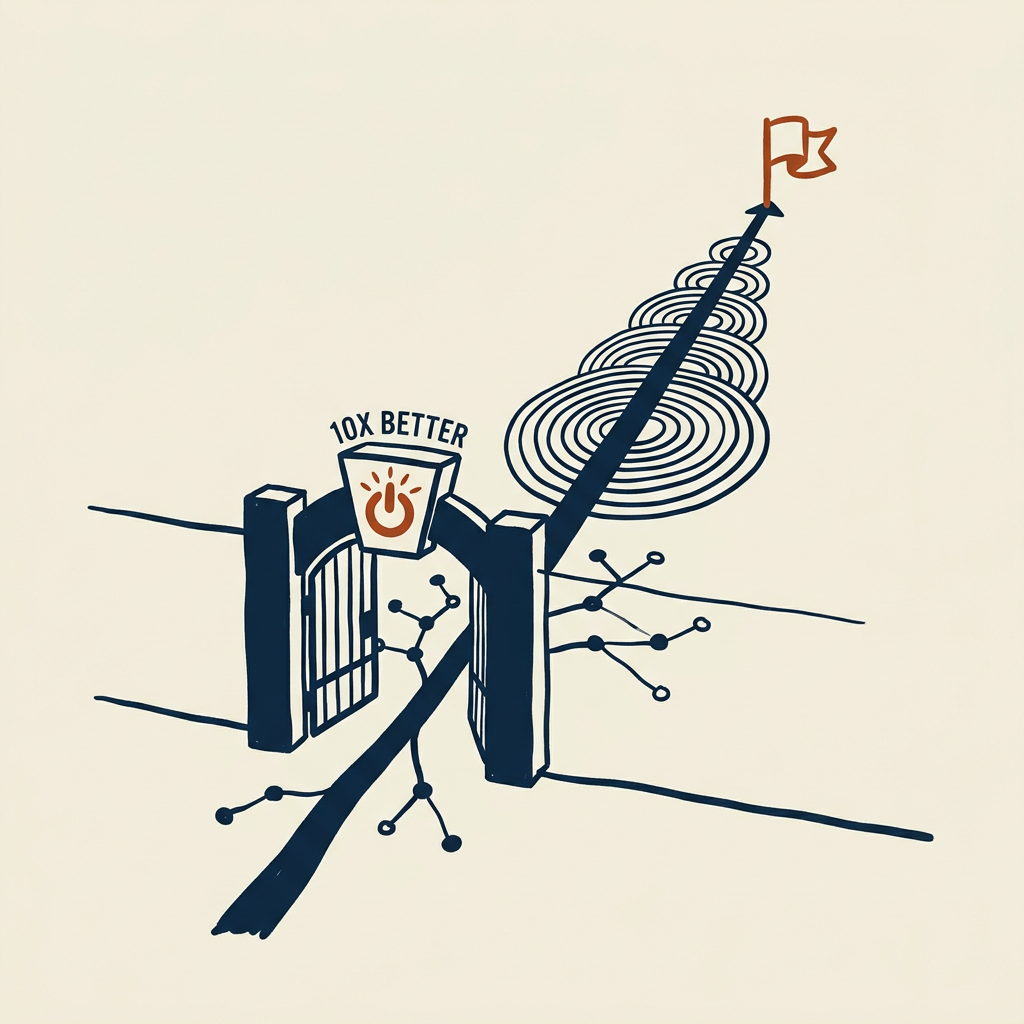
Durable monopolies are built on proprietary technology at least 10x better, network effects begun in a tiny niche, economies of scale, and branding.
If monopoly is the aim, Thiel lists four sources that actually endure. Proprietary technology must be substantially better, not marginally better; his rule of thumb is at least ten times better than the next alternative because incremental gains fail to overcome habits and switching costs.
Network effects make a product more valuable as more people use it, yet they only start working inside a small, tightly defined initial group—otherwise there is no critical mass. Economies of scale favor businesses, especially software, where fixed costs spread over rising output and the cost of one more customer approaches zero. Branding, built slowly, can lock in loyalty that behaves like monopoly power.
The strategic move that ties them together is deliberate narrowness: dominate one specific niche completely before expanding into adjacent ones. Entering a market because it looks huge usually means many rivals already fight over undifferentiated demand and leave no room to establish real control.
Amazon’s path—books first, then everything else—illustrates the sequence; the opposite temptation of “big market equals big revenue” is treated as a trap.
In practice: Amazon began by offering far greater selection than any physical bookstore, then expanded category by category; Facebook launched inside Harvard rather than to the entire world.

4
Last mover wins
Company value equals discounted future cash flows, so remaining the dominant player years later matters more than arriving first.
- Early entrantsYahoo, AltaVista and others launch search
- Google arrivesDifferent enough technology to take and hold the position
- Decade-plus laterStill the search engine that mattered—last mover, not first
Thiel anchors strategy in a simple valuation claim: a business is worth the sum of all the money it will make in the future, brought back to present value. Steady profits lasting decades therefore outrank high current revenue that rivals will soon erode.
This reframes “first-mover advantage” as tactically useful at best and strategically insufficient. Being early is worthless if a better-resourced competitor arrives and takes the market. The real prize is becoming the last significant entrant still standing and still generating cash a decade or more later.
Founders should therefore judge decisions by whether the company can still be dominant and cash-generative fifteen or twenty years out, not by quarterly growth optics alone. The same durability traits—proprietary edge, network effects, scale, brand—become the forward-looking checklist.
The framework describes what winning looks like after the fact more cleanly than it predicts it in advance, yet it still corrects pure growth-at-all-costs thinking.
In practice: Google was not the first search engine—Yahoo, AltaVista and others came earlier—yet its technology and position made it the search engine that still mattered for more than a decade.
5
Definite optimism
Great companies are products of specific detailed plans, not luck, diversification, or endless market-driven pivots.
Optimistic → Pessimistic ↑ · Definite → Indefinite →
Definite optimist
Future can be better; hold a specific plan (Golden Gate, Apollo)
Indefinite optimist
Future will be better; no plan—diversify, pivot, let probability work
Definite pessimist
Future worse; plan defensively for decline
Indefinite pessimist
Future worse; no plan, pure resignation
Thiel maps attitudes to the future on two axes: optimistic versus pessimistic, and definite versus indefinite. A definite optimist believes the future can be better and holds a concrete plan to make it so. An indefinite optimist believes things will improve yet has no particular design, preferring probability, optionality, and diversification.
He treats much of contemporary American culture and finance as indefinite-optimist territory: diversified portfolios, iterative startup pivots, standardized test-taking, and venture habits that reward looking successful across many small bets rather than building one thing extremely well. The lean-startup emphasis on rapid experiments and customer-driven pivots sits in his crosshairs.
His instruction to founders is to become definite optimists—write the specific future of the company rather than treat the firm as a sequence of validated experiments. He points to Tesla, SpaceX, and Apple under Jobs as cases run by singular vision rather than consensus iteration.
The chapter is more temperament than causal proof; successful pivots at other firms sit awkwardly beside the claim, yet the demand for a real plan remains the operational takeaway.
In practice: Engineers of the Golden Gate Bridge and the Apollo program worked from concrete blueprints toward known goals, unlike finance cultures that spread bets and wait.

6
Hunt for secrets
Every great company is built on a secret—an important truth the rest of the world does not yet believe.
Building on definite planning, Thiel argues valuable businesses start from secrets: true and important claims most people reject or have stopped seeking. He splits them into secrets of nature, found through science, and secrets about people, found by noticing what others miss or will not say about themselves.
Modern culture, in his account, has grown hostile to the search. Incremental education implies easy problems are solved and remaining ones are impossible or imaginary. A flat, always-on information world creates the illusion that nothing important stays hidden. Risk aversion after events such as the 2008 crisis punishes bold, falsifiable claims about the future.
He links the decline of secret-seeking to the same vertical stagnation described at the outset and contrasts it with mid-twentieth-century confidence in large engineering projects. Founders should hunt unpopular truths inside domains where they hold comparative insight and share those truths selectively so advantage is not eroded before defenses exist.
“Find a secret” is easier to advise than to turn into a checklist, yet the discipline of naming the unpopular belief still separates creation from copying.
In practice: PayPal’s early secret was that eBay power-sellers needed fast electronic payments the traditional banking system was not supplying.

7
Founding people first
Early choices about co-founders, clear authority, small boards, and mission-true hires decide whether a startup survives its own conflicts.
- Co-foundersPeople already known well; clear CEO from day one, not ambiguous equal command
- BoardThree seats, sometimes five—larger boards slow decisions and dilute accountability
- First 10–20 hiresBelievers in the specific mission, not generalists collecting optionality
Thiel shifts from market strategy to the human core. The earliest consequential decisions are not product features but who founds with you, how ownership and authority are split, and whom you hire while the firm is still fragile. Extreme uncertainty turns ordinary misalignment into existential risk.
He urges founders to pick co-founders they already know well; startups compress years of relationship stress into months. Equal three- or four-way splits without a designated CEO create paralysis when fast decisions are required—financial equality need not mean ambiguous command. Boards should stay small: three people, sometimes five; larger boards slow decisions and blur accountability.
The first ten or twenty hires must genuinely believe the specific mission rather than chase a paycheck or resume line. Early people who do not buy the definite vision default to hedging and indefinite thinking that undercuts the enterprise.
PayPal’s culture of people obsessive about digital money, many already linked through Stanford or the Thiel-Levchin circle, is his working model; that intensity later showed up across the so-called PayPal Mafia’s later companies.
In practice: PayPal hired for shared obsession with the digital-money mission; many who later founded or funded Tesla, LinkedIn, YouTube, and Yelp first bonded inside that early intensity.

8
Distribution is the product
A better product does not sell itself; sales and distribution channels are as essential as the technology and can themselves be a moat.
Thiel attacks a bias common among technical founders: the fantasy that excellence alone draws customers. Distribution, he insists, is structural to survival, not a later marketing layer.
He offers a rough rule by customer value. When average lifetime value sits under a dollar, viral or automated spread can work—consumer apps with built-in sharing. When deals are complex and high-value, often hundreds of thousands of dollars, the company needs a real sales force doing relationship selling, the path Palantir took with government and large enterprises.
Effective sales work is often deliberately unglamorous and hidden; engineers’ visible technical craft gets more internal credit, which distorts attention inside founder-led teams. That blind spot helps explain why some technically strong products fail commercially while weaker products with superior distribution win.
Distribution advantages—exclusive relationships or efficient acquisition—can function as monopoly power of their own: rivals with equal product quality still cannot reach the same customers profitably.
In practice: Palantir required complex, relationship-based sales to government agencies and enterprises; low-lifetime-value consumer apps can rely on viral or automated channels instead.

9
People with machines
The most valuable technology companies will pair computational power with human judgment rather than fully replace workers.
Man versus machine
Full replacement of workers; higher resistance, narrower political and market path
Man and machine
Augment judgment—machines find patterns, humans handle context and ambiguity
Writing against early-2010s fear that automation would simply destroy jobs, Thiel reframes computers as complements to human labor more often than substitutes. Value, in this view, appears at the joint between what machines do well and what people still do better.
Palantir is his central case: software that helps intelligence and financial-fraud analysts sift massive data sets. Machines surface patterns; humans keep the interpretive, contextual, ambiguous work that detectives, doctors, or investigators perform. Pure replacement strategies, he argues, misfit tasks that require judgment.
Complementary tools also face less adoption resistance and open larger markets than tools aimed at eliminating the human entirely. He presents this both as business strategy and as a partial reply to political anxiety about job loss, claiming historical fears of total automation have usually outrun how technology is actually absorbed.
The argument neatly matches the company he co-founded and continued to benefit from, and it does not deeply engage domains where substitution has already scaled, yet the complementarity design rule remains usable for founders choosing what to build.
In practice: Palantir’s software surfaces patterns in large data for analysts while leaving contextual judgment about fraud or intelligence to the humans.

10
Founder intensity
Unconventional, stubborn founders are essential to 0-to-1 companies even when the same intensity looks excessive to outsiders.
In the closing movement Thiel turns to founder psychology. History’s most transformative builders, in his telling, were often seen as eccentric or difficult; that perception is not accidental. Holding a genuinely novel vision requires resisting heavy social pressure to conform, and the same stubbornness that alienates some people is what keeps an unpopular idea alive long enough to be proved.
He tries to separate the claim from pure hero worship or a blank check for misconduct, acknowledging that founder myth can tip into destructive grandiosity and that boards have legitimate reasons to constrain power. Still, the chapter defends concentrated founder authority as a feature of successful creation companies once the initial breakthrough exists.
Founder-led firms with an idiosyncratic vision, he argues, tend to outperform professional consensus management after the hard creation step. The same thread ties back through definite plans, secrets, and monopoly building: someone has to carry the unpopular picture against a culture he sees as too comfortable with incrementalism.
Later failures of founder-centric oversight at other firms have made the admiration more contested, yet the book’s capstone remains the defense of singular vision as the human engine of going from zero to one.
In practice: He points to figures such as Steve Jobs, Howard Hughes, and Elon Musk as builders whose perceived strangeness tracked the stubbornness required to push novel visions.
Key terms
- Zero to one Creating something entirely new instead of repeating or slightly improving what already exists
- Horizontal progress Copying working ideas across more places or customers—going from 1 to n
- Vertical progress Doing something never done before—true technological creation from 0 to 1
- Monopoly (Thiel’s sense) A business so differentiated it escapes competition and keeps durable profits; closer to lasting advantage than pure antitrust control
- Last mover The company still dominant and cash-generative in its market years later, worth more than an early entrant that gets overtaken
- Definite optimism Belief the future can be better plus a specific concrete plan to make it so
- Secret An important truth about nature or people that most others do not yet believe or have stopped seeking
- 10x better Thiel’s bar for proprietary technology: substantially superior, not marginally improved, so customers actually switch
- Complex sales High-value, relationship-heavy selling needed when deals run to large contracts rather than low-priced viral products
What to do
- Write down the specific unpopular belief your project depends on before building further.
- Map total addressable market honestly and prefer a small niche you can dominate completely before expanding.
- Run the 10x test on your offer: would customers pay ten times more, or could a rival match you with minor effort?
- If the answer is no, spend the next work block on differentiation rather than growth tactics.
- Sit with whoever owns sales or distribution and give that conversation equal weight to product work.
Questions to think with
- What important truth do very few people agree with you on, and could a company be built on it?
- Could your business raise prices ten times without losing its customers?
- Are you optimizing for dominance a decade from now or for near-term growth metrics?
- Is your early team chosen for shared mission belief or for general optionality?
- Where does your product need human judgment alongside automation rather than full replacement?
The other side
The book’s weakest spots are definitional and empirical: “monopoly” is blurred with ordinary durable advantage to make it sound both superior and morally fine; the attack on lean iteration sits awkwardly beside successful pivots including at PayPal, Twitter, and Slack; “find a secret” and last-mover durability are easier to recognize after the fact than to operationalize; the man-and-machine chapter neatly fits Palantir’s own model and underplays domains where automation has already substituted at scale; and the defense of intense founder authority aged unevenly after later oversight failures at founder-centric firms.
Who it's for
Founders trying to tell whether an idea is truly differentiated or merely a copy, plus investors and MBA students who want a contrarian lens on which companies can produce outsized returns. Anyone curious how Thiel thinks about competition, monopoly, and the future will get the full argument.