




Lincoln returns after Iran combat no carrier matched
Hegseth awarded the Presidential Unit Citation as the Abraham Lincoln ended a 321-day deployment that hit Iranian forces hard and drew scrutiny over morale and supplies.
IJR · Oct 8, 2026 · 5 min read
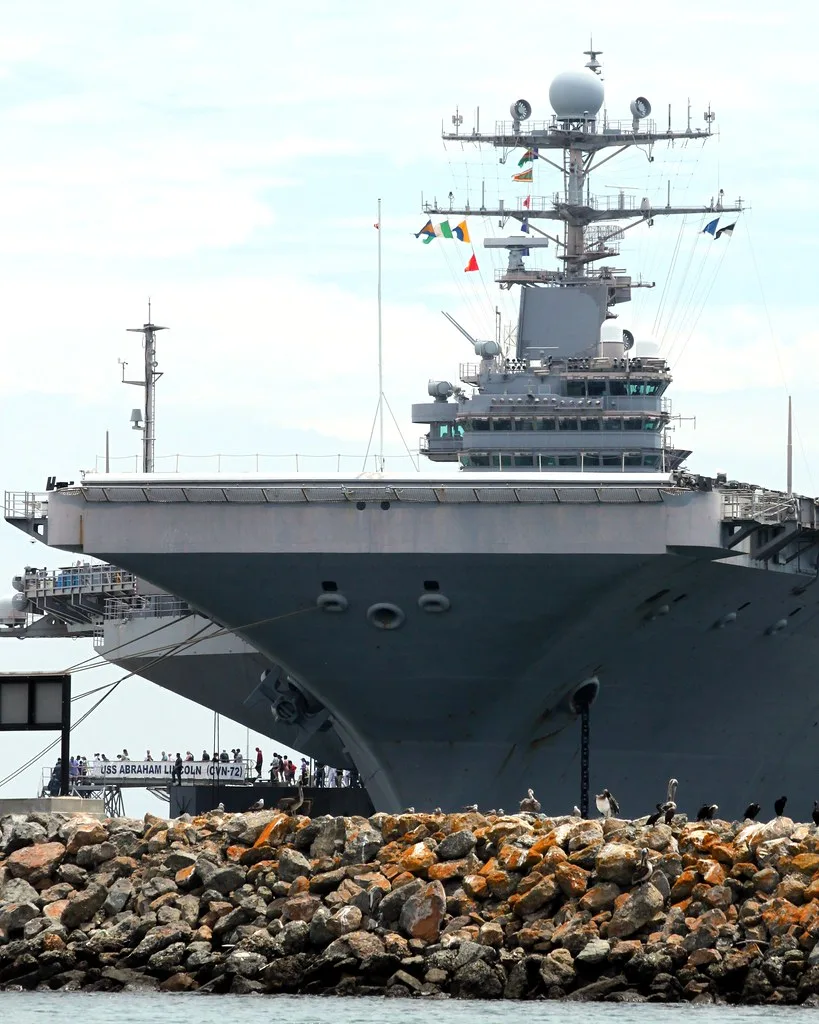
On the flight deck of the USS Abraham Lincoln on Oct. 7, 2026, Defense Secretary Pete Hegseth read the Presidential Unit Citation to sailors still underway a day before they reached home. He disclosed combat totals not previously public: 3,693 combat sorties, 1.37 million pounds of ordnance dropped on Iranian targets, 450 Tomahawk cruise missiles launched by escorting warships, 77 Iranian drones and 21 anti-ship cruise missiles shot down, defense against four fast-attack craft and explosive dhows, and 64 Iranian warships sunk.
The carrier strike group was due to dock at Naval Air Station North Island in San Diego on Oct. 8, closing a 321-day deployment that began when the ship left San Diego on Nov. 21, 2025. More than 200 days of that cruise supported U.S. operations in the Iran war, which began Feb. 28, 2026. The Lincoln spent 286 days at sea without a port call, the second-longest such stretch since the Vietnam War. Only the USS Gerald R. Ford’s 326-day deployment earlier in 2026 ran longer.
Hegseth told the crew he had signed the orders extending the deployment twice. Typical carrier strike deployments last about seven months. “I plead guilty, A., because of the incredible effectiveness that you showcased on the battlefield and the necessity. But also B., the mission required it, and C., because President Trump had full faith that you would deliver on behalf of the American people, and you did,” he said.
“What the USS Abraham Lincoln Carrier Strike Group did, no other carrier strike group has ever done,” Hegseth said, listing “10,000 sorties, 23,000 combat flight hours, almost 4,000 combat sorties, 1.5 million pounds of ordinance dropped on the enemy.” Those figures are the core national-security fact of the homecoming. A carrier kept on station after hostilities open gives the commander in chief combat options, deters wider attack, and uses the fleet the taxpayer already paid to build. Extending the Lincoln twice kept decks, escorts, and air wings in the fight when the war started in February and relief was months away. For limited government and hard power, the test is whether the group hit the targets the mission required. The citation and the disclosed tallies show it did.
The same cruise drew sustained scrutiny over living conditions and mental health. At a family town hall in San Diego on Aug. 6, 2026, relatives voiced fears about mental health and supplies. Acting Navy Secretary Hung Cao’s Sept. 22 letter to Congress confirmed eight suicide attempts across the carrier strike group. No deaths resulted, and none of the attempts occurred aboard the Lincoln itself. One sailor from the air wing went overboard in early August 2026, was rescued, and was transferred for medical care. Sen. Richard Blumenthal sent a letter asking the Navy to account for conditions aboard the Lincoln. The ship’s first scheduled port visit in more than 260 days came in Thailand on Sept. 2, 2026; it had earlier pulled into Guam on Dec. 11, 2025.
A U.S. official told ABC News the eight attempts appeared to be on the lower end of what carrier deployments experience. NBC News, in reporting by Alicia Victoria Lozano, noted that Navy officials had initially said leadership had not observed an increase in suicidal ideations or attempts aboard the ship. The record supplied here does not include a point-by-point Navy rebuttal of every supply shortfall families described; it does show the service moving supplies and storage practices for the next carrier already headed out.
Hegseth answered the coverage on the flight deck. “There were a few folks in the media who tried to turn the USS Abraham Lincoln into some sort of a symbol,” he said. “A symbol of dysfunction, or a symbol of low morale, or a symbol of a failed mission. And what I look out right here or when I talk to your leadership, and I haven’t had a chance to talk to a number of you, I know it’s the exact opposite.”
That dispute is not abstract for public confidence or for sailors’ families. When a strike group returns from combat with a Presidential Unit Citation and a sortie and ordnance record no other carrier strike group has matched, leading with dysfunction teaches adversaries the wrong lesson and tells the crew their combat work is secondary in the telling. The August town hall fears about self-harm and food are the human cost of long separations and of a war that began after the ship was already underway. The ordinary American stake runs both directions: crews need stores, hygiene items, climate control, and mental-health capacity that hold up when resupply is hard, and the country needs carriers that can remain on station when a fight starts and the calendar slips past the usual seven months.
The Navy is applying the Lincoln’s cruise to the USS Theodore Roosevelt, which left San Diego for the same theater. “Roosevelt is maximizing its load-out of food, retail products and hygiene items before getting underway,” Adm. Daryl Caudle, the chief of naval operations, said. Master Chief Petty Officer of the Navy John Perryman said the crew is converting available spaces into additional storage, “building the ability to remain self-sufficient for longer periods, especially when resupply may be difficult.” Further steps include new entertainment equipment, more durable fitness gear, spare cardio machines, climate-control inspection teams, and software pre-staged so critical services keep running when bandwidth drops or the ship operates degraded.