




Terry Fox Runs a Marathon a Day
A 21-year-old with one leg set out to run across Canada for cancer research — his Marathon of Hope has now raised over $850 million.
FaithTap · Oct 9, 2026 · 9 min read
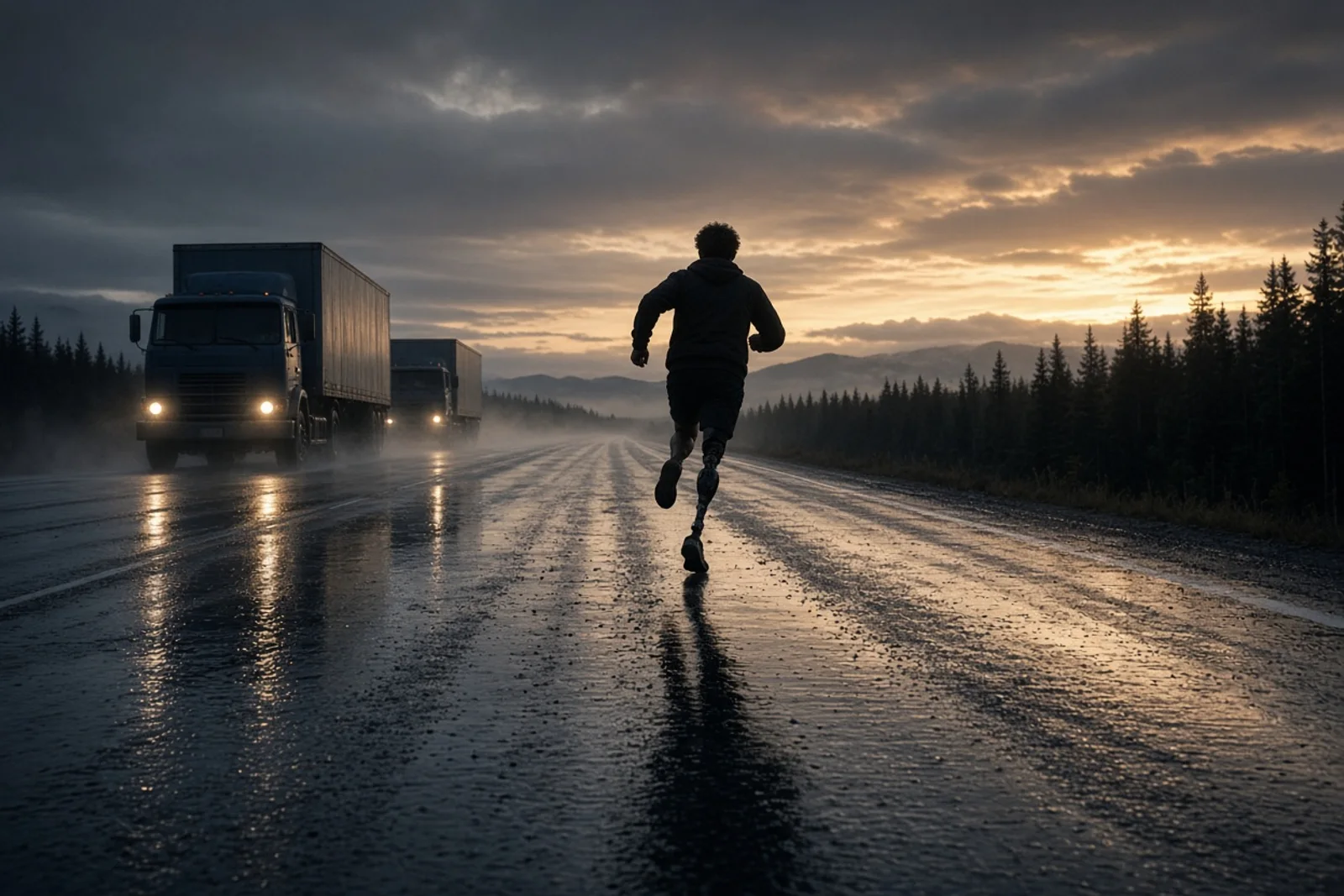
The water in St. John's harbor that April morning had a bite to it that got into your teeth. I stood back with my clipboard and my list of towns, the whole itinerary for the next five months folded into a manila envelope under my arm, and I watched a twenty-one-year-old kid in a Marathon of Hope t-shirt wade out past his ankles into the Atlantic. He bent down. He filled a plastic bottle with ocean water to carry with him, and he dipped the steel and fiberglass foot of his artificial leg into the surf like he was baptizing it for the work ahead. There were maybe a dozen of us on the beach. Nobody clapped. Nobody thought, watching that, that we were looking at the beginning of something that would still be running decades after he was gone.
I'd been hired on with the Canadian Cancer Society to scout ahead of him, town by town, arranging school gymnasiums and church basements where he could stop and speak, and so I knew his file before I ever shook his hand. Osteogenic sarcoma, diagnosed at eighteen, cancer above the right knee. Amputation. Sixteen months of treatment. He'd been a basketball player at Simon Fraser, the kind of kid who in junior high was five feet tall with no natural talent and still willed his way onto a school team through sheer repetition, practicing every morning before the sun was properly up. That was the shape of him, I came to understand. Whatever he lacked, he made up for by refusing to stop.
The wards were what did it, he told me once, sitting on the tailgate of the van eating a sandwich somewhere outside Gander. Sixteen months of watching other cancer patients, some of them children, suffering in ways that made his own amputation feel almost lucky by comparison. He said he couldn't un-see it. He said more money had to go into research, and since nobody else seemed to be running across the country to get it, he decided he would.
So April 12th, 1980, that was the start of it: one leg, one prosthesis he'd built up the strength to run on, and a plan to cross the entire country to the Pacific. Doug Alward, his oldest friend from those basketball days, drove the van. Some nights, when there wasn't money for a motel, the two of them slept in it on the shoulder of the highway, engine off, breath fogging the windows.
His mornings started at four-thirty. I know because I was sometimes there for them, holding a flashlight while he strapped the leg on in the dark, the Velcro and buckles loud in the cold quiet before any bird had started up. He ran close to forty-two kilometres a day, a full marathon, every single day, which is a number that sounds reasonable on paper and is in fact almost impossible, and he did it on a limb that chafed and blistered and once developed cysts that left blood in his shoe by the end of an afternoon. He never told me the pain wasn't real. He told me it wasn't the point.
Newfoundland in April was not kind to him. Snow came sideways off the water some mornings. Wind pushed him sideways on the road. There were stretches — long ones — where nobody came out to watch, where no donation landed in the fishbowl we kept by the van, where it was just Terry's peculiar hopping stride, thud and swing, thud and swing, echoing off the rock cuts with nobody but Doug and me and the gulls to hear it.
I used to worry those empty stretches would break him before the country ever got the chance to notice him. He didn't seem worried. He'd say, more or less, that people would come around if they knew, and the job in front of us was to make sure they knew. So I kept driving ahead, calling radio stations, walking into Legion halls and Rotary lunches with photographs of a smiling kid running on a metal leg, telling anyone who'd listen that he was coming through their town on such-and-such a date and could they please be there.
Prince Edward Island was gentler. Nova Scotia found its voice. By New Brunswick the fishbowl in the van wasn't a fishbowl anymore, it was buckets, and there were mornings I'd arrive in a town two days ahead of him and already find hand-painted signs nailed to telephone poles. Something was catching. You could feel it building the way you feel weather change before you can name it.
He turned down every offer that came with a logo attached. Companies wanted their name on his shirt, on the van, on banners strung across small-town main streets, and he said no to every one of them, because the day this became an advertisement was the day people stopped seeing him and started seeing a product. I watched him refuse money more than once, money we genuinely needed, because he'd rather run broke and clean than well-funded and compromised. That refusal became its own kind of legend before the run was even finished.