Contractor Pleads Guilty in $2.5B China Server Scheme
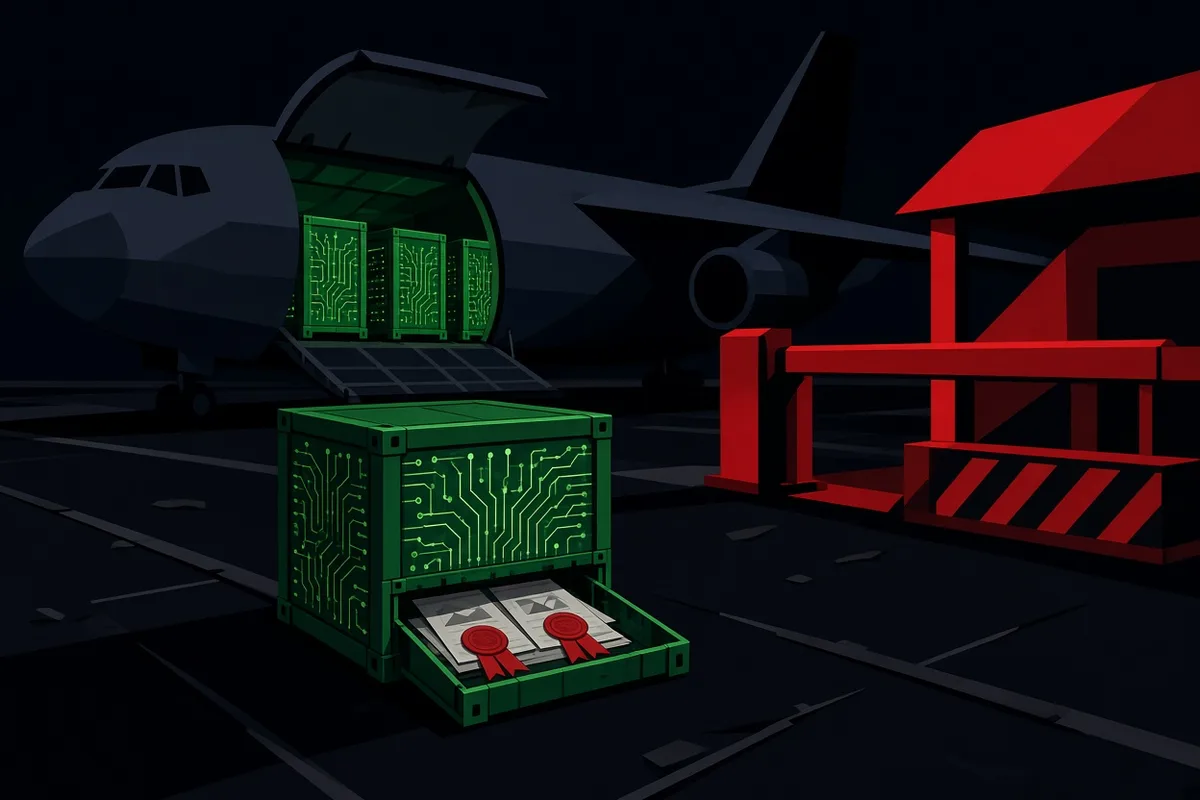
Ting-Wei “Willy” Sun entered his guilty plea in U.S. District Court in Manhattan on Thursday, Oct. 8, 2026. The docket also reflected the admission. Court filings reported by Reuters, in coverage by Karen Freifeld, show that he admitted four federal counts: conspiracy to violate export controls, conspiracy to smuggle goods, conspiracy to defraud the United States, and obstruction of justice.
Export controls are the licensing rules that decide which advanced hardware may leave the country without permission. Conspiracy to violate those controls means agreeing to move the hardware anyway. Conspiracy to smuggle goods is the charge for routing the shipments past the border without that permission. Conspiracy to defraud the United States covers the false documents and cover arrangements used to keep the true destinations off official forms. Obstruction of justice is the separate count for steps taken later to mislead investigators once the government began looking. He pleaded to every one of them.

The admission itself was spare on the public docket. The original indictment, filed in March 2026, had named three men. Prosecutors charged Sun alongside Yih-Shyan “Wally” Liaw and Ruei-Tsang “Steven” Chang over an alleged diversion of about $2.5 billion in U.S. AI servers to China, according to the Department of Justice. About $2.5 billion. That was the figure the charging papers put on the hardware.
Liaw co-founded Super Micro Computer in 1993 and its board in 2023. The San Jose company builds high-performance servers for data centers and artificial intelligence, with manufacturing in Silicon Valley, the Netherlands, and Taiwan. Super Micro itself was not a defendant. Liaw was arrested in California in March 2026 and released on bail. Chang was identified in the papers as a Taiwan sales manager; he did not appear. The day the indictment became public, Super Micro stock fell about 33 percent, CNBC reported.
The alleged scheme had begun around 2023 or 2024. The indictment named the chips by model. Nvidia’s B200, H100, and H200 graphics processing units, and the servers that contained them, sat on the Commerce Control List. A graphics processing unit is the specialized processor that trains and runs advanced artificial-intelligence models. Under those rules, advanced AI server systems carrying the listed chips could not ship to China without a U.S. license, a restriction aimed at national-security and military-AI risk. Karen Freifeld of Reuters reported the charging papers’ listing of those three Nvidia GPUs. Super Micro builds the high-performance AI servers that house this class of hardware.
The route behind the diversion ran through a company in Southeast Asia. Servers were allegedly sold toward that entity and then routed on to China-based end customers. FBI Assistant Director James C. Barnacle Jr. described a pass-through company used to hide the client list and the conduct, according to an Associated Press account of the case. Prosecutors said the servers were repackaged in unmarked boxes and moved under false paperwork meant to misdirect U.S. authorities. More than $510 million of servers moved to Chinese customers in a three-week window from late April to mid-May 2025.
In December 2025, dummy servers were staged to mislead a Commerce Department inspector during an on-site check. The real machines had already left. Court filings reported by Reuters, in coverage by Karen Freifeld and others, described the staging as one step in a longer effort to keep Chinese end customers off the official trail.

The investigation reached across the Pacific. Taiwanese authorities, in a related probe, detained several individuals in May and June 2026, among them Super Micro employees. In a separate case, prosecutors charged Earthmade Computer CEO Greg Lui over an alleged additional route of about $300 million in Nvidia chips.
Sun’s plea is the first guilty plea among the three men charged. A sentencing date for him has not been disclosed anywhere in the public filings. Cooperation terms, if the parties reached any, have not been made public. Liaw has pleaded not guilty. The trial is set for Nov. 2, 2026, in Manhattan federal court. After the March crash, the October tape was quiet. Across the prior twenty trading sessions Super Micro stock had held inside a range running from $40.025 to $45.15. On Oct. 9, 2026, the shares closed at $41.75, up 1.32 percent.
Chang remains at large. He has not appeared. No court date for him appears in the record.