Anthropic Opens Bay Area Wet Lab for AI Biology Work

Anthropic was operating a wet lab in the San Francisco Bay Area. Two people familiar with the facility described physical experiments running there. Eric Kauderer-Abrams, who leads life sciences at the company, confirmed the lab in a Reuters interview.
“We believe that to do biology, the final test is still and will be for a while in real lab work,” Kauderer-Abrams said.
Anthropic builds Claude, a family of large language models, and had kept its public biology work largely inside software—evaluations that never left the machine. A wet lab is the other kind of room: built for hands-on biology, where cells, reagents, and instruments replace pure simulation.
A company spokesperson said the lab is not specifically for drug discovery and declined to elaborate on its purpose. Anthropic disclosed no details on size, staff count, opening date, or biosafety level. Biosafety level is the graded standard that tells what biological materials a laboratory is cleared to handle.

Drug discovery is the process by which new candidate medications are found. In the modern form, researchers screen large libraries of chemicals against isolated biological targets thought to be linked to disease, then refine the hits for affinity, selectivity, and stability before any testing in cells or animals. The full path is capital-intensive and inefficient; most candidates fail. Historically the work began with traditional remedies or chance finds, and either way it ends only after years of further development. Ruling that purpose out left the projects inside the Bay Area facility unnamed.
Kauderer-Abrams said the physical work was already under way. “We absolutely are doing that today, and I would describe our approach as being typical of what you would see in most biotech companies, where there’s some amount of that that we’re doing in our own facilities and some amount of that that we’re working with external partners on.”
Anthropic was founded in 2021 with the goal of promoting AI safety. Dario Amodei, the company’s chief executive, has identified bioterrorism as one of the major risks associated with advanced AI. The company has identified situations in which its systems might have been used to help develop biological weapons.
Asked how they managed the balance, Kauderer-Abrams said, “In our life-science work, we’re always balancing these things, making models better in ways that we think will uplift and accelerate developing medicines, and being thoughtful and careful about how we deploy it to limit the risk.”
In April 2026 Anthropic acquired Coefficient Bio, a startup with fewer than ten employees. The deal was worth about $400 million in stock. That same month Novartis chief executive Vas Narasimhan joined the company’s Long-Term Benefit Trust and board.

On June 30 Anthropic launched Claude Science, a research workbench that bundled more than sixty tools, connectors, and databases across genomics, structural biology, and cheminformatics. Genomics is the study of an organism’s complete set of genes. Structural biology maps the three-dimensional shapes of proteins and other molecules. Cheminformatics applies computing methods to chemical information. The package moved laboratory research software past general chat applications and into the specialized data layers scientists already use.
Hiring followed the same arc. Job postings sought a procurement and operations lead and a specialist in protein and nucleic acid characterization. One posting stated the goal in plain terms: to speed up progress in the life sciences by an order of magnitude. Life sciences ranked among Anthropic’s largest investment areas by headcount and resources.
In August 2026 Anthropic released the Model Hardware Standard. The open protocol lets artificial intelligence operate laboratory equipment, from liquid handlers and robotic arms to advanced microscopes whose optics turn on hundreds of individual mirrors, motors, and lasers. Mapping a biological result often requires several instruments to run in a fixed sequence. Scientists have long written those coordination scripts by hand. The standard gave models a shared way to issue the commands, spot errors mid-run, correct them, and write the automation themselves.
Researchers at Carnegie Mellon put Claude on the protocol and completed serial dilution dose-response experiments. A dose-response run measures how a biological system reacts across a ladder of concentrations of a test substance. The model adjusted the parameters, tracked each result, and produced high-confidence curves.
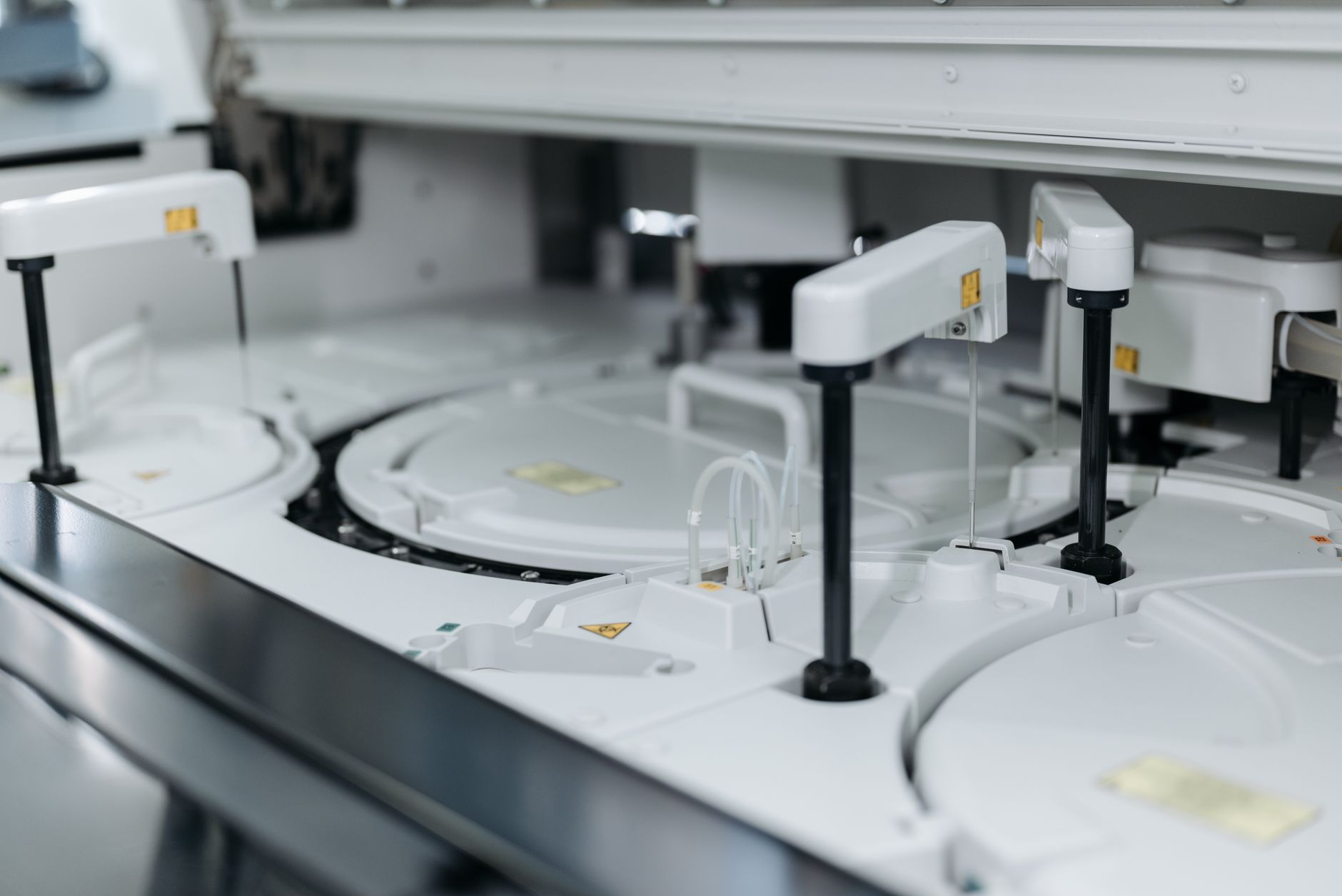
“We’re in the very early innings of using AI to automate the execution of lab work, an area that has the potential to bring about meaningful acceleration in so many different processes,” Kauderer-Abrams said.
Novo Nordisk agreed to test Claude Science two days before the lab was announced. Genentech and Bristol Myers Squibb were already Anthropic customers. Both are pharmaceutical companies whose business is developing medicines and bringing them to market; Anthropic sold them models and tools.
“We’re not competing with pharma and biotech companies that make their business in bringing drugs to market,” Kauderer-Abrams said.
Dario Amodei stated the claim in one sentence. “I believe that AI could cure most major diseases in the next 5–10 years.”
Kauderer-Abrams placed the same horizon at the center of the company’s purpose. “The mission of the company is to develop powerful AI in such a way that benefits the world. By far, we see the biggest opportunity for that in the life sciences, and that is motivating everything that we’re doing.”