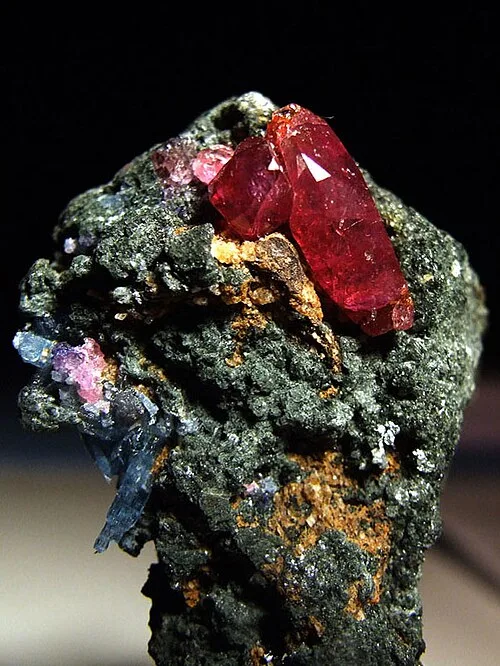
Occurrence and mining
Historically, rubies have been mined in Thailand, in the Pailin and Samlout District of Cambodia, as well as in Afghanistan, Australia, Brazil, Colombia, India, Namibia, Japan, and Scotland. After the Second World War, ruby deposits were found in Madagascar, Mozambique, Nepal, Pakistan, Tajikistan, Tanzania, and Vietnam. It occurs in association with pargasite, zoisite, calcite, phlogopite, painite, sapphire, pyrite and fuchsite.
The Montepuez ruby mine in northeastern Mozambique is situated on one of the most significant ruby deposits in the world, although, rubies were only discovered here for the first time in 2009. In less than a decade, Mozambique has become the world's most productive source for gem-quality ruby. In 2025, its production capacity is expected to increase from 200 to 600 tons per hour. · Currently, Mozambique rubies are some of the most sought-after in the world, rivalling even the famous Burmese Rubies. In 2022, the mine reportedly produced approximately 10 million carats of rubies, making it one of the most prolific and consistent sources of high-quality rubies today.
The Republic of North Macedonia is the only country in mainland Europe to have naturally occurring rubies. They can mainly be found around the city of Prilep. Macedonian rubies have a unique raspberry color.
A few rubies have been found in the U.S. states of Montana, North Carolina, South Carolina and Wyoming.
Spinel, another red gemstone, is sometimes found along with rubies in the same gem gravel or marble. Red spinels may be mistaken for rubies by those lacking experience with gems. However, the finest red spinels, now heavily sought, can have values approaching all but the finest examples of ruby.
The Mogok Valley in Upper Myanmar (Burma) was for centuries the world's main source for rubies. That region has produced some exceptional rubies; however, in recent years few good rubies have been found. In central Myanmar, the area of Mong Hsu began producing rubies during the 1990s and rapidly became the world's main ruby mining area. The most recently found ruby deposit in Myanmar is in Namya (Namyazeik) located in the northern state of Kachin.
In Azad Jammu and Kashmir, there are vast proven reserves of millions of rubies, worth up to half a billion dollars. However, as of 2017 there was only one mine (at Chitta Katha) due to lack of investment. In Afghanistan, rubies are mined at Jegdalek. In 2017 the Aappaluttoq mine in Greenland began running. However, operations at the Greenland ruby mine have been suspended due to poor production. Most rubies mined from Greenland were heavily fractured and had to be heated with Borax powder.
The rubies in Greenland are said to be among the oldest in the world at approximately 3 billion years old. The Aappaluttoq mine in Greenland is located 160 kilometers south of Nuuk, the capital of Greenland. The rubies are traceable from mine to market.