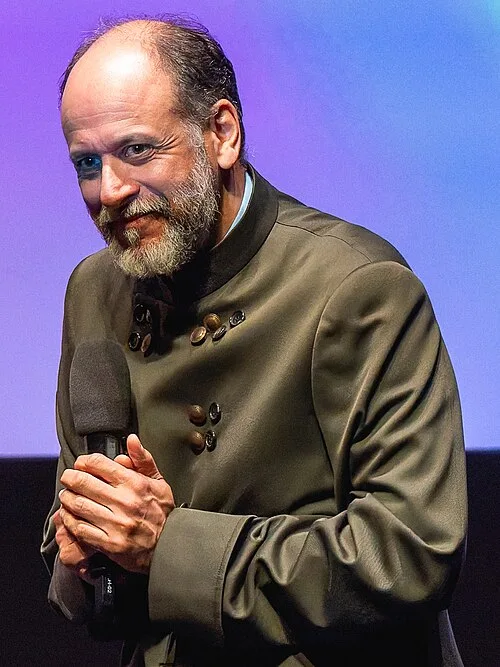
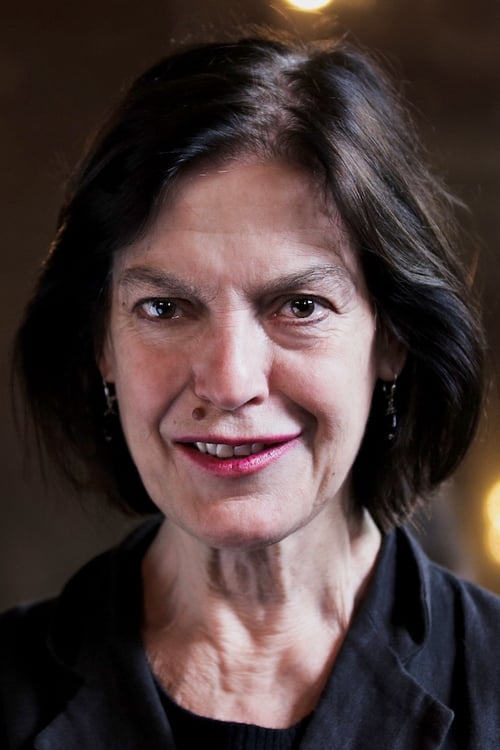
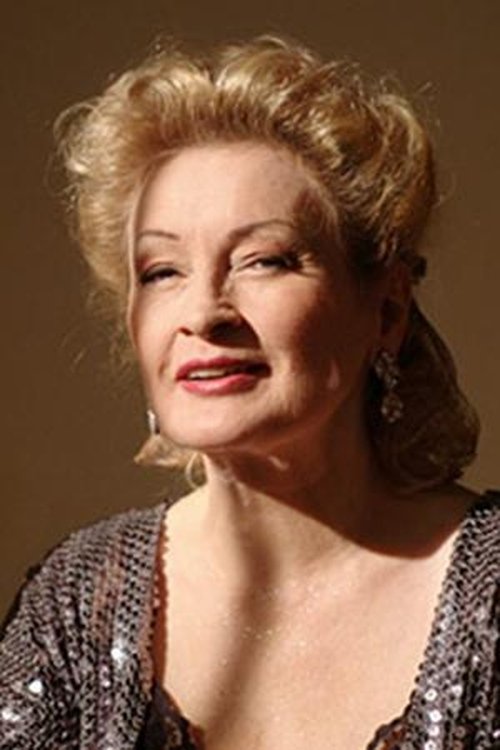
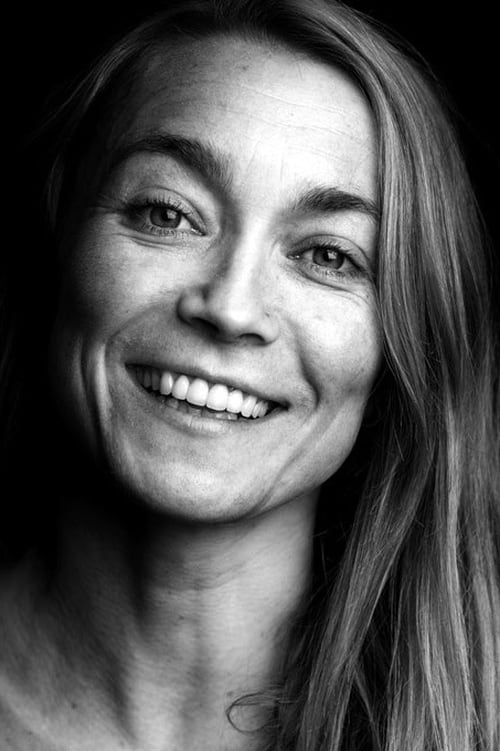
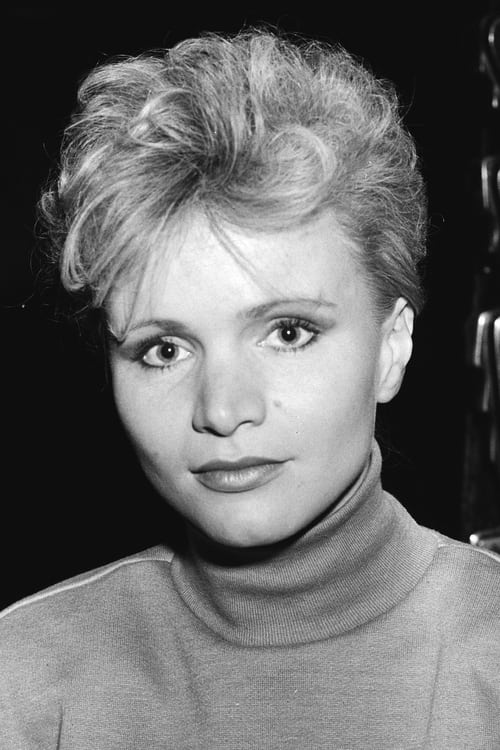
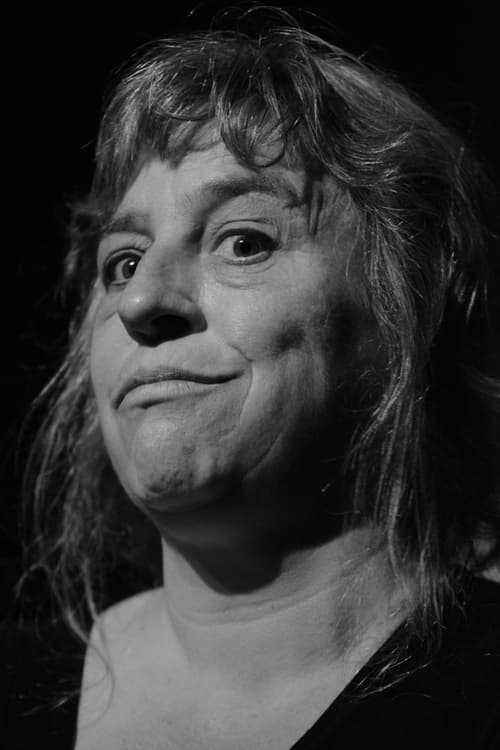
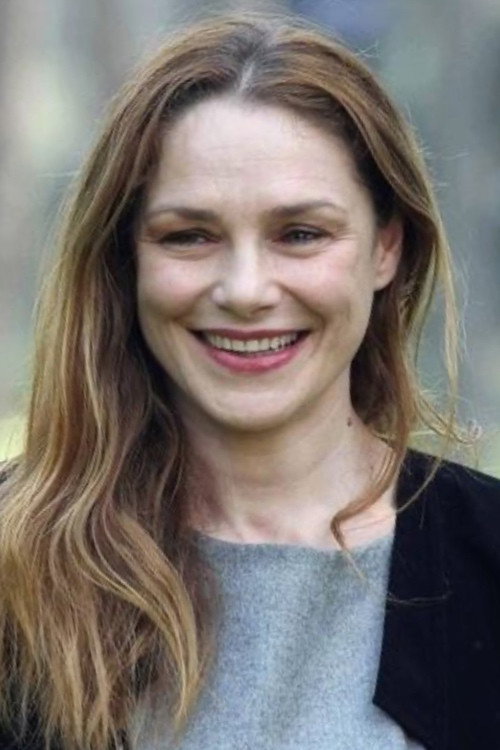
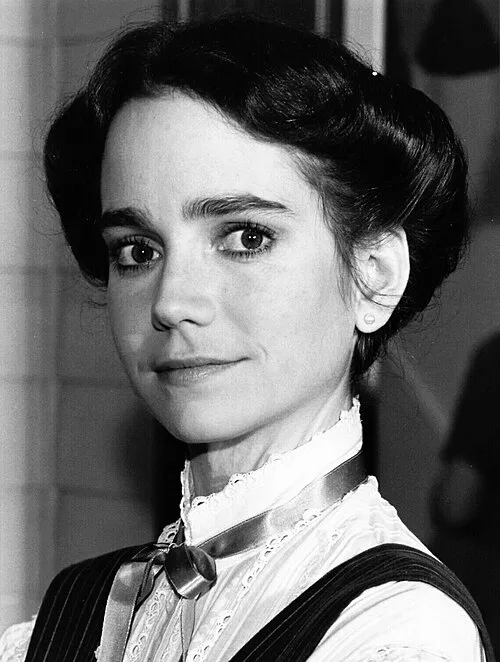
Suspiria is a 2018 supernatural horror film directed by Luca Guadagnino from a screenplay by David Kajganich, inspired by Dario Argento's 1977 Italian film of the same name. It stars Dakota Johnson as an American woman who enrolls at a prestigious dance academy in Berlin run by a coven of witches. Tilda Swinton co-stars in three roles, as the company's lead choreographer, as a male psychotherapist involved in the academy, and as the leader of the coven. Mia Goth, Elena Fokina and Chloë Grace Moretz appear in supporting roles as students, while Angela Winkler, Ingrid Caven, Sylvie Testud, Renée Soutendijk and Christine LeBoutte portray some of the academy's matrons. Jessica Harper, star of the original film, has a cameo appearance.
A remake of Suspiria was first announced in 2008 after Guadagnino had acquired the rights from the original film's writers, Argento and Daria Nicolodi. In September 2015, Guadagnino confirmed his plans to direct, describing his version as an "homage" to the original rather than a straightforward remake. A new screenplay was drafted by Kajganich, who had written Guadagnino's A Bigger Splash the year before. Kajganich set the film during the so-called "German Autumn" of 1977 to explore themes of generational guilt in that country during the Cold War. The film's other themes include motherhood, evil and the dynamics of matriarchies.
Unlike the original film, which used exaggerated colors, Guadagnino conceived the visuals in Suspiria as "winterish" and bleak, absent of primary colors. The film incorporates stylized dance sequences choreographed by Damien Jalet, which form part of its representation of witchcraft. Principal photography took place in late 2016 and early 2017 in Varese, Italy, and in Berlin. The musical score was composed by Radiohead singer Thom Yorke, who took inspiration from krautrock. The film is dedicated to the memories of Vogue Italia editor-in-chief Franca Sozzani, film director Jonathan Demme and Deborah Falzone.
Suspiria premiered at the 75th Venice International Film Festival on September 1, 2018. It was given a limited release by Amazon Studios in Los Angeles and New York on October 26, 2018, where it grossed over $180,000 in its opening weekend, marking the highest screen-average box-office launch of the year. It was screened on October 31 in some US cities before opening in wide release on November 2, 2018. It was released in Italy on January 1, 2019.
The film was a box-office bomb and critical response was polarized; some praised the film for its visual elements and performances, while others criticized its historical-political setting as arbitrary in relation to its other themes.
Contents
Plot
During the German Autumn of 1977, Susie Bannion, an American from a Mennonite family in Ohio, is admitted at the Markos Dance Academy in West Berlin. The academy is reeling from the disappearance of a student, Patricia Hingle, who vanished after telling her psychotherapist, Josef Klemperer, that the academy is controlled by a coven of witches. Journals left by Patricia in Klemperer's office detail The Three Mothers, a trio of witches who predate Christianity: Mater Suspiriorum, Mater Tenebrarum and Mater Lachrymarum. Klemperer, initially dismissive of Patricia's claims, becomes suspicious of the academy after her disappearance.
During rehearsal, a Soviet student, Olga, becomes indignant towards Madame Blanc and storms out of the studio. Olga attempts to escape with her belongings but finds herself trapped alone in a room lined with mirrors. Blanc, meanwhile, resumes the rehearsal, during which Susie performs an aggressive dance; her movements begin physically afflicting Olga, ravaging her body and damaging her organs and bones. Several of the academy's matrons drag Olga's mangled body away with large hooks. Later, the matrons hold an informal election for who is to serve as the coven's new leader. The vote is between Madame Blanc and Mother Markos, an aged and grossly disfigured witch who has long controlled the coven, and for whom the academy is named; Markos wins the popular vote. Afterwards, Miss Griffith, the most sheepish of the matrons, kills herself.
Susie befriends her classmate Sara. While investigating the disappearances of Olga and Patricia, the two realize the academy has washed all traces of them. Susie quickly climbs the ranks as Blanc's protégée, then is appointed the lead of the academy's upcoming piece, Volk. Meanwhile, Sara grows suspicious of the matrons after a meeting with Klemperer and uncovers clandestine hallways in the building where she discovers esoteric relics. Klemperer attends the performance. Immediately prior, Sara explores a passageway leading into the catacombs where she finds a heavily withering Patricia. Sara runs away but the matrons manifest holes in the floor, causing her to fall and fracture her leg. Sara emerges midway through the performance, dancing her part in a hypnotic trance, but collapses in pain before the dance ends. Blanc subsequently chastises Susie for intervening in the matrons' efforts to manipulate Sara's body.
The next day, Susie attends a celebratory dinner with the matrons. Meanwhile, Klemperer encounters Anke, his presumed-deceased wife, at his dacha in East Germany. She tells him she faked her death after fleeing the Nazis and started a new life in England. They walk together, passing through a security checkpoint into West Berlin without being noticed. Klemperer realizes the two have arrived at the Markos Academy; before his eyes, he realizes Anke is, in fact, Miss Huller, one of the matrons, and that he has been lured there to bear witness to an impending witches' sabbath.
Analysis and themes
Motherhood
The theme of motherhood is explored frequently in the film, both within the coven and in Susie's early life and relationship to her own mother. Michael Leader of Sight & Sound considers the film "an extended exercise in metafictional annotation that insists on dragging the original's darkest metaphors into the light."
Michael O'Sullivan of The Washington Post links the film's theme of motherhood (characterized alongside its "discontents" as being "chewed on like a vulture tearing at a carrion") with ethnic nationalism, though he states that "neither subtext goes much of anywhere". Julie Bloom echoed similar sentiments in The New York Times, writing that while the film "revels in gore and gruesome displays of horror... it also delves into the dynamics of a wholly female community, touching on issues of power, manipulation, motherhood and the horrible things some women can do to other women and themselves."
Matt Goldberg of Collider interprets a perfidious form of motherhood as a core theme of the film, as he notes the matrons merely pretend "to be motherly towards the students, [but] they're actually just using them for their power." Madame Blanc's near-decapitation at the hands of Mother Markos when she is resistant to beginning the sabbath demonstrates that Blanc and Markos "do not share the same values", and that Blanc has formed a genuine kinship with Susie. Hannah Ewens of Vice notes: "With coven power transferred to Susie, it's impossible to say where her talent ends and the influence of the mothers begins. Mothers aren't supposed to have favorites, but deep down they often do—and Madame Blanc's is Susie from the moment of her audition."
Abuse of power and national guilt
For the majority of the film, Susie appears to be an otherwise normal woman who finds her natural talents rewarded and prized by the coven. As the film progresses into its final act, however, it is revealed that Susie is in fact Mother Suspiriorum, one of the Three Mothers whom the coven exalts. Film Crit Hulk, a pseudonymous writer for The New York Observer, interprets Susie's character arc as the discovery of her shadow self: "Initially she seems just a fresh-faced girl from Ohio, eager to make strides into this esteemed dance company. But her shadow self is soon awoken, which we are meant to fear. Susie unleashes her libido as the rapturous demon below claws at the floor. She turns deeply sexual, almost becoming carnal as she writhes to the ground." Similarly to Goldberg, they interpret Susie's unveiling of herself as Mother Suspiriorium to be messianic in nature, as she eradicates the corrupted Mother Markos and the loyal followers who idolize her. Goldberg reads Susie's destruction of Markos and her followers as retribution for their abuse of power:
Guadagnino is repeatedly hitting on a world where power has been abused, and those who feel no guilt or shame are running rampant. We see it in Klemperer's history as a Holocaust survivor; we see it in the current events that pop up in the news during the movie; and we see it inside the coven where the older women who are supposed to be teaching and helping the students are instead preying on them. The movie isn't saying that powerful women are bad; it's saying that anyone who abuses their power to their own ends rather than serving others is perverting that power.
While Susie/Mother Suspiriorum shows no mercy for Markos and her followers, Goldberg asserts that she is capable of compassion, citing the fact that she grants the physically devastated Sara, Olga, and Patricia "the sweet release of a gentle death rather than obliterating them." Goldberg extends this interpretation to Susie/Mother Suspiriorum's visit to Klemperer in the epilogue, during which she relates his lost wife's death in a concentration camp, information he had not previously known. Goldberg reads the sequence as an emphasis that "women bonding together have the power to remove the fear of death, and that while the world—especially the powerful—need 'guilt' and 'shame,' Klemperer should not feel those things because he has not abused his power. He's the "witness" and from the perspective of witnessing an authoritarian rise to power—in his case, Nazi Germany—he is responsible for watching and doing nothing. However, it's people in power who need guilt and shame."
Production
Development
A remake of Suspiria (1977) was announced in 2008 by director David Gordon Green, who had co-written a script with his sound designer. In 2007, Luca Guadagnino had convinced the original film's creators Dario Argento and Daria Nicolodi to allow him to option a remake of the film. Guadagnino subsequently offered the project to Green, who cast Isabelle Huppert, Janet McTeer, and Isabelle Fuhrman. Green described his screenplay as "operatic", adding, "I love Argento's film and we wrote a very faithful, extremely elegant opera ... I don't mean musical opera, but it would be incredibly heightened music, and heightened and very operatic and elegant sets." According to Green, financing conflicts resulted in the project being scrapped.
In September 2015, at the 72nd Venice Film Festival, Guadagnino announced plans to direct a "remake" of Suspiria with the four main actors of his film A Bigger Splash, which had premiered at the festival. Guadagnino revealed that his version was to be set in Berlin circa 1977, and would have as its main theme "the uncompromising force of motherhood". Guadagnino has since said explicitly that the film is not a remake, but is instead a "homage" to the "powerful emotion" he felt when he first watched the original film:I was so terrified, but as always with something that terrifies you, I was completely pulled in. I think the process of how that movie influenced my psyche probably has yet to stop, which is something that happens often when you bump into a serious work of art like Suspiria. I think the movie I made, in a way, [represents] some of the layers of [my] upbringing, watching the movie for the first time and thinking of it and being obsessed by it.Guadagnino said in 2018 that he felt Suspiria was his most personal film to date. The film was a co-production between the United States and Italy.
Screenplay
The screenplay was written by American writer David Kajganich, who had previously written Guadagnino's A Bigger Splash. Though Kajganich admitted to not being a fan of the original film, he agreed to write a screenplay for Guadagnino. On writing the film, Kajganich stated: Horror often loses me when it starts to no longer regard real people in a real world. And so, I said to Luca when he asked me would I ever be interested in joining him in this, I did say 'I will take quite a practical approach if you're okay with that. I would want to know how something like this could happen, how it would work, what the hierarchy of the coven would be, you know, all of those practical questions that normally aren't maybe of interest to a typical horror film, whatever that is,' and he was all for it. And so, I did quite a lot of research and to actual witchcraft and covens and we did quite a lot of research into the period that it's set in, what was going on in feminist politics and feminist art then, and how were concerns being exploited from the inside out and how that might look inside of the context of the occult. And so, you know, we did try to ground it and how real people in these fantastical situations might behave.
Kajganich chose to set the film in Berlin in 1977—the year the original film was released—during the series of terrorist events known as the "German Autumn". The film begins shortly after the hijacking of Lufthansa Flight 181, in order to hint at "larger thematic concerns", specifically the response of the youth of the era to the denial by their parents' and grandparents' generations of German culpability in World War II. Kajganich used the political tumult of the time as a means of contextualizing the central plot surrounding the Markos dance academy, "where an American is getting her education in a way in how a modern kind of fascism might look." For inspiration, Kajganich studied women's literature of the period, as well as the films of German contemporary filmmaker Rainer Werner Fassbinder, and "listened to a lot of [German singer] Nico".
Guadagnino was mostly interested in the witchcraft and solidarity among women aspects of Kajganich's script, themes which he said have been "perverted by the official history and the official religions as making a bargain with the devil. The witchcraft that I'm interested in also has a lot to do with what, psychoanalytically, is called the concept of the terrible mother, which you can see also in some religions, particularly in the Kali goddess." Retaining the dance academy locale, Kajganich proposed that the witches would transmit their spells via movement: "It makes total sense why a coven would hide in a dance company, because they could wield their influence in public ways, without the public realizing." Kajganich pitched this concept to Guadagnino early on, and shaped the screenplay using dance as a narrative through-line. Guadagnino was also enthusiastic in response to Kajganich's setting of the film, remarking: "Dario's movie was a sort of self-contained box of fleshy delicacies, which was not in relationship with the moment it was made. It was too much of an opportunity for me and David to actually say, 'It's 1977 – deal with it, let's make it the center of the story.'"
Casting
On November 23, 2015, Guadagnino confirmed that Tilda Swinton and Dakota Johnson had been cast in the film and that shooting was scheduled to begin in August 2016, with release set for 2017. Johnson was asked to play the part of Susie Bannion while filming Guadagnino's A Bigger Splash. After watching the original film, Johnson agreed to commit to the project. "I was obviously really invested—really invested in Luca as a person, collaborator, artist", Johnson said. "You just want to go on any adventure with him."
Swinton, a friend and frequent collaborator of Guadagnino who had also co-starred in A Bigger Splash, was cast in three roles: Madame Blanc, the lead choreographer of the academy; Helena Markos, its decrepit matron; and Dr. Josef Klemperer, a psychologist who becomes embroiled in the coven. In the part of Klemperer, Swinton is credited as "Lutz Ebersdorf". Swinton stated that she modeled her portrayal of Madame Blanc after Martha Graham and Pina Bausch, who she felt embodied "the shape Madame Blanc cuts — her silhouette, her barefoot rootedness, the precise choreography of her relationship with cigarette after cigarette."
In October 2016, Chloë Grace Moretz was cast as Patricia Hingle, a student who goes missing from the academy, while Mia Goth was cast as Sara, another one of the academy's dancers. Moretz commented on her participation in the film: "It's unlike any other directing process I have ever been a part of... Luca is Luca and there's kind of no mistaking it for anything else. He'll let you do the craziest stuff on screen and won't bat an eye, he'll tell you to go farther."
Also cast were European actresses Sylvie Testud, Angela Winkler, Fabrizia Sacchi, and Renée Soutendijk, each as matrons of the academy. Fashion models Małgosia Bela and Alek Wek appear in their feature film debuts as Susie's mother and another of the academy matrons, respectively. Jessica Harper, who played Suzy Bannion in the original film, also joined the cast as Anke Meier, the wife of Klemperer who disappeared during the Nazi invasion. Harper was asked to appear in the cameo by Guadaganino, but under the provision that she would be able to perform in German. To prepare, she took German classes at a Berlitz school.
The role of Dr. Josef Klemperer is portrayed by Swinton, although it is credited as played by an actor named Lutz Ebersdorf in the film and its promotional material, and the filmmakers maintained that Ebersdorf was a real psychoanalyst until a month after the film's premiere.
Filming
While some filming took place at the Palazzo Estense in December 2016, the central shooting location was the Grand Hotel Campo Dei Fiori in Varese, Italy, which served as the Markos Dance Academy. In the film, the hotel appears to be positioned in West Berlin along the Berlin Wall, but the actual location of the building is on a remote mountaintop overlooking Varese.
Inbal Weinberg, the film's production designer, commented: "When we arrived in Italy, we went to scout for alternative places, because this was logistically going to be almost a nightmare... the hotel had so much going for it." Weinberg dressed the Grand Hotel Campo dei Fiori's interiors with dressings and furniture from various decades to give it an "intentionally out-of-time feeling." German Bauhaus geometric designs were used for certain interiors, such as the carpets of Madame Blanc's apartment, while Modernist architecture served as a constant reference point. The Frankfurt kitchen, a mass-produced fitted kitchen introduced in 1926, was the basis for the matrons' kitchen design, as well as the Sonneveld House in Rotterdam. In designing the dancers' dormitories, Weinberg dressed them with posters from contemporaneous underground bands, and "plasticky" furnishings from the 1970s. Costume designer Giulia Piersanti selected vintage clothing from the period that was "colorful, but not necessarily bright." Many of the costumes in the film were purchased from a used clothing warehouse in Prato, Italy.
For the film's climactic sabbath scene, the production used a loggia in the hotel, filling in its arches which were then meticulously covered with braided hair. "It was Luca's idea to use hair", said Weinberg. "We conceptually decided that the texture of the wall is the hair of victims." The process of weaving the artificial hair took the design crew weeks to complete.
Principal photography began at the Grand Hotel Campo dei Fiori in Varese on October 31, 2016, with a production budget of $20 million. The shoot lasted approximately two months, concluding in December 2016, while the remainder of principal photography was finished in early 2017, concluding in Berlin on March 10, 2017. Approximately two weeks were spent in Berlin, during which filming of the street and U-Bahn sequences took place, as well as those occurring at the police station, which was shot in an abandoned office building in Mitte. The scenes of Klemperer at his dacha were shot in suburban Berlin.
Special effects
Makeup artist Mark Coulier served as the film's makeup effects coordinator. The bulk of the special effects featured in the film were achieved via practical methods. According to Coulier, the death sequence of Olga, and the final sabbath scene were the most demanding in regard to special effects. For the former, a prosthetic arm, leg, broken ribs, and a protruding dental cast were created for actress Elena Fokina (Olga), allowing her to appear as though the bones in her limbs, abdomen, and jaw were being crushed and broken. Fokina, a professional dancer and contortionist, achieved the majority of the contortions herself, while her actual arm and leg were removed from the footage in post-production via digital processing. In conceiving Olga's broken arm, Coulier was inspired by a stunt performed by Ronny Cox in Deliverance (1972), in which he dislocated his own shoulder in the film.
The witches' sabbath that serves as the climax of the film was technically complicated due to Swinton's portrayal of three roles, each of which required their own unique and extensive makeup effects, as well as full-body prosthetics. Additional prosthetics were created to achieve the disfigured appearance of Patricia, as well as the disembowellment of Sara. "We had so many other makeup effects and full-body prosthetics going on", Coulier recalled. "We had Chloë Moretz in her dead-Patricia makeup, we had the intestines being pulled out, we had all sorts of stuff. It was a big challenge, and we had about 20 people on set, all applying makeups for that long sequence." The wound which Susie tears open on her chest in the climax was also achieved with prosthetics, though it was digitally enhanced in post-production.
Choreography
Unlike the original film, which, though set at a ballet academy, featured very little on-screen dancing, Guadagnino's Suspiria uses dance as a key plot device. Congruous to the period in which it is set, contemporary dance was a central influence on the dance style depicted in the film. Kajganich commented that German expressionist dancers Mary Wigman and Pina Bausch were specific influences on his conceptualization of the dance routines. While writing the screenplay, Kajganich shadowed choreographer and dancer Sasha Waltz to gain further insight into the technicalities of the profession. The work of Isadora Duncan was also an influence.
Damien Jalet choreographed the elaborate dance sequences in the film. Guadagnino hired him after seeing a live performance of Jalet's Les Médusées (transl. "The Bewitched"), at the Louvre. Incidentally, Jalet had drawn inspiration from Argento's Suspiria when choreographing Les Médusées. Jalet subsequently used Les Médusées as the basis for the film's six-minute climactic dance sequence called "Volk". For the last sabbath scene, Jalet said: "We wanted to go from something pretty technical, mathematical, with a certain sense of elegance to something where the body becomes wilder and more and more distorted", Jalet commented. "The scene described something very chaotic, but I felt we needed to create something still very ritualized." Indonesian dance also served as a reference point for the sequence, which features movements that are "staccato, with harsh stops and starts, and an arm styling that is both intimate—in moments when the dancers hold on to each other—and harshly linear."
Aside from Johnson and Goth, all of the actresses in the on-screen dance scenes were professional dancers. Johnson trained extensively in the year leading up to the shoot to achieve the body type and technique of a dancer, spending two hours each day training at a dance studio in Vancouver while filming Fifty Shades Freed (2018). She trained in various forms of dance ranging from ballet to contemporary dance, as her character is that of a formally untrained, yet broadly proficient, dancer. Johnson also studied the work of Wigman, and listened to various musical acts of the 1970s, such as The Carpenters, Jefferson Airplane, and Nina Simone, artists she felt would have informed her character's instinctive movements. In the early autumn of 2016, roughly two months before the shoot began, both Johnson and Goth began rehearsing the film's choreography on location in Varese for six to eight hours per day.
Music
Radiohead singer Thom Yorke composed the score, his first feature film soundtrack. It features the London Contemporary Orchestra and Yorke's son Noah on drums. He initially refused the offer, but accepted after months of requests from Guadagnino. Much of the score was completed prior to the film shoot, giving Guadagnino the opportunity to play it on set during filming.
Yorke cited inspiration from the 1982 Blade Runner soundtrack, musique concrète artists such as Pierre Henry, modern electronic artists such as James Holden, and music from the film's 1977 Berlin setting, such as krautrock. He said: "There's a way of repeating in music that can hypnotise. I kept thinking to myself that it's a form of making spells. So when I was working in my studio I was making spells. I know it sounds really stupid, but that's how I was thinking about it." The soundtrack was released on October 26, 2018, by XL Recordings.
Release
In promotion for the film, a scene was screened during a luncheon at the 2018 CinemaCon in Las Vegas, Nevada, in April 2018. It was reported that the footage was so intense it "traumatized" those present. The scene presented was that in which Olga is contorted and mangled via movements made during Susie's improvisational dance. Peter Sciretta of /Film described the scene as "very gruesome and hard to watch. This film will make most people feel uneasy." In May 2018, Videa acquired Italian distribution rights to the film.
Suspiria held its world premiere at the 75th Venice International Film Festival on September 1, 2018. It opened in a limited release in Los Angeles and New York on October 26, 2018. Guadagnino held an exclusive Q&A session during the film's opening weekend in Los Angeles. Limited screenings began on Halloween night in various US cities, including Dallas, Denver, Portland, San Francisco, Seattle, Springfield, and Tempe. The US release expanded to a total of 311 screens on November 2, 2018. It was released in the United Kingdom by Mubi on November 16, 2018. It was released in Italy on January 1, 2019.
Home media
Suspiria was released in the United States on digital platforms on January 15, 2019, and on Blu-ray on January 29, through Lionsgate. The digital and Blu-ray releases include three behind-the-scenes featurettes.
As of July 2019, the film has made $1.1 million in Blu-ray sales.
Reception
Box office
Suspiria grossed a total of $179,806 during its opening weekend playing at the ArcLight Hollywood and Regal Union Square in Los Angeles and New York, respectively. This marked an average of $89,903 per screen, the highest screen-average box office launch of the year. Upon its expansion the following week, the film grossed $964,722 between November 2 and 4, ranking number 19 at the US box office. The film had closed on December 20 after it grossed $5,169,833 internationally, and $2,483,472 in the United States, making for a worldwide gross of $7,653,305. In 2020, Guadagnino said Suspiria had "made absolutely nothing. It was a disaster at the box office."
Critical response
The critical responses to Suspiria were strongly polarized upon its release. Peter Travers of Rolling Stone stressed that "polarizing" served as "too tame a word" to describe the reactions to the film. On review aggregator Rotten Tomatoes, the film has an approval rating of 65% based on 335 reviews, with an average rating of 6.9/10. The website's critical consensus reads: "Suspiria attacks heady themes with garish vigor, offering a viewing experience that's daringly confrontational—and definitely not for everyone." On Metacritic, the film has an average weighted score of 64 out of 100, based on 56 critics, indicating "generally favorable reviews".
Commenting on the horror elements of the film, Andrew Whalen of Newsweek deemed it "a powerful and dread-inducing experience even before it reveals itself to be not just an arthouse exploration of a horror aesthetic." He also compared the body horror in the film to that of the works of David Cronenberg. Like Whalen, Kristen Kim of The Nation observed similar elements, and wrote that it took "the body horror of the original to an unsightly new level. If the blood runs pretty in the old Suspiria, it's urine here that trickles down the legs of a painfully contorted ballerina." Writing in Variety, Owen Gleiberman compared certain visual elements of the film to The Exorcist (1973) and summarized it as a "gory but imperiously lofty matriarchal horror film", though he noted that the film would have benefited from more shocks. The Boston Globe's Ty Burr described the film's finale as "Lovecraftian" but concluded that what it "mostly leaves behind is an acrid taste of having experienced something stylish but unfulfilling."
The Los Angeles Times's Justin Chang felt that the reimagining of witchcraft is "boldly absurd" and concluded: "By the time the phantasmagorical finale arrives, you are flooded with blood and viscera, yes, but also something even more unsettling — a sudden onrush of feeling, a deep, overpowering melancholy. It's the most startling of the movie's transfigurations, and it returns us to the primordial theme of motherhood." Anthony Lane of The New Yorker wrote a favorable review of the film, concluding: "The first time I saw Guadagnino's Suspiria, I came out pretty much covered in gore, and confounded by the surfeit of stories. Can a splash be so big that it drowns the senses? How does such a film cohere? The second time around, I followed the flow, and found that what it led to was not terror, or disgust, but an unexpected sadness." David Ehrlich, who gave the film an A−, commented in IndieWire that "Suspiria is a film of rare and unfettered madness, and it leaves behind a scalding message that's written in pain and blood: The future will be a nightmare if we can't take responsibility for the past." Slant Magazine's Greg Cwik praised the cinematography, but expressed disappointment for what he felt was a lack of cohesion: "Suspiria is a largely befuddling accumulation of shots and sounds that never coalesce."
Lawsuit
On September 27, 2018, it was reported that the film's American distributor, Amazon Studios, was being sued for copyright infringement by the estate of artist Ana Mendieta. The suit, filed in a federal court in Seattle, Washington, alleged that two images present in the film's teaser trailer were plagiarized from Mendieta's work. The first is an image of a woman's hands bound with rope on a white table, allegedly derived from Mendieta's Untitled (Rape Scene), and the other is the red silhouette of a body imprinted on a bedsheet, which was claimed to have been derived from her Silueta series.
A cease-and-desist letter had been delivered to Amazon in July over the images, and they were not included in the subsequent theatrical trailer released the following month. According to the suit, both images had been excised from the film, but an alleged eight others bore notable similarities to other works by Mendieta. On October 24, 2018, two days before the film's US release, it was reported that Amazon Studios and the Mendieta estate had reached an undisclosed settlement.
Proposed sequel
Suspiria had the working title of Suspiria: Part One, with Guadagnino and Kajganich conceiving it as the first half of a bigger story. They planned Part Two to explore the origins of Madame Blanc and Helena Markos and the future of Susie Bannion. The subtitle was dropped so that Suspiria would be thought of as a standalone work.
Guadagnino said he would be interested in developing Part Two if the film were a commercial success. He expressed interest in making a prequel about Markos, set hundreds of years before the first film, saying, "I have this image in my mind of Helena Markos in solitude in the year 1212 in Scotland or in Spain. Wandering through a village and trying to find a way on how she can manipulate the women of the village. I know she was there. I know it was six to seven hundred years before the actual storyline of this film."
In 2020, Guadagnino said a sequel was impossible, as Suspiria had been "a disaster at the box office".