USS Abraham Lincoln Returns After Extended Deployment
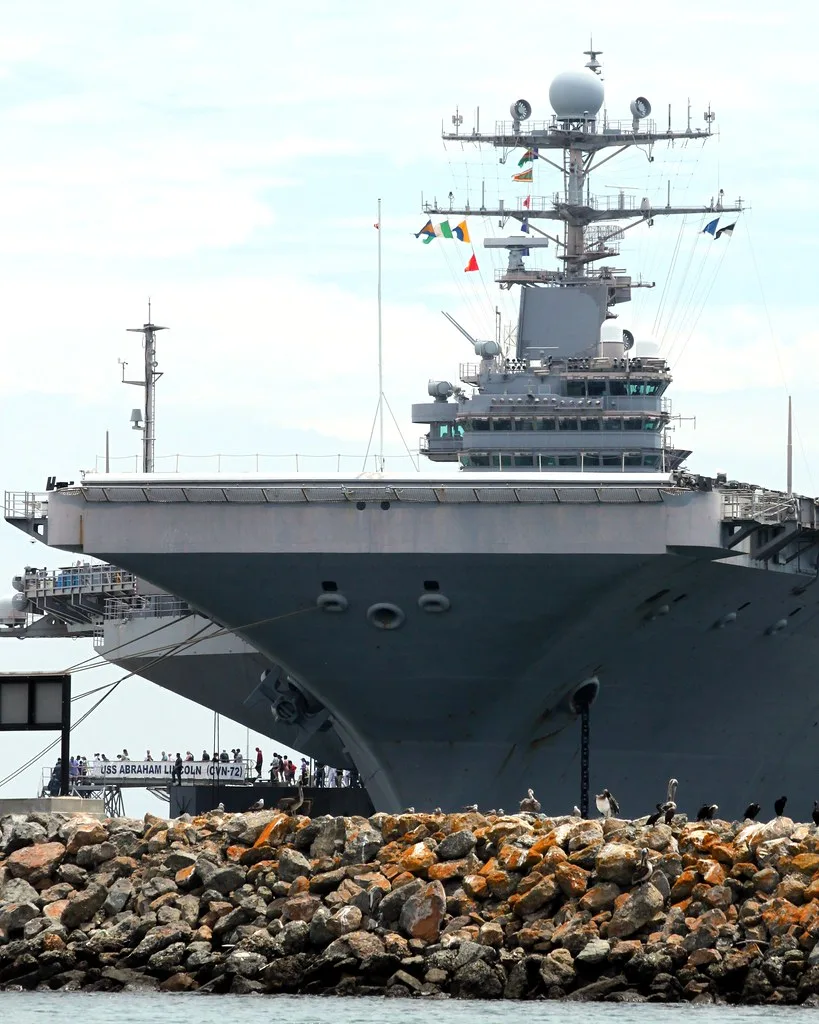
Pvt. Grayden Monroe, nineteen, and his mother reached the naval base by 4 a.m., the sky still pitch black, and took the metal bleachers overlooking the dark water before any other military family had arrived. They were the first. In the hours before the carrier docked, the pier filled with people who had waited through the longest stretch most of the crew had ever spent away from home.
Sailors in dress whites manned the rails as the USS Abraham Lincoln entered San Diego Bay. On a live feed from the ship, some skipped and held hands rushing to their positions. Homecoming, he said, felt like “a combination of the day before Christmas and the last day of school.” Families lined the waterfront waving American flags. The Nimitz-class carrier, fifth of her class and flagship of Carrier Strike Group 3, had left this same harbor on November 21, 2025. On October 8, 2026, the arc closed at 321 days. The ship moved through the bay toward Naval Air Station North Island, where the first of the waiting families already held their places on the pier.

Sixty-four parents were set to leave the ship first, each of them meeting a baby born during the deployment. Sailor Brent Ledbetter had watched his son grow in videos and photographs sent by his wife, an air traffic control officer who had also been assigned to the Lincoln until pregnancy took her off duty. “I just want to hold him, play with him,” Ledbetter said. On the pier, Carla Smith waited with another mother. Her own son, a Lincoln sailor, had come ashore two weeks earlier with the ship’s security. “They are all heroes,” she said.
The Abraham Lincoln spent 286 consecutive days at sea without a port call, a modern-day Navy record. What those days had been for was still painted on the ship as it closed on the pier. A mural like this is rare in the armed services. He estimated the last time service members undertook a similar project was back in the 1940s. “Over on the far right, you can see all the submarines that were sunk by the strike group,” Forsythe said, “and then down below, we’re still working on it, but that’s going to represent every bomb that was dropped on an air surface target.” Isabella Norfleet, a crewmember, said, “We try to make our impact on the boat, make it last, make the morale better.”
It flew 3,693 combat sorties, each one a single combat mission by an aircraft. It delivered 1.37 million pounds of ordnance. It launched 450 Tomahawk cruise missiles, long-range ship-fired weapons that steer themselves to distant targets. It shot down 77 one-way attack drones, unmanned aircraft built to hit a target and not come back. It sank 64 Iranian warships and vessels. It destroyed 21 anti-ship cruise missiles.

Operation Epic Fury began on February 28, 2026, after the strike group’s redirect into the fight, and ran for 40 days of major combat. Across the full deployment the embarked Carrier Air Wing completed 14,037 aircraft sorties and logged 31,460 forward-deployed flight hours. Those flights consumed 20.5 million gallons of aviation fuel.
On October 7, Defense Secretary Pete Hegseth flew out to the ship to present the Presidential Unit Citation, the highest award a U.S. military unit can receive for extraordinary heroism in action, and to address the crew. Rear Adm. Robert Loughran, commander of Carrier Strike Group 3, spoke pier-side of the families who had underwritten it. “They bore an extraordinary burden during these 10 months. Their patience, sacrifice, steadfast support were the foundation of every mission we accomplished.”

The strain on Carrier Strike Group 3 was accounted for by Acting Navy Secretary Hung Cao in responses submitted to Congress. Eight sailors assigned to the strike group had attempted suicide during the deployment. Multiple had tried to jump overboard. There were no suicides. Cao said the men and women of the strike group had demonstrated exceptional resolve under demanding conditions. The Navy said it was loading carriers with more supplies to ensure self-sufficiency if logistics came under stress, adding quality-of-life improvements, and working to keep sailors and Marines better connected with loved ones.
On the transit home, Capt. Dan Keeler had Matthew Brown fly out to the ship. Brown, the CEO and co-founder of Chimney Trail, gave sailors an introductory seminar in cognitive-behavioral therapy, a form of talk therapy that helps people identify patterns of thinking and change them. The seminar prepared them for the return, including how to reconcile the past months with someone who does not understand a deployment. “Every single sailor and Marine that left on this deployment is going home,” Keeler said. “That’s legendary, legendary performance by this team.”
At Naval Air Station North Island, sixty-four parents stepped off first and met their babies for the first time.